
What if a yacht’s comfort matters most after it drops anchor? For a passenger sensitive to motion, booking a yacht with zero speed stabilizers for sensitive passengers can make time at anchor more comfortable, but it cannot promise a motion-free trip. Zero-speed systems are designed to reduce rolling while a yacht is stationary. How the yacht is stabilized underway depends on the vessel and its system.
It is understandable to focus on the stabilizer specification when someone in your group may feel unwell. But the system is only one part of the picture. The yacht’s design and layout, sea conditions, route, and each passenger’s sensitivity all affect how the trip feels.
This guide explains the difference between stabilization at anchor and underway, what zero-speed systems can and cannot do, and how to compare yachts beyond a single technical feature. You will also find practical ways to plan a flexible Greek itinerary around guest needs and changing conditions. YAL’OOU coordinates tailored routes, crews, and onboard experiences to help make comfort part of your charter planning.
Key Takeaways
- Zero-speed stabilization is designed to reduce roll while a yacht is stationary, but it does not guarantee a motion-free experience.
- When booking a yacht with zero speed stabilizers for sensitive passengers, compare the yacht’s verified at-anchor and underway capabilities rather than relying on a headline specification.
- Compare the yacht’s layout and guest spaces alongside its stabilizer technology.
- Plan a Greek route and pace around guest needs, while leaving room to adapt to wind, sea state, and exposure.
- Share motion concerns and rest preferences early so the yacht, crew, and itinerary can be planned with comfort in mind.
What zero-speed stabilizers mean when booking a yacht for sensitive passengers
A luxury charter can still feel challenging for someone sensitive to motion. Even when a yacht is anchored and the surroundings seem calm, a passenger may notice the vessel moving. When booking a yacht with zero speed stabilizers for sensitive passengers, treat stabilization as a feature that may reduce a particular type of movement, not as a guarantee that everyone will feel well.
Concise definition: Zero-speed stabilization is technology designed to reduce a yacht’s rolling motion while the vessel is stationary. It describes capability at anchor, not a promise of motion-free comfort or a measure of performance while underway.
Ship stabilizers use different designs and operating principles. For a general overview of ship stabilizers, including fins and their role in reducing roll, see Wikipedia. For charter planning, the key point is that a feature’s name alone does not explain how it performs on a particular yacht.
How zero-speed stabilization differs from underway stabilization
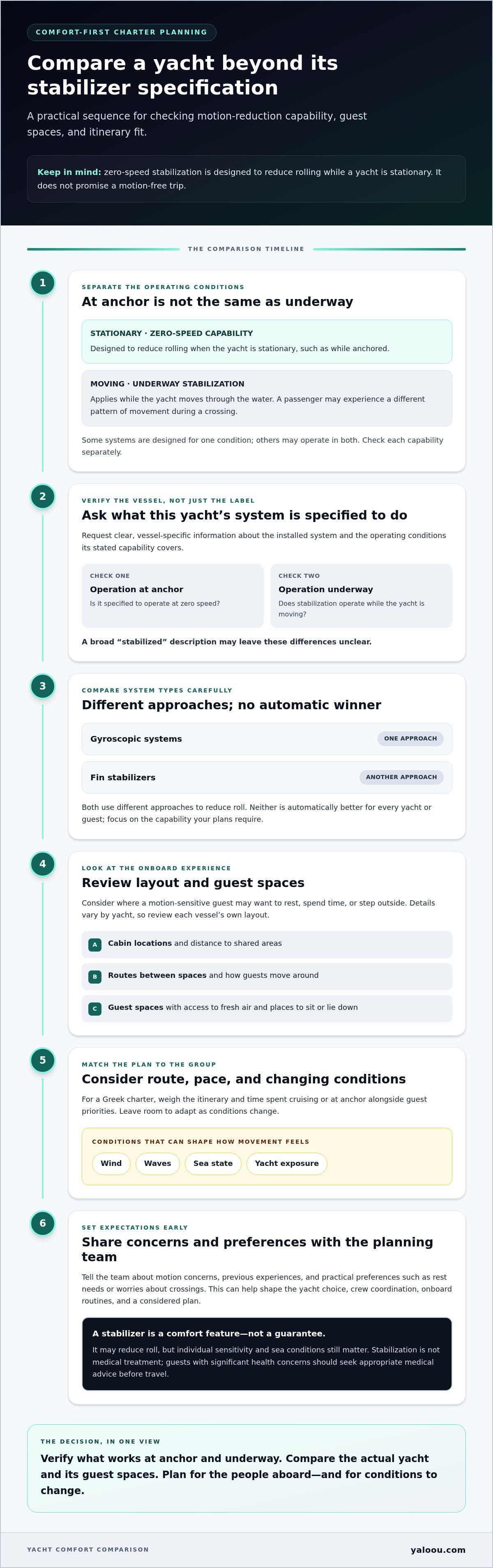
Zero-speed capability refers to operation while the yacht is stationary, such as when anchored. Underway stabilization operates while the yacht moves through the water. Some systems are designed for one condition, while others may operate in both. Capability and performance vary by system and vessel, so compare the yacht’s stated at-anchor and underway operation separately.
This distinction matters when you review a charter plan. A passenger may rest aboard at anchor, then experience a different pattern of movement during a crossing. “Zero-speed” describes the first situation. It does not, by itself, explain how the yacht behaves underway or how much movement a guest will feel. Vessel-specific specifications are more useful than a general label.
Why sensitive passengers need more than a technical specification
People experience motion differently. A system that reduces roll may make conditions feel more comfortable, but an individual’s sensitivity and the sea state still matter. Wind, waves, and the yacht’s exposure can affect how movement is perceived. Consider stabilization alongside the vessel, itinerary, and time spent cruising or at anchor, rather than treating it as a standalone solution.
Stabilization is a comfort feature, not medical treatment. It cannot prevent seasickness or promise a particular outcome. Guests with significant health concerns should seek appropriate medical advice before travel, especially if motion sensitivity has affected them on previous trips. Sharing practical preferences early, such as rest needs or concerns about crossings, also helps shape a considered charter plan.
For a Greek yacht charter, aim to match the yacht’s verified capabilities with the guests and itinerary. A tailored route can account for passenger priorities and leave room to adapt as conditions change. Clear information, careful comparisons, and realistic expectations are the starting points for planning with comfort in mind.
How to compare yacht stabilizers, layouts, and guest comfort
A useful comparison goes beyond whether a yacht is described as “stabilized.” Check how its system is designed to operate, then consider where guests will rest, spend time, and move around. When comparing yacht charter options, review each vessel individually. Similar yacht types do not necessarily have the same equipment or layout.
What to compare in a yacht’s stabilization system
Gyroscopic systems and fin stabilizers use different approaches to reduce roll. Neither is automatically better for every yacht or guest. Focus on the capability that matters for your plans: operation at anchor, underway, or both. Since performance depends on the specific system and vessel, use verified vessel information rather than inferring capability from yacht size or category.
Comparison pointWhat to look forWhy it matters
At-anchor capability
Whether the system is specified to operate at zero speed
Relevant to time spent stationary, including at anchor
Underway system
Whether stabilization operates while the yacht is moving
Separates cruising capability from at-anchor performance
Layout
Cabin locations, shared areas, and routes between spaces
Helps you consider where guests may prefer to rest or spend time
Guest spaces
Practical access to fresh air and comfortable places to sit or lie down
Supports choices that suit individual preferences
Ask for clear, vessel-specific details: what system is installed, and which operating conditions does its stated capability cover? A broad description can leave important differences unclear. Precise information makes it easier to compare yachts based on the conditions your group cares about, rather than on a feature label alone.
Which onboard details can support a more comfortable experience?
Consider the layout from the passenger’s point of view. Cabin position, distance to shared spaces, and access to fresh air may matter to someone who wants to rest or step outside easily. Look at how guests move between areas and whether there are places to sit quietly or lie down. These details vary by yacht, so use each vessel’s own layout and information rather than making assumptions.
The human side of the charter matters, too. Crew coordination and the ability to adapt onboard routines can help the group respond thoughtfully to guest preferences. Share practical needs during planning, such as preferred rest periods or a wish to keep transitions between activities unhurried. These choices can support a considerate experience, but they cannot guarantee that motion-related discomfort will be avoided.
Comfort can also involve more than motion. RINA Comfort Class for yachts addresses design considerations such as noise and vibration, which can provide useful context when comparing the wider onboard environment for sensitive passengers.
Booking a yacht with zero speed stabilizers for sensitive passengers works best as a vessel-by-vessel comparison, combining verified technical information with the guest experience. YAL’OOU coordinates tailored crews, routes, and onboard experiences. Explore charter experiences shaped around your group.
Does a zero-speed yacht suit your group and Greek charter plans?
A yacht with stabilizers may be a priority, but its value depends on how your group plans to spend time aboard. Consider the route, trip pace, and when a motion-sensitive guest is most likely to want comfort: underway, during meals, while resting at anchor, or overnight. A good choice balances the vessel’s verified features with the experience your group wants, rather than treating one feature as the whole decision.
The right balance can differ between a day charter and a longer crewed trip. A day may involve a shorter period aboard, while an overnight itinerary brings more time for rest, meals, and staying at anchor. Neither pattern guarantees a particular comfort level. Stabilization can reduce motion in the conditions it is designed for, but it does not remove all movement in every situation.
When the yacht’s comfort features may matter most
Think through the trip from the passenger’s point of view. Will they want to rest in a cabin, join meals aboard, or relax at anchor? Which parts of the day feel most challenging: movement during a crossing or motion while stationary? These preferences help you weigh comfort features against the group’s pace and priorities. For a broader look at destinations, explore the Greek yacht destinations and consider how the route supports the trip your guests want.
In the Cyclades and across the Aegean Sea, wind, sea state, and route exposure can influence the onboard experience. Conditions vary by date and location, so a destination name alone cannot predict how a particular passage will feel. Build the plan around guest preferences and leave room for the crew to respond as conditions change.
How route flexibility supports passenger comfort
Island-hopping does not have to follow a rigid sequence if the group’s needs or conditions call for a change. A tailored itinerary can account for preferred travel pace, time at anchor, and the balance between cruising and relaxing aboard. Coordinating with the crew can help keep the day responsive, without making a promise about how any passenger will feel.
Think practically about the group’s priorities:
- Choose a pace that gives guests time to rest between activities.
- Discuss whether meals, overnight stays, or time at anchor are especially important.
- Keep the route adaptable instead of treating every planned stop as fixed.
Route planning also includes how guests arrive, depart, and spend time ashore. The Association of Marina Industries offers broader information about the marina industry, useful context when considering the places and facilities that form part of a boating itinerary.
Booking a yacht with zero speed stabilizers for sensitive passengers is ultimately a decision about fit: verified vessel capability, the group’s preferred rhythm, and a route that can be tailored around guest needs. YAL’OOU coordinates crewed charters and Greek island logistics. Explore tailored yacht charter experiences.
A practical booking checklist for a motion-sensitive guest
Good planning starts with clear, practical details. If you are booking a yacht with zero speed stabilizers for sensitive passengers, describe what the guest needs from the trip, then compare the yacht and itinerary as one plan. This gives the charter planner and crew useful context without treating any feature as a guarantee of comfort.
What passenger information helps shape the charter?
Share comfort priorities early, including the preferred pace, how much time the guest wants to spend aboard, and any route or activity preferences. Keep private medical details limited to what is necessary for planning. Questions about health, medication, or travel suitability should go to a qualified professional. Clear preferences can help shape the experience while respecting the guest’s privacy.
How to review the vessel and itinerary together
Compare verified stabilizer capability with the cabin layout and the planned time spent cruising, resting, and at anchor. A vessel profile can help you understand the yacht, but do not infer stabilizer equipment from its name, size, or appearance. For example, the Baglietto 100 yacht profile is a vessel-specific reference. Use its published details only for the features it actually describes.
Review the route with the same care. A flexible island-hopping plan gives the crew room to coordinate adjustments as conditions or guest preferences change. Discuss how the schedule can adapt rather than relying on a fixed sequence of stops regardless of how the day unfolds.
Use this checklist to bring the key decisions together:
- Describe the passenger’s needs. Share motion concerns, preferred pace, rest needs, and priorities for time aboard.
- Compare verified vessel features. Review documented stabilizer operation at anchor and underway, along with the cabin layout and guest spaces.
- Shape the route around the group. Discuss destinations, desired time ashore, and a pace that leaves room for breaks.
- Review the plan with the crew. Align on onboard routines and how the itinerary can adapt if conditions or guest needs call for a change.
YAL’OOU coordinates tailored Greek routes, crews, and guest logistics, bringing vessel details and passenger preferences into charter planning. Share practical concerns early so they can inform the itinerary and onboard experience from the outset.
Explore curated Greek yacht experiences to plan a charter around your group’s priorities.
Plan a Greek yacht charter around comfort, not a promise
A thoughtful charter plan brings three decisions together: verify what the stabilizers are designed to do, choose a vessel that suits the guests, and keep the itinerary adaptable. This makes booking a yacht with zero speed stabilizers for sensitive passengers a comfort-led decision, not a search for a technical feature that promises more than it can deliver.
Set realistic expectations before departure
Stabilizers can reduce roll in the operating conditions they are designed for, but they cannot remove every movement or symptom. A passenger’s experience depends on the vessel, changing conditions, and individual sensitivity. Be candid about those limits while planning. If a guest has significant health concerns or questions about whether travel is appropriate, they should discuss them with a qualified medical professional.
Before settling on a yacht, review its current, vessel-specific information and make sure it describes stabilization capability clearly. Distinguish operation at anchor from operation underway, then weigh both against how the group expects to use the yacht. Consider the whole trip, including time spent cruising, resting aboard, enjoying meals, and visiting islands. No single feature can stand in for that broader fit.
Turn the comfort plan into a memorable charter
A comfort-focused charter does not mean giving up the pleasure of exploring Greece. It means shaping the experience around the people aboard. A group that values unhurried meals and restful time at anchor may prefer a different pace from guests eager to visit several destinations. A tailored route, coordinated crew, and thoughtful onboard logistics help align the plan with those priorities.
Leave room for adjustments. Wind, sea state, and exposure can influence how a passage feels, and conditions vary by date and location. A flexible itinerary lets the crew coordinate a response to the day’s circumstances and the group’s preferences. It can support a more considered experience, though it cannot guarantee a particular comfort outcome.
Before departure, bring the plan together by reviewing:
- Vessel fit: Confirm the current stabilizer details and compare them with the group’s needs.
- Guest priorities: Make sure rest, time aboard, and preferred pace have shaped the plan.
- Route flexibility: Understand how the itinerary can adapt if conditions or guest preferences change.
- Crew coordination: Align onboard experiences and logistics with the agreed priorities.
YAL’OOU coordinates crewed yacht charters, tailored Greek routes, and guest experiences, helping connect vessel choice with the trip your group wants to enjoy. Plan with clear expectations, then leave space for the freedom and discovery of an island charter. Plan a Greek yacht experience with your guests’ comfort in mind.
Make comfort part of the journey from the start
Start by turning a passenger’s comfort priorities into a clear trip brief. Note what helps them feel at ease, which parts of the day concern them, and where they would value flexibility. This gives the planning process a practical focus without expecting technology to control every aspect of how the sea feels.
For booking a yacht with zero speed stabilizers for sensitive passengers, keep the goal realistic: choose a yacht whose verified features suit your plans, then shape the pace and onboard experience around the people travelling. YAL’OOU coordinates daily and weekly crewed charter planning, tailored routes, and guest logistics across the Cyclades and other Greek destinations.
Ready to turn your group’s priorities into a Greek island escape? Explore curated Greek yacht experiences and start planning a charter shaped around your guests. Thoughtful planning can make the trip more considered from the first day to the last.
Frequently Asked Questions
What are zero-speed stabilizers on a yacht?
Zero-speed stabilizers are equipment designed to reduce rolling while a yacht is stationary, for example when anchored for lunch. “Zero speed” describes this stationary operating condition, not how the system performs during a passage. Look for specifications that identify when the system operates and what capability applies to that particular yacht, rather than relying on a general feature label.
Do zero-speed stabilizers prevent seasickness?
No. Stabilizers may reduce rolling, but they cannot guarantee that a passenger will not feel seasick or uncomfortable. Individual response, vessel movement, the route, and conditions all play a part. If a guest has health concerns or questions about travel, they should speak with a qualified medical professional. For planning, share practical comfort preferences and consider how the guest will use the yacht, including where they can rest between activities.
Can yacht stabilizers work while the yacht is anchored?
Some systems are designed to operate while a yacht is stationary, but not every yacht equipped with stabilizers has that capability. Check the specific vessel’s technical information for at-anchor operation and distinguish it from stabilization while moving. If the information describes only underway performance, do not assume the system also operates at anchor. Even when active, stabilization can reduce motion without removing every movement.
Are gyro stabilizers or fin stabilizers better for sensitive passengers?
Neither type is automatically better for every passenger or yacht. Gyro and fin systems use different methods, and performance depends on the equipment and vessel. Compare the particular yacht’s verified operating capability instead of choosing by system name alone. Consider whether the feature addresses the guest’s main concern, such as time spent stationary at anchor or movement during planned passages.
How should I choose a Greek yacht itinerary for a motion-sensitive passenger?
Start with the passenger’s preferred pace, time aboard, and plans for rest and activities ashore. Routes around Athens, Aegina, Poros, Spetses, Mykonos, Paros, Antiparos, Syros, Tinos, Sifnos, Serifos, Milos, Poliaigos, Kimolos, Santorini, Ios, Koufonisia, Amorgos, Crete, Corfu, or Zakinthos can be shaped around group preferences. Conditions vary by date and location, so keep the itinerary adaptable rather than expecting calm seas.
Should I choose a yacht with stabilizers for a day charter or a weekly charter?
Choose based on how your group expects to use the yacht, not simply the charter length. A day trip may center on cruising, swimming, and a meal, while a weekly charter can include overnight stays and more time aboard between destinations. Compare the specific yacht’s stabilization information, layout, and planned activities. Tell the charter planner what the sensitive passenger is comfortable doing and where extra flexibility would help.
What should I tell the charter planner about a sensitive passenger?
Share the guest’s motion concerns, preferred travel pace, rest preferences, and itinerary priorities before vessel and route decisions are settled. For booking a yacht with zero speed stabilizers for sensitive passengers, also explain whether the main concern is time underway, at anchor, or both. You can keep private medical details confidential. Direct health or treatment questions to a qualified healthcare professional.
Disclaimer
The YAL’OOU Travel Guide is curated with care to inspire and inform discerning travelers. While every effort is made to ensure the accuracy and relevance of the information provided, all content is offered for general guidance only and may evolve over time.
Details such as local regulations, availability, pricing, and services are subject to change without prior notice. We encourage guests to seek personalized advice and confirm arrangements directly when planning their journeys.
YAL’OOU accepts no liability for any inaccuracies, omissions, or outcomes arising from the use of this information. The Travel Guide may feature recommendations, insights, and selected third-party experiences, presented solely as a source of inspiration and not as formal endorsements.
By accessing this section of our website, you acknowledge and accept this disclaimer as part of your experience with YAL’OOU.