
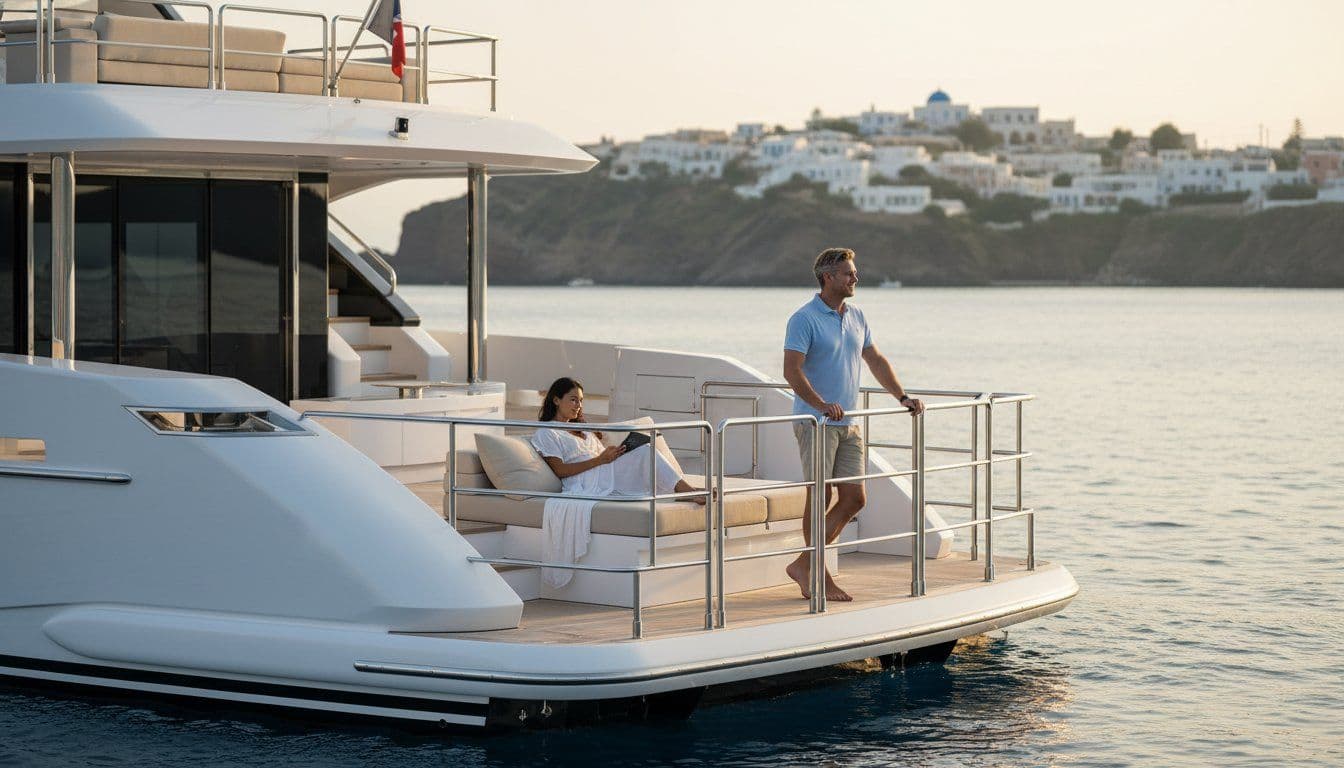
Did you know that nearly 40% of professional skippers admit to experiencing seasickness during their careers? If the experts feel the sway, it's natural to wonder how to avoid seasickness on a yacht during your own private Greek charter. You've planned a flawless escape, so the fear of missing a sunset dinner or feeling uneasy in front of your guests shouldn't hold you back. It's a common worry, but nausea is no longer an inevitable part of the luxury lifestyle.
Mastering your comfort at sea is now a blend of high-tech innovation and professional expertise. This guide shares the secrets to a perfectly stable journey, from the latest 2026 FDA-approved treatments like NEREUS™ to the advanced stabilizer systems found on modern vessels. We'll show you how experienced crews use strategic route planning to find the calmest waters in the Aegean. You'll gain the clarity you need on non-drowsy medications and holistic rituals to ensure your time on the water is defined by freedom and luxury, not discomfort.
Key Takeaways
- Master vessel selection by choosing catamarans or yachts equipped with zero-speed stabilizers to neutralize motion even at anchor.
- Adopt the 24-hour guest protocol to prep your body with specific hydration and dietary choices before departing from Mykonos or Athens.
- Learn how to avoid seasickness on a yacht by combining the latest 2026 medical breakthroughs with time-tested natural remedies.
- Leverage professional crew expertise to navigate around the Meltemi swell using advanced weather routing and proactive onboard wellness strategies.
What Causes Seasickness? Understanding the Sensory Conflict
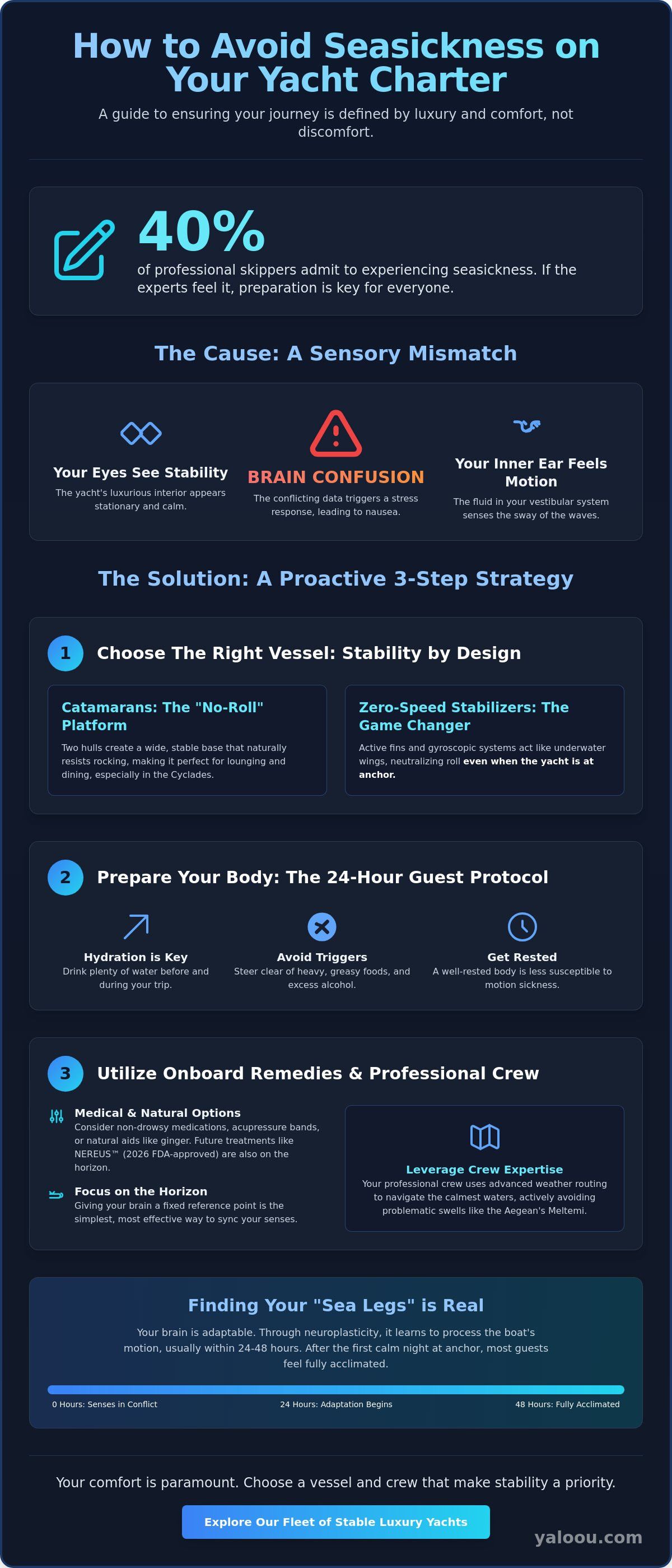
Seasickness isn't a mystery; it's a data error in your brain. Your inner ear senses the Aegean swell, while your eyes focus on the stable, elegant interior of the saloon. This mismatch is the core of Understanding Motion Sickness. It's often called the "mismatch theory." When your vestibular system and visual input don't align, the brain triggers a stress response. It's a primal reaction to a modern luxury experience.
To better understand this concept, watch this helpful video:
Luxury yachts offer a distinct advantage over mass-market ferries. Larger commercial vessels often have a slow, rhythmic roll that's harder for the brain to process. Modern private yachts use advanced hull designs and stabilization technology to minimize this movement. Understanding these mechanics is the first step in learning how to avoid seasickness on a yacht. You aren't just a passenger; you're on a vessel designed for precision and comfort.
Watch for early indicators. It's not just nausea. Excessive yawning, a sudden cold sweat, or mild headaches are the first signals. If you notice these, act immediately. Don't wait. Anxiety plays a massive role too. If you're constantly worried about getting sick, your body stays in a state of high alert. This stress makes you more susceptible to the physical triggers. Relaxing into the experience is part of the cure.
The 'Vestibular Conflict' Explained
Your inner ear contains fluid that moves with the boat. When you look at your phone or read a book, your eyes tell your brain everything is stationary. This is the ultimate trigger for first-timers. The brain receives conflicting signals and assumes you've ingested something toxic. This "mismatch" is why the physical response is so visceral. Keep your eyes on the horizon to give your brain a fixed reference point. It's a simple, high-impact adjustment.
Why 'Sea Legs' Are Real (and How Long They Take)
Neuroplasticity is the secret behind the "sea legs" phenomenon. Your brain is remarkably adaptable and eventually learns to filter out the "noise" of the waves. This transition usually takes between 24 and 48 hours. Most guests find that after the first night at anchor in a calm bay, their balance is fully established. This natural adjustment is a key part of how to avoid seasickness on a yacht. Once your brain syncs with the rhythm of the sea, the rest of your charter is pure joy.
Choosing the Right Vessel: Stability and Technology
Selecting the right platform is the most effective way to address how to avoid seasickness on a yacht. It's a matter of engineering, not just luck. While the sea is inherently dynamic, modern naval architecture provides sophisticated tools to neutralize its impact. High-end charters prioritize stability through specific hull designs and cutting-edge stabilization systems that most travelers never see.
Vessel size and displacement are your first lines of defense. A larger, heavier yacht possesses more inertia, meaning it resists the energy of the waves rather than being tossed by them. Displacement and length-over-water significantly affect your comfort in a swell. When you're planning a journey through the Aegean, choosing a vessel with the right technical specs ensures the environment serves your comfort rather than challenging it.
Hull Designs and Their Impact on Motion
Catamarans are the "no-roll" choice for those who prioritize a stable platform for dining and lounging. With two hulls spaced wide apart, they offer a wide footprint that naturally resists the side-to-side rocking common in monohulls. This design is particularly effective in the Cyclades. Conversely, performance monohulls use speed to their advantage. At higher velocities, the hull's shape creates its own stability, cutting through the chop rather than riding over it. You can explore our fleet of stable luxury yachts to find the perfect match for your needs.
Stabilizer Fins and Gyros
The real magic in modern yachting happens with zero-speed stabilizers. These systems, found on premium vessels like the Baglietto 100, work even when the yacht is at anchor in a quiet bay. Active fin stabilizers act like underwater wings, moving constantly to counteract the roll. Gyroscopic stabilizers use a high-speed spinning flywheel to create a powerful righting torque inside the hull. These technologies create a "virtual" stability that defies the surrounding environment.
According to NOAA's guide to seasickness, reducing the physical movement of the vessel is the most direct way to prevent sensory conflict. This is why a technohull rib is often surprisingly stable for quick island hops; its speed and tube buoyancy work together to keep the ride flat. For overnight stays, the "low and middle" rule for cabin selection is your golden ticket. The center of motion is always at the yacht's midpoint. Staying in a cabin located low in the hull and mid-ship minimizes the movement you feel while sleeping.
Ready to see how these technologies transform a trip? You can discover a more comfortable way to travel by booking one of our curated yacht experiences where stability is a priority.
The Yacht Guest’s Protocol: Prevention Before Departure
Preparation for a smooth voyage starts long before the anchor is lifted. If you want to know how to avoid seasickness on a yacht, look at your schedule 24 hours before boarding in Athens or Mykonos. A common mistake is skipping meals to "stay safe." This is counterproductive. An empty stomach is actually more sensitive to the acid changes triggered by motion. Eat a light, protein-focused meal about two hours before departure to keep your system stable and settled.
Hydration is equally vital. Dehydration interferes with the fluid in your inner ear, which is your body's balance center. Sip water consistently throughout the day. When reviewing Harvard Health on motion sickness remedies, it's clear that maintaining a steady internal environment is a primary defense. Don't wait until you feel thirsty; your body needs that lead time to prepare for the change in environment.
The Pre-Charter Diet
Coordinate with your private chef to ensure your first few meals are gentle on the system. Lean proteins and complex carbs are ideal. Green apples are a sailor’s secret; they contain pectin, which naturally settles the stomach. Avoid heavy dairy, greasy foods, and excessive caffeine in the day leading up to your trip. These can slow digestion and increase the likelihood of discomfort. If you're enjoying sunset drinks, use the "one-for-one" rule. Drink one full glass of water for every cocktail to keep your equilibrium sharp.
Strategic Onboard Positioning
Your first two hours on board are the most critical for acclimatization. Stay on deck in the fresh air rather than retreating to a cabin. Use the horizon as a fixed reference point to help your brain sync with the yacht's movement. If you feel any tension, move to the mid-ship lounge. This area is the yacht's center of gravity and offers the most stability. Our crew can set up a "Station of Comfort" here with chilled towels and ginger elixirs, allowing you to enjoy our bespoke yacht experiences without a single worry. This proactive support is a key part of how to avoid seasickness on a yacht when traveling with a professional crew.
Remedies and Medications: What Actually Works?
The secret to a nausea-free holiday isn't just what you take, but when you take it. The "night before" rule is the ultimate professional strategy for how to avoid seasickness on a yacht. By taking your first dose of medication before you go to sleep, you allow the active ingredients to fully enter your bloodstream while your body is at rest. This proactive approach ensures your equilibrium is protected before you even step onto the gangplank the following morning.
Modern maritime medicine has evolved significantly. While older treatments are still effective, new pharmaceutical breakthroughs offer more targeted relief with fewer side effects. Having a well-stocked kit and a plan of action allows you to focus on the horizon rather than your stomach. Our crews are well-versed in these options and can help you manage your comfort from the moment you board.
Pharmacological Solutions
Choosing the right medication is a balance between relief and alertness. Over-the-counter options like Bonine (meclizine) are popular because they offer a "less-drowsy" formula compared to traditional Dramamine. For those seeking the latest technology, NEREUS™ (tradipitant) was approved by the FDA on December 30, 2025, and became commercially available on May 1, 2026. As the first new prescription drug for motion sickness in over 40 years, it represents a major shift in how travelers manage sea conditions.
The Scopolamine patch remains a favorite for week-long Greek charters. It provides a steady, controlled release of medication through the skin for up to three days. Always test any new medication or patch at home before your trip begins. You want to ensure you don't experience side effects like dry mouth or blurred vision while trying to enjoy a gourmet dinner at sea. Knowing your body's reaction in advance is essential for a stress-free experience.
Holistic and Natural Relief
Ginger is more than a traditional remedy; it's a scientifically backed staple of the yachting world. Whether you prefer capsules, freshly brewed tea, or raw slices provided by your private chef, ginger naturally neutralizes stomach acid. Peppermint oil is another elegant tool. Applying a few drops to your temples or inhaling the scent can calm the vagus nerve and reduce the sensation of dizziness almost instantly.
Acupressure wristbands, such as Sea-Bands, are a popular drug-free option. They work by applying constant pressure to the P6 point on the wrist. While some debate the placebo effect, the physical sensation often provides a grounding focus for the brain. You might also hear sailors mention the "Earplug Trick," which involves placing a single earplug in the non-dominant ear to help the brain recalibrate balance. When exploring how to avoid seasickness on a yacht, these combined strategies create a comprehensive safety net for every guest.
Experience the Aegean in total comfort by choosing our exclusive yacht experiences, where your well-being is our crew's primary mission.
The YAL’OOU Advantage: Professional Crew and Route Planning
While technology and medicine provide a solid foundation, the human element defines the luxury experience. A professional crew is your ultimate resource for how to avoid seasickness on a yacht. They don't just react to symptoms; they anticipate them. Our captains and crew members are experts in the specific rhythms of the Aegean Sea. They turn a potentially choppy crossing into a seamless transition between islands. You aren't just a passenger; you're a guest under the protection of maritime experts.
In the Cyclades, the Meltemi wind is the primary variable. These strong, dry north winds can create a significant swell during the summer months. However, an experienced captain knows that timing is everything. We monitor high-resolution weather models to plan crossings during the calmest windows. Often, this means moving in the early morning when the sea is like glass. This level of tactical planning is something you won't find on a mass-market ferry or a bareboat rental. It's the difference between enduring a trip and enjoying it.
Expert Navigation in the Cyclades
Flexibility is the cornerstone of comfort. If conditions aren't ideal for a specific route, we pivot. We might seek the leeward side of Paros or Mykonos, where the island's landmass acts as a natural barrier against the wind. By staying in the "wind shadow," we ensure the yacht remains stable. You can discover our curated Greek destinations where we've mapped out the most sheltered and serene spots for our guests. Seeking the "lee" ensures a stable night's sleep even when the open sea is active.
Bespoke Onboard Care
The care continues below deck with a high-touch, VIP concierge approach. Our private chefs are trained to tailor menus instantly. If a guest feels slightly "under the weather," heavy sauces are replaced with chilled ginger-infused broths or light, crisp salads. Our stewardesses are proactive. They offer cold compresses, ensure strategic cabin ventilation, and provide acupressure wristbands at the first sign of a swell. This level of attention removes the fear of embarrassment. You're cared for by professionals who understand exactly how to manage your well-being.
A crewed charter is the ultimate safety net for those prone to motion sickness. You have a dedicated team focused entirely on your comfort. When you combine local expertise with the stability of a high-end vessel, the challenge of how to avoid seasickness on a yacht becomes a solved problem. This allows you to focus on the discovery, the freedom, and the unparalleled beauty of the Greek islands.
Embrace the Freedom of the Aegean with Confidence
Discomfort is no longer a prerequisite for an authentic Greek island escape. By mastering how to avoid seasickness on a yacht through advanced stabilization technology, proactive protocols, and the latest 2026 medical innovations, you reclaim control over your holiday. The Aegean is yours to explore, from the hidden coves of the Small Cyclades to the vibrant shores of Mykonos, all while enjoying the absolute stability of a world-class vessel.
At YAL’OOU, we specialize in high-touch maritime experiences where your well-being is the priority. Our fleet features the latest zero-speed stabilizers to ensure comfort even at anchor. Our captains bring over 20 years of local experience to every crossing, using expert weather routing to navigate the Meltemi with precision. We don't just provide a boat; we offer a bespoke itinerary designed for maximum comfort and a crew dedicated to your peace of mind.
The sea is calling, and it's never been more inviting. Take the first step toward a journey defined by luxury, stability, and joy. Book your smooth and seamless Greek yacht charter with YAL’OOU today and discover the islands exactly as they were meant to be seen.
Frequently Asked Questions
Is it better to stay inside or go on deck if I feel seasick?
You should always head to the deck if you start feeling uneasy. Fresh air is essential for cooling the body and reducing the sensory mismatch that causes discomfort. Focus your eyes on the horizon to give your brain a stable reference point. Staying inside, especially in a cabin where you can't see the water's movement, is the fastest way to trigger a full physical response.
Will I get seasick on a luxury yacht even if it has stabilizers?
While stabilizers significantly reduce rolling, they don't eliminate all motion in heavy seas. High-end systems like zero-speed stabilizers can neutralize up to 90% of a yacht's roll. However, if you're among the 10% of people who suffer from severe motion sickness, you might still feel some discomfort during active crossings. Choosing the right vessel remains the best strategy for how to avoid seasickness on a yacht.
What is the best medication for seasickness that doesn't cause drowsiness?
NEREUS (tradipitant) is currently the leading non-drowsy prescription option, having launched in May 2026. It targets different receptors than older drugs to maintain your alertness during the day. For over-the-counter needs, Meclizine (marketed as Bonine) is widely preferred over traditional formulas because it causes significantly less drowsiness. Always consult with a medical professional before starting a new prescription for your Greek holiday.
Are catamarans better than monohulls for avoiding motion sickness?
Catamarans are generally superior for stability because their dual-hull design creates a wide platform that resists rolling. They don't lean into the wind like monohulls, which makes dining and lounging much more comfortable for sensitive guests. Monohulls offer a classic sailing feel, but if your priority is a "no-roll" experience in the Cyclades, a luxury catamaran is the smarter choice for your group.
Should I eat before going on a yacht charter?
You should definitely eat a light meal about two hours before your charter begins. An empty stomach is highly sensitive to the acid changes caused by motion, which can actually accelerate nausea. Opt for lean proteins or complex carbohydrates like crackers or bread. Avoid heavy dairy, greasy foods, or acidic citrus, as these slow down your digestion and make your system more reactive to the sea's movement.
What should I do if I start feeling sick while the yacht is moving?
Move immediately to the mid-ship area on the main deck, as this is the yacht's center of gravity with the least motion. Keep your eyes fixed on the horizon and avoid looking at phones or books. Sip on ginger ale or ice-cold water and ask the crew for a cold compress. Taking these steps early is the most effective way to manage how to avoid seasickness on a yacht before it escalates.
How do the Meltemi winds in Greece affect yacht stability?
The Meltemi winds create a consistent northerly swell in the Aegean that can challenge a yacht's stability during the peak summer months. Our captains mitigate this by planning crossings for the early morning when the winds are typically at their weakest. By using high-resolution weather models, we can pivot itineraries to stay on the leeward side of islands like Paros, ensuring you remain in calm, protected waters.
Does the size of the yacht determine how much it will rock?
Size definitely matters when it comes to stability. A larger yacht has more displacement and weight, which provides greater inertia against the waves. This means the vessel resists the energy of the water rather than being tossed by it. While technology helps smaller boats, a longer and heavier yacht will almost always provide a smoother, more grounded ride through a significant Aegean swell.
Disclaimer
The YAL’OOU Travel Guide is curated with care to inspire and inform discerning travelers. While every effort is made to ensure the accuracy and relevance of the information provided, all content is offered for general guidance only and may evolve over time.
Details such as local regulations, availability, pricing, and services are subject to change without prior notice. We encourage guests to seek personalized advice and confirm arrangements directly when planning their journeys.
YAL’OOU accepts no liability for any inaccuracies, omissions, or outcomes arising from the use of this information. The Travel Guide may feature recommendations, insights, and selected third-party experiences, presented solely as a source of inspiration and not as formal endorsements.
By accessing this section of our website, you acknowledge and accept this disclaimer as part of your experience with YAL’OOU.