

Charter accounting should be predictable financial governance, not an end-of-voyage guessing game. Yet, standing on the aft deck worrying about mid-trip top-up requests or botching maritime etiquette can quickly dampen an otherwise extraordinary escape. If you feel anxious about how to calculate APA final balance and crew gratuity distribution, you aren't alone. Tracking daily fuel burn, provisioning invoices, and dockage fees while determining customary tip percentages across the deck, interior, and galley teams often feels unnecessarily complicated.
You don't need a background in marine finance to handle your checkout meeting with absolute confidence. By understanding the core mechanics of expense reconciliation, you will master yacht charter accounting and learn to handle crew gratuity seamlessly. Ahead, we break down clear mathematical formulas to compute refunds or deficits, clarify standard Mediterranean tipping customs, and outline proper presentation etiquette so you can step off the gangway completely stress-free.
Key Takeaways
- Master how to calculate APA final balance and crew gratuity distribution using transparent equations based purely on verified operational expenses.
- Track daily burn rates proactively with mid-voyage updates on fuel, provisions, and marina dockage to eliminate financial surprises.
- Navigate accounting settlements with ease, whether converting an unspent surplus toward gratuities or settling an operational deficit.
- Apply regional tipping benchmarks accurately, calculating customary Mediterranean gratuities of 10% to 15% strictly against the net base fee.
- Lead the final captain reconciliation meeting with complete confidence, auditing expense logs and presenting gratuities per maritime etiquette.
Demystifying the Advance Provisioning Allowance (APA)
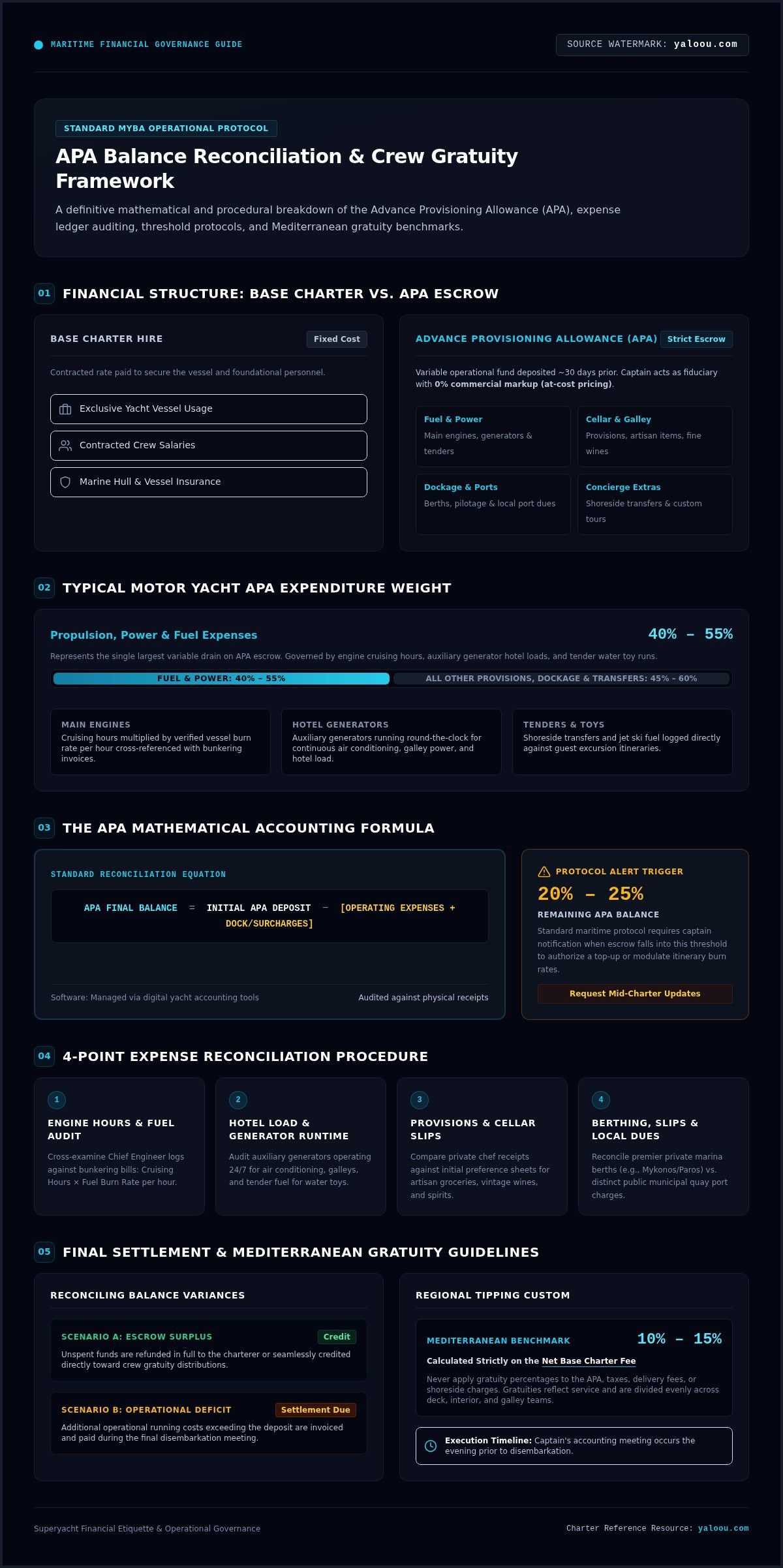
Think of the Advance Provisioning Allowance (APA) as your yacht's dedicated operating fund. Paid roughly 30 days before embarkation, this advance covers every variable running cost during your voyage. Crucially, this fund carries zero commercial markup from brokers or yacht owners. You pay direct, at-cost prices for everything consumed on board. Understanding these mechanics is the first step in learning how to calculate APA final balance and crew gratuity distribution with complete clarity.
Operating variables naturally influence your burn rate. Shifting an itinerary across Aegean island destinations to avoid seasonal Meltemi winds can alter cruising speeds, increase engine hours, and change marina dockage expenses. Being mindful of these shifts keeps your onboard budget predictable from start to finish.
The Legal Nature of the Escrow Account
Under standard MYBA agreements, the APA functions as a strict escrow account held in trust. The yacht captain acts as a fiduciary. They must track daily expenditures, safeguard your funds, and preserve verified invoices for every transaction. While your base charter hire covers the yacht, crew salaries, and hull insurance, the APA remains strictly reserved for your individual operational expenses.
Primary Expense Categories Covered by APA
Every receipt logged into the vessel's ledger maps back to specific operational categories:
- Propulsion and power: Main engine fuel, auxiliary generators powering round-the-clock air conditioning, and tender fuel for water toys. On motor yachts, fuel typically accounts for 40% to 55% of all APA expenditures.
- Culinary and cellar provisions: Artisan ingredients, daily guest provisions, dietary specialties, premium spirits, and requested wines.
- Dockage and port tariffs: Municipal quay charges, private marina berths, pilotage, and local clearance fees.
- Concierge extras: Specialized passenger shoreside transfers or custom onshore excursions arranged directly through the crew.
Recognizing what qualifies as an operational expense removes friction early, making it straightforward to audit your ledger and grasp how to calculate APA final balance and crew gratuity distribution when your charter concludes.
Step-by-Step: How to Calculate Your APA Final Balance
Calculating your account standing requires a straightforward audit of documented receipts against your initial escrow deposit. The standard mathematical formula is precise:
APA Final Balance = Initial APA Deposit - (Total Documented Operating Expenses + Transaction/Port Surcharges)
When you know how to calculate APA final balance and crew gratuity distribution systematically, you eliminate surprises before setting foot in the captain's office. Standard protocol calls for an alert if your balance drops to 20% to 25% remaining. Requesting a mid-charter update keeps daily burn rates visible, giving you complete oversight of your onboard finances.
Step 1 & 2: Auditing Vessel Operating Hours and Fuel Burns
Start by auditing engineering logs against actual sea time. The chief engineer logs precise engine hours and generator runtime each day. Your review should follow three checkpoints:
- Main engine propulsion: Multiply total recorded cruising hours by the vessel's verified fuel burn rate per hour, then cross-reference with local marine bunkering receipts.
- Hotel load generators: Verify auxiliary generator hours, which run continuously to power air conditioning, galley equipment, and onboard power systems.
- Tenders and water toys: Check fuel charges for shoreside tender transfers and jet skis against logged excursion itineraries.
Step 3 & 4: Reconciling Provisions, Dockage, and Local Dues
Once machinery logs are verified, shift attention to physical merchant invoices. Match private chef provisioning receipts directly against your initial preference sheets to ensure specialty items and vintage labels align with what was delivered. Next, examine berth charges. Premier marina slips in Mykonos or Paros carry standard published rates, while public municipal quays in smaller Greek ports feature separate, smaller municipal dues.
Captains finalize this reconciliation statement the evening before departure using digital yacht accounting software. If you prefer curated routes engineered to optimize efficiency and minimize wasted engine hours, exploring bespoke luxury yacht experiences can streamline operational management. By auditing the numbers early, you master how to calculate APA final balance and crew gratuity distribution with complete peace of mind.
Resolving APA Surpluses and Shortfalls at Disembarkation
Reconciliation yields one of two clear outcomes: unspent credit or an outstanding balance. Both scenarios follow strict maritime financial protocols. Knowing how to calculate APA final balance and crew gratuity distribution gives you complete control over which settlement channel protects your cash flow best.
Handling an APA Surplus: Cash vs. Wire Refund
When total voyage costs finish below your initial advance, the unspent funds belong entirely to you. You can resolve a surplus using three practical options:
- Immediate cash refund: The captain disburses the remaining euro cash balance directly from the yacht's safe upon countersigning the final statement.
- Broker wire transfer: Unspent funds return electronically through your central charter broker account, typically processing within three to five business days.
- Gratuity reallocation: Many guests choose to sign an APA release form directing the unspent cash surplus straight into the crew gratuity pool, wiring only the outstanding difference if needed.
Settling an APA Deficit: Payment Channels and Fees
Demanding itineraries or exceptional cellar selections can push expenditures past the initial advance. If funds dip near the standard 20% to 25% reserve threshold mid-voyage, the captain will request a proactive top-up to maintain operations.
Any terminal deficit must be cleared before you leave the gangway on your final morning. Choose your payment method wisely:
- Cash payment: Direct settlement in local currency (euros across the Greek Mediterranean) eliminates transaction lags and foreign exchange markups.
- Same-day bank wire: Effective for larger amounts, provided your bank supplies immediate wire confirmation before disembarkation.
- Onboard credit card terminal: Swiping on board is convenient, but maritime satellite terminals pass a 2.5% to 4% merchant processing surcharge directly to your bill.
Selecting the right settlement channel seals your account efficiently. Mastering how to calculate APA final balance and crew gratuity distribution ensures you avoid unnecessary banking fees while wrapping up your voyage smoothly.
Understanding Superyacht Crew Gratuity Guidelines
Crew gratuity rewards the tireless hospitality that defines life at sea. While tipping remains entirely discretionary and non-contractual under updated MYBA guidelines, established customs govern maritime regions. Mediterranean charters carry a customary benchmark of 10% to 15% of the net base charter fee (10% for solid service, rising to 12.5% or 15% for exceptional delivery). In contrast, Caribbean and US waters lean toward 15% to 20% under CYBA terms.
One fundamental rule governs this calculation: compute percentages strictly on your contracted net base charter fee. Never calculate tips against your gross total, which bundles local taxes, delivery fees, or your variable provisioning funds. Keeping these figures cleanly separated is essential when mastering how to calculate APA final balance and crew gratuity distribution without overpaying.
Evaluating Crew Service: Objective Performance Benchmarks
Base your final percentage on measurable standards across all departments on board:
- Deck operations: Seamless tender transfers, swift water toy setups, situational safety vigilance, and proactive anchoring maneuvers in challenging anchorages.
- Interior hospitality: Unobtrusive housekeeping, flawless table styling, anticipatory drink service, and care for personalized guest requests.
- Galley performance: Chef adaptability to complex dietary preferences, creative meal execution, and ingredient quality throughout the voyage.
The Master Rule: The Captain’s Distribution Protocol
Maritime tradition strictly forbids tipping individual crew members. Handing cash to your favorite stewardess or deckhand disrupts teamwork and insults back-of-house crew who work unseen. Engineers managing watermakers and deckhands washing hulls at sunrise contribute just as heavily to your comfort.
Place the collective gratuity inside a single presentation envelope addressed to the captain. You will present this in the main salon or bridge during your private checkout meeting. The captain then distributes the sum fairly across all hands, typically in equal shares across the roster. Ready to embark on a seamless Greek Mediterranean voyage supported by meticulous fiscal guidance? Explore our bespoke luxury yacht experiences to plan an unforgettable escape.
Handling this step correctly ensures you honor proper maritime etiquette while demonstrating how to calculate APA final balance and crew gratuity distribution with complete professionalism.
Seamless Charter Closure: The Captain Meeting and Execution
Timing makes all the difference when concluding your voyage. Never attempt to audit accounts on the dock with luggage in hand. Schedule your private reconciliation session with the captain on the final evening after dinner or at least two hours before morning departure. Setting aside dedicated time gives you space to review final figures, settle balances, and execute the crew tip without feeling rushed.
Approaching this final session with an orderly agenda takes the stress out of departure. Once you understand how to calculate APA final balance and crew gratuity distribution, this formal sign-off becomes a satisfying, professional wrap-up to your sea journey.
Agenda for the Bridge Accounting Session
Step onto the bridge or into the private study with your primary charter paperwork ready. Work through the account systematically:
- Review engineering logs: Cross-check fuel bunker receipts against recorded propulsion hours and auxiliary generator logs. Cycladic passages between Mykonos and Paros often demand varying speeds to handle open-sea conditions, making verified log entries your clearest reference point.
- Audit reconciled receipts: Inspect the digitized binder or tablet log showing third-party receipts for chef provisions, berthing permits, and municipal port dues.
- Execute the discharge statement: Sign off on the final expense balance. If an unspent surplus remains, specify whether you prefer a broker wire refund, cash return, or direct reallocation into the tip envelope. If there is a shortfall, clear it on the spot via wire confirmation or cash.
Executing Gratuity Handover and Disembarkation
With the ledger fully settled, transition directly to the gratuity presentation. Hand the sealed envelope directly to the captain. Take this moment to share verbal feedback, highlighting stellar service from the interior team, the deckhands, or the galley. The captain will record your commendations and divide the pool equitably among all crew members once you depart.
After closing the books, disembarkation should feel effortless. Ensure your captain confirms departure logistics with shoreside staff, syncing your gangway exit with scheduled VIP ground transfers waiting at the pier. Once ashore, you can reflect on your Mediterranean journey and begin planning future island routes across the luxury fleet at YAL’OOU.
A well-managed checkout protects your travel budget, respects maritime traditions, and demonstrates exactly how to calculate APA final balance and crew gratuity distribution like a seasoned charterer.
Navigate Your Charter Finances with Total Confidence
Financial clarity transforms your time on the water from tentative to effortless. Armed with clear accounting equations and established maritime protocols, you now have the knowledge to audit vessel logs, manage mid-voyage fuel consumption, and reward stellar service appropriately. Mastering how to calculate APA final balance and crew gratuity distribution removes every ounce of uncertainty, letting you focus entirely on the thrill and freedom of cruising.
At YAL’OOU, we pair boutique Greek Mediterranean charter expertise with uncompromising fiscal transparency. Every voyage features itemized captain logs, customized island itineraries that reduce unnecessary engine burn, and dedicated concierge support coordinating your VIP shoreside transfers. When you're ready to cruise the Aegean with complete peace of mind, plan your private Greek charter with YAL’OOU and enjoy a flawless voyage from embarkation to your final gangway step.
Frequently Asked Questions
What is the standard percentage for APA on a luxury yacht charter?
Standard APA ranges between 20% and 30% of the base charter fee for sailing catamarans and sailing yachts due to lower fuel burn. For motor yachts, standard allocations run from 30% to 40%, climbing past 45% for high-speed performance vessels. This advance covers real operational expenses like fuel, fine provisions, and Greek island docking fees without owner markup.
Can I use remaining APA funds to pay for the crew gratuity?
Yes, repurposing an unspent APA surplus toward the crew tip is standard practice across the Mediterranean. During your final accounting meeting with the captain, you can sign an APA disbursement release form instructing the yacht to allocate the credit directly to the crew gratuity pool. This streamlines disembarkation by eliminating unnecessary banking wires or cash withdrawals at island ports like Mykonos or Paros.
How do captains account for fuel consumption and marina berth fees?
Captains track propulsion fuel, tender gasoline, and generator runtime using daily engine logbooks paired with certified bunkering receipts. Berth fees are recorded directly through official municipal port invoices or private marina receipts, such as slips in Tourlos or Parikia. These itemized charges populate transparent digital yacht management software, showing your real-time burn rate whenever you review how to calculate APA final balance and crew gratuity distribution.
What happens if our charter expenses exceed the initial APA deposit?
If your operational expenses outpace your advance funds, the captain will notify you once reserves drop below 20% to 25%. You can choose to adjust your itinerary to curb high-speed fuel consumption or inject an interim top-up. Any remaining deficit at the end of the charter must be settled before you step off the gangway via bank wire, cash, or onboard credit card.
Why is crew gratuity calculated on the base charter fee rather than the total cost?
Gratuity reflects the base cost of hiring the yacht and crew, excluding variable operational expenses and statutory obligations. Calculating tips against gross totals would unfairly penalize you for fuel burned during rough Aegean passages, expensive provisioning requests, or government VAT. Understanding this distinction is fundamental when learning how to calculate APA final balance and crew gratuity distribution accurately under standard MYBA guidelines.
Is it acceptable to tip an individual crew member who provided exceptional service?
No, tipping individual crew members directly violates maritime etiquette and disrupts crew camaraderie. Luxury yacht crews function as a cohesive team where deckhands and engineers work behind the scenes to keep you safe and comfortable. Always deliver the pooled tip in a sealed envelope to the captain, who will distribute it equitably while passing along your personal compliments to specific standout staff.
What payment methods are accepted if I need to settle an APA balance deficit?
You can settle an APA deficit using euro cash, a confirmed same-day bank wire transfer, or an onboard credit card terminal. While card payments offer convenience on the bridge, maritime satellite processing terminals usually carry a 2.5% to 4% merchant surcharge. Paying via cash or immediate wire avoids these additional processing fees before disembarking in ports like Athens or the Cyclades.
Disclaimer
The YAL’OOU Travel Guide is curated with care to inspire and inform discerning travelers. While every effort is made to ensure the accuracy and relevance of the information provided, all content is offered for general guidance only and may evolve over time.
Details such as local regulations, availability, pricing, and services are subject to change without prior notice. We encourage guests to seek personalized advice and confirm arrangements directly when planning their journeys.
YAL’OOU accepts no liability for any inaccuracies, omissions, or outcomes arising from the use of this information. The Travel Guide may feature recommendations, insights, and selected third-party experiences, presented solely as a source of inspiration and not as formal endorsements.
By accessing this section of our website, you acknowledge and accept this disclaimer as part of your experience with YAL’OOU.