
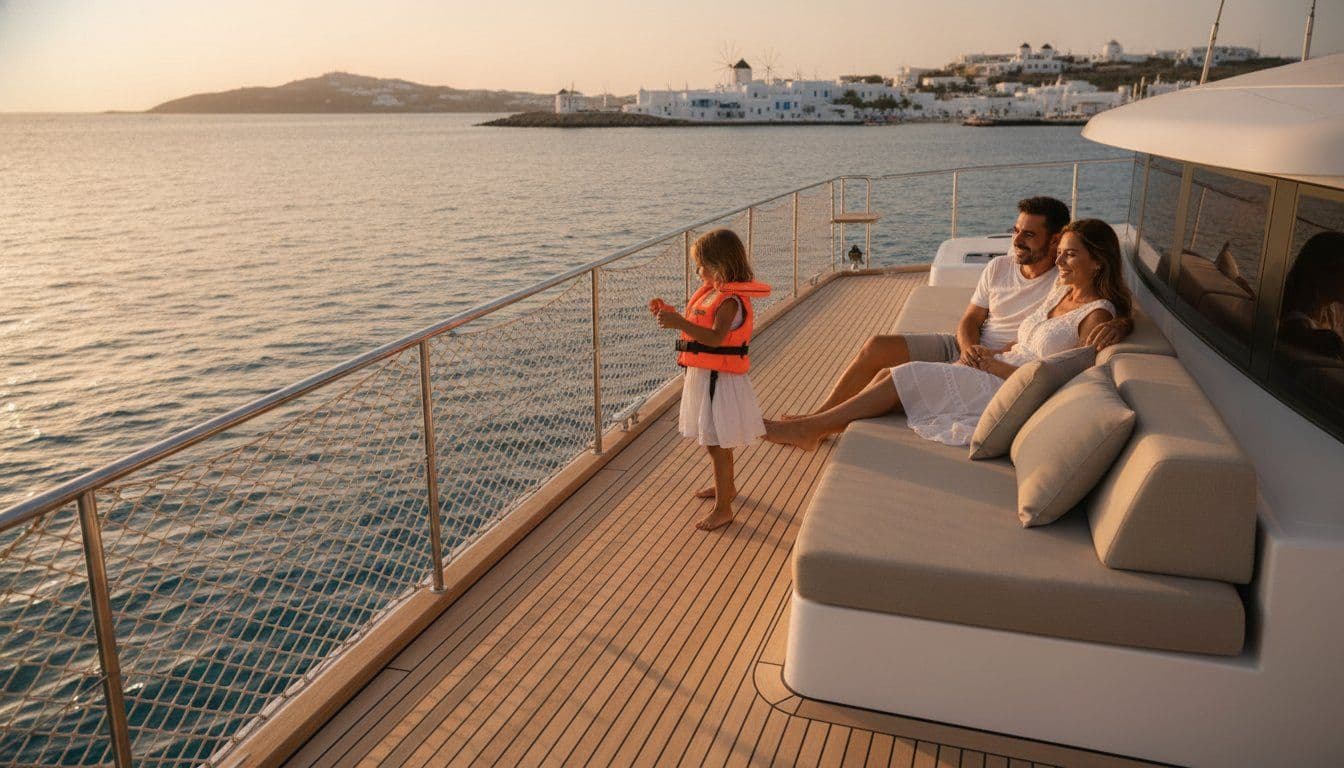
Imagine watching the sunset over Mykonos with a glass of wine in hand, but your heart is racing. Instead of relaxing, you're scanning the deck for open gates or steep, narrow stairs. For many parents, the fear of a "man overboard" incident or a tumble down a yacht's ladder turns a dream vacation into a high-stress vigil. Learning how to ensure child safety on a crewed yacht is the only way to trade that anxiety for the effortless freedom you've worked so hard to enjoy.
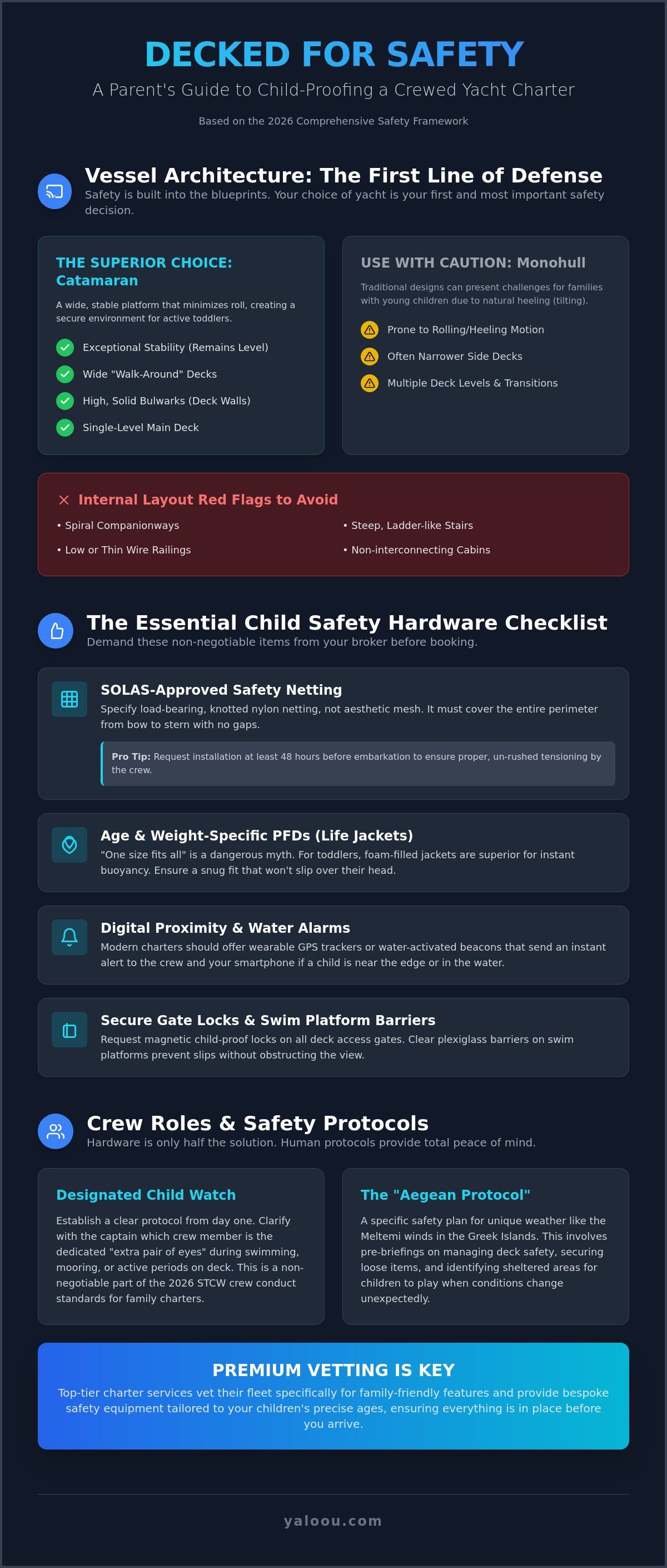
We agree that your family's security is non-negotiable. That's why we've built a comprehensive 2026 safety framework. It goes beyond basic life jackets to include the latest STCW crew conduct standards and specialized vessel layouts. This article provides a definitive checklist to send your broker before you book. We'll explore the best yacht designs for families, the technical specs of SOLAS-approved safety netting, and how to establish a clear "Aegean Protocol" with your crew for total peace of mind.
Key Takeaways
- Identify why specific yacht architectures, such as stable catamaran hulls, provide superior "walk-around" safety for active toddlers.
- Master the essentials of how to ensure child safety on a crewed yacht through non-negotiable hardware like custom safety netting and specialized life jackets.
- Learn to clarify crew roles using the latest 2026 STCW standards and establish a dedicated "Designated Child Watch" protocol from day one.
- Discover the "Aegean Protocol" for managing deck safety during the Meltemi winds and other unique Greek Island weather conditions.
- Explore how premium charter services vet their fleet for family-friendly features and provide bespoke safety equipment tailored to your children's ages.
Choosing the Right Vessel: Architecture as the First Line of Defense
Safety starts long before you step onto the teak deck. It's built into the blueprints of the vessel. When you're researching how to ensure child safety on a crewed yacht, the hull design and deck layout should be your first points of inspection. A yacht's architecture acts as an invisible guardian, preventing accidents before they happen. While aesthetic features like sunpads and bars catch the eye, parents must look for high bulwarks and wide walkways.
Hull stability is the primary safety factor for toddlers and young children. Their high center of gravity and developing motor skills make them vulnerable to the natural rolling motion of the sea. A stable platform reduces the risk of trips and falls, allowing children to move with more confidence. High bulwarks, the solid vertical walls around the deck's edge, provide a far more secure barrier than thin wire railings. They ensure that even a stumble doesn't lead to a dangerous situation.
To help your children prepare for the water and understand the environment, watch this helpful video:
The Stability Factor: Catamarans in the Cyclades
The wide beam of a catamaran is a game changer for family charters. Unlike monohulls, which heel or tilt under sail, catamarans remain level. This stability is crucial in the choppy waters of the Cyclades. A single-level main deck allows you to supervise active children without worrying about them navigating steep transitions. For those seeking a blend of performance and security, the Tesoro 40 Inboard offers an exceptionally stable platform with a layout designed for easy movement.
Internal Layout Red Flags for Parents
Avoid "child-trap" layouts at all costs. Spiral companionways and steep, ladder-like stairs are major fall risks for small feet. Instead, look for yachts with wide, shallow staircases and plenty of handrails. Adhering to modern Boating safety standards means choosing a vessel where the "flush deck" design minimizes tripping hazards. Interconnecting cabins are another vital feature. They allow you to stay close to your children at night without sacrificing the privacy of your own suite. This proximity ensures you can respond instantly if a child wakes up disoriented in a new environment.
The Essential Child Safety Hardware Checklist
Choosing a stable vessel is only the first step. The next layer of protection involves the specific hardware that creates a physical barrier between your child and the water. Understanding how to ensure child safety on a crewed yacht requires a focus on professional-grade equipment rather than standard gear found on mass-market boats. High-end charters in 2026 now utilize a blend of traditional physical barriers and advanced digital alerts to provide a fail-safe environment for young explorers.
Beyond the basics, focus on these critical hardware categories:
- Digital Proximity Alarms: Wearable GPS trackers or water-activated beacons that alert the bridge and your smartphone the moment a child moves beyond a set perimeter or touches the water.
- Gate Locks and Plexiglass: Modern yachts often feature magnetic child-proof locks on side gates and clear plexiglass barriers on swim platforms to prevent accidental slips without blocking the view.
Safety Netting: Installation and Types
Safety netting is the single most important modification for families with toddlers. However; not all netting is equal. You must distinguish between "aesthetic" mesh, which is thin and easily torn, and load-bearing safety netting made from knotted nylon. This netting must cover the entire perimeter from bow to stern, leaving no gaps near the stanchions. Because professional installation is labor-intensive and requires precise tensioning, always request it at least 48 hours before embarkation. This ensures the crew has the time to secure it properly without rushing during your arrival.
PFDs and Life Jacket Standards
The "one size fits all" approach is a dangerous myth in maritime safety. A life jacket that is too large will simply slide off a child's head the moment they hit the water. For toddlers, foam-filled jackets are superior because they provide instant buoyancy without relying on a mechanical inflation system. Older, more confident swimmers may prefer self-inflating models that offer better mobility on deck. The ISO 12402 standard specifies the safety requirements for personal flotation devices used by persons engaged in activities, whether for work or leisure, in or near water. Regardless of the type, the "Crotch Strap" rule is vital; it's the only feature that prevents the jacket from riding up over the child's face.
Investing in the right hardware means you can finally relax as the sun dips below the horizon. If you're ready to plan a secure getaway, explore our curated family experiences to see how we prioritize these safety layers in every Greek Island itinerary. Mastering how to ensure child safety on a crewed yacht is about being proactive with the right tools before you even leave the dock.
Crew Roles and the "Safety Briefing" Standard
While a stable hull and high-tech netting provide the foundation, the human element is what truly secures your journey. Understanding how to ensure child safety on a crewed yacht requires a shift in perspective. You aren't just hiring a boat; you're partnering with a professional team trained to manage risks you might not even see. The crew's training and the protocols you establish together are the final, most critical layers of your safety framework.
Every crew member must hold an STCW (Standards of Training, Certification, and Watchkeeping) certificate. As of January 1, 2026, these standards have been updated to include mandatory training on personal conduct and welfare. This ensures a professional environment where safety and respect are paramount. When interviewing a Captain before your charter, ask about their specific experience with young families. A Captain who understands how to ensure child safety on a crewed yacht will already have a list of "kid-friendly" bays with calm waters and minimal traffic.
The "Designated Child Watch" protocol is a game changer. This isn't about the crew acting as full-time playmates. It's about clarifying who has eyes on the children during high-risk moments like docking, anchoring, or swimming. The Stewardess often becomes the primary safety anchor inside the yacht. They ensure stairs are clear of toys and that cabin doors are secured with child-proof latches while the vessel is underway.
Nanny vs. Crew: Defining the Boundaries
Don't confuse maritime safety with childcare. The crew's priority is the vessel and the safety of everyone aboard. They cannot provide the undivided attention a toddler requires. If you want to enjoy a quiet dinner or explore a shore-side boutique without distraction, consider hiring a specialized "Yacht Nanny" through the YAL’OOU concierge. A dedicated nanny integrates into the yacht's safety hierarchy, allowing the crew to focus on navigation while your children receive expert care.
The Mandatory Family Safety Briefing
The first 30 minutes onboard are the most critical. This is when the crew conducts the mandatory safety briefing. It's vital to get the children involved immediately. Gamify the process. Make a race out of who can find and put on their life jacket the fastest. Use this time to identify "Safe Zones," such as the main salon or interior cabins, where children can move freely without a life jacket. Establishing these boundaries early prevents confusion and ensures that "Life Jacket Time" is respected as a non-negotiable rule on deck.
The Aegean Protocol: Safe Navigation with Children
Navigating the Greek Islands requires more than just a map; it demands a localized strategy that respects the unique temperament of the Aegean Sea. While previous sections focused on the yacht's physical build and crew certifications, the "Aegean Protocol" focuses on active operational safety. Understanding the local environment is a core part of how to ensure child safety on a crewed yacht. This is especially true when dealing with the Meltemi, the powerful, dry north winds that sweep through the Cyclades during the summer months.
The Meltemi can turn a calm morning into a choppy afternoon with little warning. For adults, this might just mean a more exciting sail; for children, it changes the deck's safety profile instantly. When these winds pick up, the "Life Jacket on Deck" rule must be strictly enforced. No child should be outside the salon without a secured PFD when the vessel is underway in Force 5 winds or higher. Additionally, night safety is paramount. High-end charters now utilize cabin lockdowns and motion sensors to ensure that a curious toddler doesn't wander onto the deck while the parents are asleep.
Tender transfers represent the most high-risk moments of any charter. Moving from the stable platform of a luxury yacht to a smaller, moving rib requires precision. Children must always be the first to board and the last to disembark, always under the "four-hand" rule where both a crew member and a parent provide a physical anchor during the transition. Once inside the tender, kids must remain seated in the center of the boat to maintain stability.
Safe Island Hopping in Greece
Morning cruising is your secret weapon for family harmony. The Aegean is typically at its calmest between 08:00 and 11:00, making this the ideal window for inter-island passages. Planning shorter routes of 2 to 3 hours prevents "sea sickness fatigue," which can make children restless and less likely to follow safety protocols. For inspiration on kid-friendly routes, check our 7-day Greek Islands itinerary. These paths prioritize sheltered bays and shorter transit times.
Water Toy and Swim Platform Safety
The swim platform is the center of fun, but it requires a "Zero Propeller" policy. The yacht’s engines and generators must be completely off, or the propellers must be mechanically locked, before any child enters the water. Supervised use of Jet Skis and Seabobs is great for older children, but beach landings in busy hubs like Mykonos or Paros should always be done via the tender to avoid swimmer zones. If you are ready to experience the islands with a team that understands these nuances, book one of our bespoke family yachting experiences today. Mastering how to ensure child safety on a crewed yacht means choosing a partner who knows the Aegean as well as they know their own fleet.
The YAL’OOU Difference: Bespoke Family Security
Securing a luxury charter shouldn't feel like a compromise between style and safety. At YAL’OOU, we've redefined the standard for family travel in the Mediterranean. We understand that knowing how to ensure child safety on a crewed yacht requires more than just a checklist. It requires a dedicated partner who vets every vessel with a parent’s eye and a sailor’s expertise. We don't just facilitate rentals; we engineer secure environments for your most precious passengers. Our team bridges the gap between high-end hospitality and rigorous maritime protection.
Our process begins with a rigorous audit of vessel architecture. We specifically look for wide side-decks, high bulwarks, and secure flybridge gates. If a yacht meets our architectural standards but lacks specific hardware, we step in. From sourcing load-bearing safety netting to providing high-end cribs and medical-grade sanitization, our team handles the logistics before you even arrive in Athens. This proactive approach eliminates the "first-day stress" that often accompanies family travel.
Being a local Greek broker gives us a distinct advantage. We understand the nuances of Aegean maritime law and have direct lines to port authorities across the Cyclades. If an emergency arises, our 24/7 concierge support provides an immediate safety net. Whether you need a pediatric consultation in Paros or a swift transfer back to the mainland, we manage the logistics so you don't have to. You are never alone on the water when you charter with us.
Our Family-First Fleet Highlights
The Baglietto 100 is a prime example of our family-first philosophy. Its massive beam provides incredible stability, while the expansive, flat decks are perfect for children to move safely. Many of our vessels feature dedicated "Kids Zones" equipped with high-tech monitoring systems. These allow you to relax while keeping a digital eye on the playroom from your smartphone. Explore our full range of crewed yachts in Greece to find the perfect match for your family's specific age groups and needs.
Seamless Safety Planning
Safety extends to what happens off the deck as well. Our VIP Concierge coordinates everything from dietary safety to medical preparation. We vet private chefs for allergen awareness and ensure that every destination on your route has accessible medical facilities. This local expertise provides peace of mind from the moment you land in Athens to your final sunset in Santorini. Ready to plan your journey? Contact our experts today to start designing your secure family escape. Mastering how to ensure child safety on a crewed yacht is our passion, so it doesn't have to be your worry.
Secure Your Family's Dream Escape in the Aegean
A luxury charter should be defined by the freedom of the open sea, not the stress of monitoring every step your child takes. From selecting a vessel with stable architecture to mastering the Aegean Protocol, you now have the blueprint for a secure journey. You've learned that the secret of how to ensure child safety on a crewed yacht lies in a combination of high-tech hardware, updated STCW crew training, and localized maritime expertise.
At YAL’OOU, we take this responsibility personally. Our strictly vetted family-friendly fleet and expert Greek maritime knowledge ensure every safety detail is managed before you even leave the dock. With our 24/7 local concierge support across the Cyclades, you can focus on the sunset while we handle the logistics of security and comfort. Plan Your Safe Family Charter with YAL’OOU and discover a world where modern technology and expert care serve your family's joy. The Greek Islands are waiting for you to explore them with total peace of mind.
Frequently Asked Questions
Is a crewed yacht charter safe for a toddler who can’t swim?
Yes, a charter is perfectly safe for non-swimmers if you enforce the "Life Jacket on Deck" rule and install safety netting. Toddlers must wear a properly fitted PFD at all times when they aren't in the interior salon. The crew sets up physical barriers and netting to create a secure environment, ensuring your child stays safe even before they've learned to swim.
How much does it cost to install safety netting on a charter yacht?
Installation costs vary based on the vessel's size and the complexity of the deck layout. It's a bespoke service that involves several hours of manual labor to ensure the netting is properly tensioned and secure. You should request this modification at least 48 hours before embarkation to ensure the yacht is fully prepared for your family's arrival.
Do yacht crews provide child-minding services?
No, the crew's primary responsibilities are maritime safety, navigation, and high-end guest service. While they're often great with children, they can't provide the constant, one-on-one supervision a toddler requires. Hiring a specialized yacht nanny is the most effective way to manage how to ensure child safety on a crewed yacht while allowing you to enjoy your vacation.
What happens if my child gets seasick during the charter?
The Captain can quickly adjust the itinerary to find a sheltered bay with minimal wave motion. Most professional crews are trained in first aid and carry pediatric-grade motion sickness remedies to help children feel better fast. Our concierge can also coordinate a consultation with a local doctor in ports like Mykonos or Paros if symptoms don't improve.
Are there specific yachts that are better for babies and newborns?
Catamarans are the ideal choice for babies because their wide twin-hull design provides superior stability and prevents the boat from tilting. The single-level living spaces make it much easier to move around with a stroller or set up a portable crib. These vessels offer a "home-like" feel that is much more comfortable for newborns than traditional monohulls.
Can I bring my own car seat or high chair on the yacht?
You're welcome to bring your own equipment, but we can usually source these items for you through our VIP concierge. Providing your broker with a list of required gear weeks in advance ensures that everything is installed and safety-checked before you board. This eliminates the hassle of carrying bulky gear through international airports.
What are the most kid-friendly islands to visit in Greece by boat?
Naxos and Paros are excellent choices because they offer vast stretches of shallow, sandy beaches that are perfect for young children. The Small Cyclades, particularly Koufonisia, feature sheltered turquoise bays that act like natural swimming pools. These islands provide calm conditions for safe beach landings and stress-free water play.
Is the tap water on a yacht safe for children to drink?
While yacht water is safe for showering and hygiene, we always recommend bottled or filtered water for drinking. Children's stomachs can be sensitive to the mineral balance in desalinated tank water. The crew ensures that a fresh, chilled supply of mineral water is always available in the galley and cabins for your family's comfort.
Disclaimer
The YAL’OOU Travel Guide is curated with care to inspire and inform discerning travelers. While every effort is made to ensure the accuracy and relevance of the information provided, all content is offered for general guidance only and may evolve over time.
Details such as local regulations, availability, pricing, and services are subject to change without prior notice. We encourage guests to seek personalized advice and confirm arrangements directly when planning their journeys.
YAL’OOU accepts no liability for any inaccuracies, omissions, or outcomes arising from the use of this information. The Travel Guide may feature recommendations, insights, and selected third-party experiences, presented solely as a source of inspiration and not as formal endorsements.
By accessing this section of our website, you acknowledge and accept this disclaimer as part of your experience with YAL’OOU.