
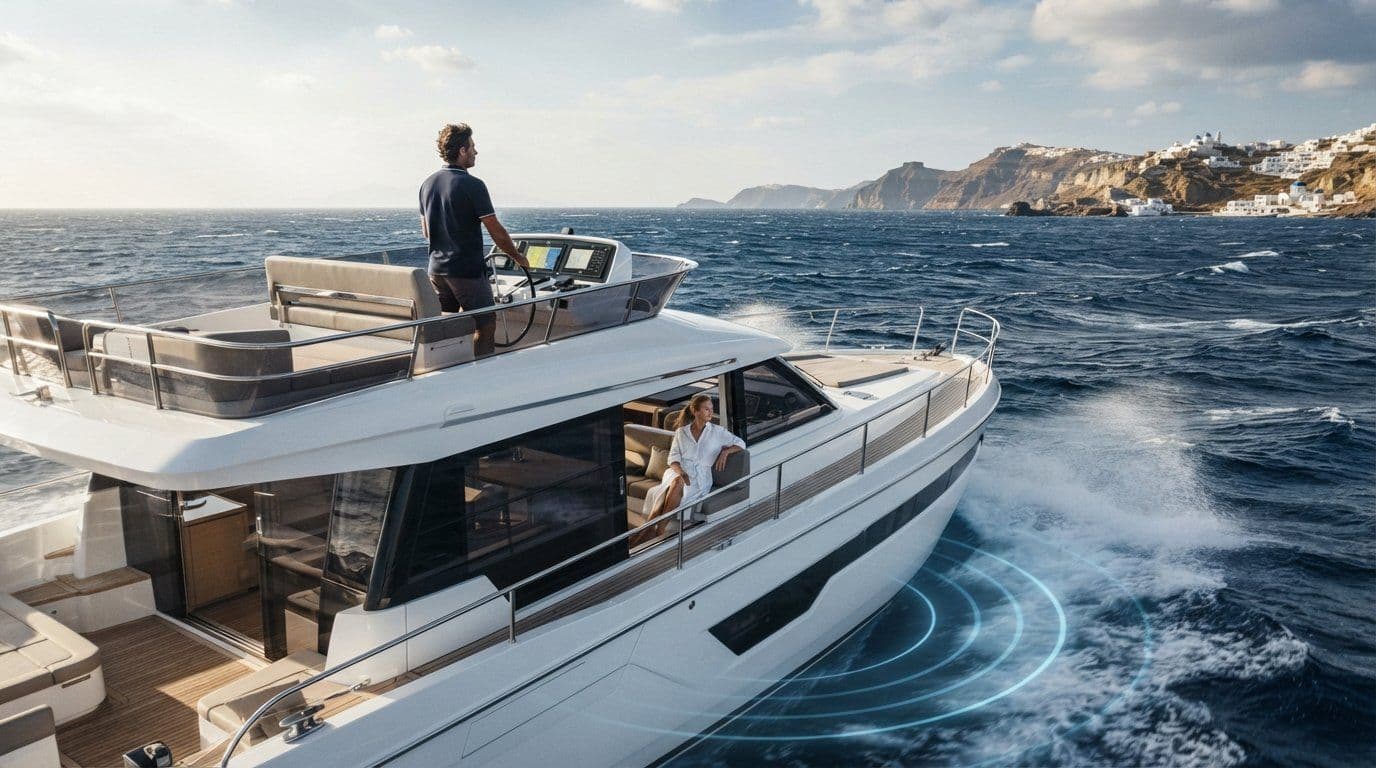
Did you know that nearly 90% of travelers will experience motion sickness when exposed to severe wave motion without the right preparation? It is a common fear that can cast a shadow over even the most opulent Aegean escape. When the Meltemi winds accelerate through the Cycladic channels, turning a calm sea into a challenging chop, the anxiety of nausea is real. You have planned the perfect luxury holiday. The last thing you want is for the journey between Mykonos and Paros to be defined by discomfort rather than discovery.
Learning how to prevent motion sickness during rough Cyclades crossings is the difference between a trip you endure and a voyage you truly enjoy. We will show you how to master the art of seafaring with expert strategies that keep your journey as smooth as the champagne on deck. This guide explores advanced stabilization technologies like Seakeeper gyros, expert navigation tactics used by professional crews, and the most effective medical protocols for 2026. Get ready to reclaim your freedom on the water with total confidence and expert precision.
Key Takeaways
- Decode the Meltemi winds and the Venturi effect to anticipate and outsmart the Aegean’s most challenging sea states.
- Explore how advanced gyroscopic stabilization technology can eliminate up to 95% of boat roll for a seamless experience even at anchor.
- Master the essential 24-hour preparation window and dietary secrets on how to prevent motion sickness during rough Cyclades crossings before you even step on deck.
- Identify the most stable "Center of Gravity" locations on a yacht and use the Horizon Rule to keep your senses perfectly aligned with the sea.
- Leverage professional "Lee Side" routing strategies to find calm, sheltered waters in the wave shadows of the islands.
Understanding the Cyclades Meltemi: Why Aegean Crossings Get Rough
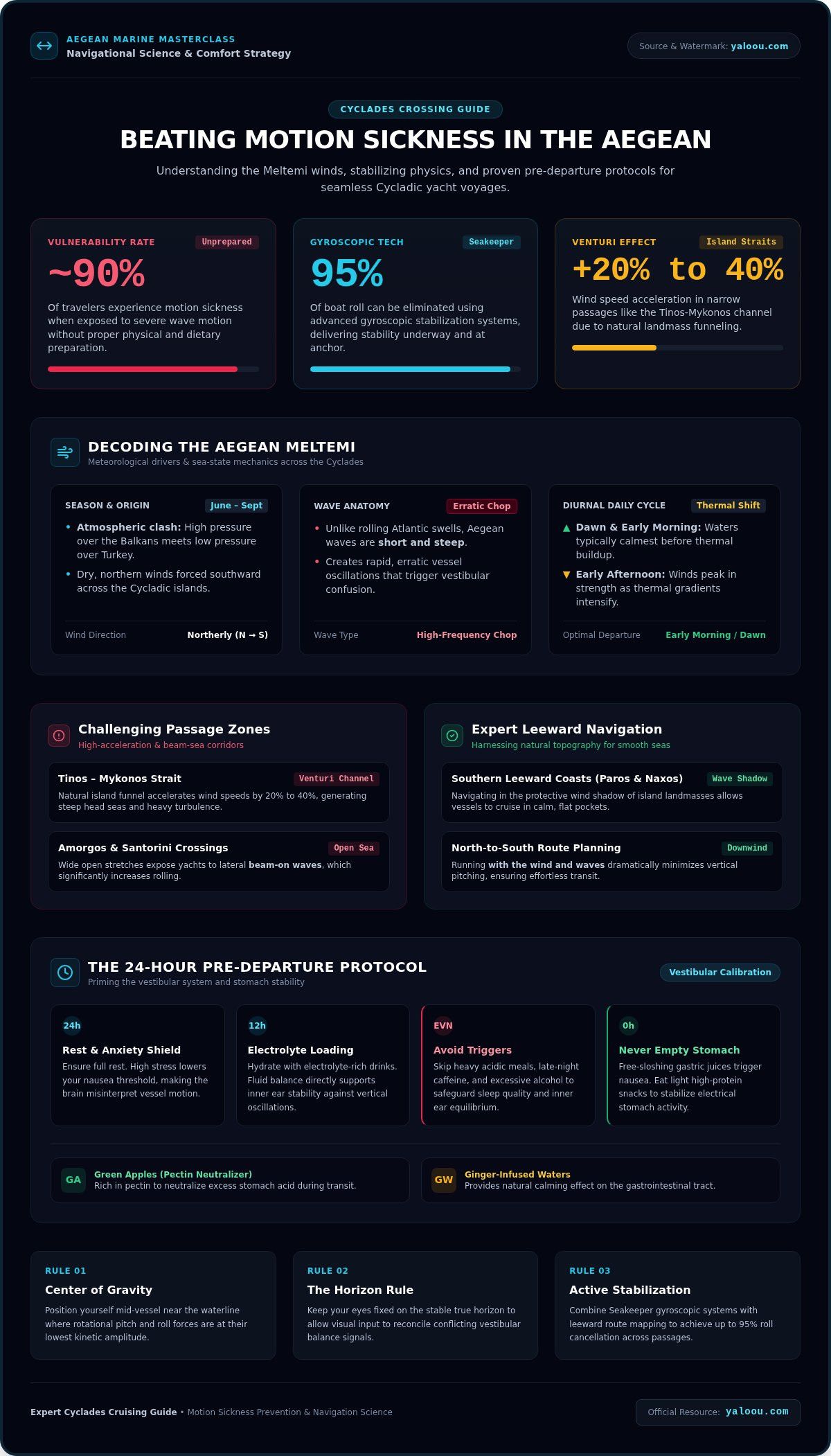
The Aegean Sea is famous for its crystalline waters, but it's also home to a unique meteorological phenomenon: the Meltemi. These dry, northern winds dominate the region from June through September. Unlike the long, rolling swells of the Atlantic, the Aegean produces short, steep waves that create a persistent "chop." This erratic motion is exactly why travelers often search for how to prevent motion sickness during rough Cyclades crossings. Understanding these Aegean Meltemi wind patterns is the first step toward a comfortable voyage.
To better understand how to manage these conditions, watch this helpful video:
The Science of Aegean Wind Patterns
The Meltemi is a predictable yet powerful force in Greek navigation. It's born from a clash between high-pressure systems over the Balkans and low pressure over Turkey. This atmospheric tug-of-war funnels air southward across the islands. You'll notice a distinct daily cycle; winds often remain calm at dawn but peak in the early afternoon as thermal gradients intensify. For those planning a luxury itinerary, sailing north-to-south is generally much smoother. Running with the wind and waves reduces the vessel's vertical pitching, making the journey feel effortless.
Identifying the Choppiest Routes in the Cyclades
Certain passages act as natural funnels, creating the "Venturi effect." This phenomenon accelerates wind speeds by 20% to 40% in narrow straits. The Tinos-Mykonos channel is a classic example. It's a notorious test for any vessel. Similarly, crossing the open sea toward Amorgos or Santorini can expose yachts to beam-on waves that increase rolling. These areas are where knowing how to prevent motion sickness during rough Cyclades crossings becomes most critical.
However, local geography is your best ally. Expert captains use the "wind shadows" of island landmasses to find calmer pockets. By staying close to the southern, leeward coasts of islands like Paros or Naxos, you can enjoy stable waters even when the open sea is white-capped. Choosing the right luxury yacht and a crew with deep local knowledge ensures you stay ahead of the weather and enjoy the ride.
Pre-Departure Preparation: Priming Your Body for the Sea
Preparing for a voyage starts long before you step onto the teak deck. The "24-hour rule" is vital for any luxury traveler. You need to prime your vestibular system by ensuring you're well-rested and calm at least a full day before departure. Anxiety significantly lowers your threshold for nausea. When you're stressed about the weather, your brain is already on high alert, making it more likely to misinterpret the Aegean's motion. Mastering how to prevent motion sickness during rough Cyclades crossings begins with a proactive mindset and a calibrated body.
Hydration is another non-negotiable factor. Don't just drink water; focus on electrolyte balance. Dehydration affects your inner ear's fluid levels, which are critical for maintaining balance. Sip electrolyte-rich beverages starting the evening before your sail. This simple step keeps your system resilient against the erratic vertical oscillations common in the Cycladic channels.
The Luxury Seafarer’s Diet
Don't make the mistake of sailing on an empty stomach. A void in your stomach allows gastric juices to move freely, which actually triggers nausea faster than a light meal. The night before your crossing, skip the heavy acids, late-night caffeine, and excessive alcohol. These choices disrupt your sleep and your inner ear's stability. On the morning of your trip, reach for high-protein snacks or dry crackers. High-protein meals are proven to stabilize the stomach's electrical activity during motion. Green apples are a seasoned yachtsman’s secret weapon. They contain pectin, which helps neutralize stomach acid, while ginger-infused waters provide a natural, calming effect on the digestive tract.
Medical Interventions: Patches, Pills, and Natural Aids
If you're highly susceptible to discomfort, consider pharmacological support well in advance. Transdermal scopolamine patches are a gold standard for multi-day trips. They deliver a steady, controlled dose over 72 hours. However, they can cause side effects like dry mouth, so apply them at least four hours before boarding. Antihistamines like Dramamine or Bonine are effective for shorter bursts, but the "drowsiness" trade-off can dampen your energy. For a drug-free approach, pharmaceutical-grade ginger root or acupressure Sea-Bands are reliable alternatives that many guests prefer. For a deeper look at your medical options, consult the CDC travel health guidance on motion sickness.
When you feel physically prepared, the psychological fear of the Meltemi fades. This readiness allows you to focus on the bespoke Aegean experiences that await you at your next destination. A prepared body is the foundation of a truly effortless journey.
Stabilizers and Hull Design: How Luxury Yachts Beat the Swell
Modern luxury yachting has transformed the Aegean experience through high-end engineering. In the past, travelers were often at the mercy of the waves. Today, gyro-stabilizers like the Seakeeper system have changed the game. These systems use a spinning flywheel to create powerful torque that counteracts boat roll. They can eliminate up to 95% of roll at rest. This technology is a critical factor in how to prevent motion sickness during rough Cyclades crossings because it stops the erratic side-to-side motion that confuses the inner ear.
While fin stabilizers are excellent for higher speeds, gyros provide stability even when you're anchored in a secluded bay. This dual-stabilization approach ensures that the sensory mismatch described in the NOAA overview of seasickness causes and relief is minimized from the moment you step on board. The result is a predictable, fluid motion that allows your body to adapt quickly to the sea's rhythm.
Private Yachts vs. Mass-Market Ferries
Mass-market ferries, especially high-speed catamarans, are designed for speed and passenger volume. Their flat hulls tend to "slap" against the short, steep Aegean waves. This creates a jerky, high-frequency motion that is a primary trigger for nausea. In contrast, a private yacht allows the captain to adjust the vessel's speed and heading. By changing the angle at which the hull meets the swell, the crew can soften the ride significantly. Explore our stabilized luxury fleet to see how hull geometry and weight distribution create a superior experience.
The Comfort of the Baglietto 100 and Tesoro 40
The design of the vessel itself plays a massive role in your comfort. Heavy-displacement yachts like the Baglietto 100 offer incredible stability in heavy weather. Its weight and deep-V hull design allow it to plow through the chop rather than bouncing over it. For shorter day-trips, the Tesoro 40 Inboard utilizes modern engineering to provide a smooth, dry ride. These vessels aren't just about style; they're built to handle the specific challenges of the Greek seas. A professional captain will engage these stabilization systems before the first wave hits. This proactive management is the ultimate secret in how to prevent motion sickness during rough Cyclades crossings, ensuring your focus remains on the beauty of the horizon.
Onboard Tactics for Immediate Relief during Rough Seas
Even on a perfectly stabilized yacht, knowing where to be makes a massive difference. The "Center of Gravity" is your sanctuary. This is typically located mid-ship on the lower deck. Think of the boat like a seesaw. The ends move the most, while the middle stays relatively still. By positioning yourself here, you minimize the vertical acceleration your inner ear has to process. This is a fundamental lesson in how to prevent motion sickness during rough Cyclades crossings. The Aegean's short-period chop, often occurring at frequencies between 0.1 Hz and 0.4 Hz, is particularly challenging, so finding the pivot point of the vessel is your first line of defense.
Your eyes and inner ear must agree. When you look at a phone or a book, your eyes see a static image, but your inner ear feels the motion. This conflict triggers nausea. Use the "Horizon Rule" instead. Fix your gaze on the distant, stable horizon line. This visual cue helps your brain synchronize the motion you feel with the motion you see. If symptoms persist, try controlled breathing. Inhale deeply through the nose and exhale through the mouth. It calms the vagus nerve and lowers your heart rate. This controlled focus is a powerful tool in how to prevent motion sickness during rough Cyclades crossings.
Strategic Positioning on a Yacht
Fresh air is a natural remedy. While modern air conditioning is powerful, the scent and feel of the sea breeze often provide more relief. If the yacht is heading into a "head sea" (waves coming directly at the bow), the aft (rear) deck is usually more stable. The bow takes the brunt of the impact, while the aft follows through with less intensity. If you feel overwhelmed, the "Lie Down" method works wonders. Find a flat surface, close your eyes, and let your body sync with the vessel's rhythm. This resets the brain's motion sensors by removing the visual conflict entirely.
The Role of the Crew in Your Comfort
A professional crew is your greatest asset. The stewards at YAL’OOU Exclusive Yachting & More are trained to spot the subtle, early signs of discomfort before they escalate. They can provide aromatherapy, such as peppermint or ginger oils, which are known to soothe the stomach. Cold compresses applied to the back of the neck or the forehead can also provide immediate relief by regulating body temperature. You don't have to manage the sea alone. Discover more about our bespoke onboard experiences and how we prioritize your well-being from the moment you step on board.
Navigating the Cyclades with YAL’OOU Exclusive Yachting & More: The Expert Advantage
The most effective way to manage the sea isn't fighting it; it's outsmarting it. While stabilizers and onboard tactics provide a safety net, professional navigation is your primary shield. Route flexibility is the ultimate answer to how to prevent motion sickness during rough Cyclades crossings. Unlike fixed ferry schedules that must plow through whatever the Aegean throws at them, a private charter with YAL’OOU Exclusive Yachting & More allows for dynamic adjustments. If the Meltemi is howling through the Mykonos-Tinos channel, our captains simply find a better way.
We utilize the "Lee Side" strategy as a standard practice. By sailing along the southern coasts of islands like Paros, Naxos, or Ios, we leverage the island’s landmass as a natural windbreak. This "wave shadow" creates pockets of calm water even when the open sea is white-capped. Timing is equally critical. We plan major crossings during the early morning window, typically between 06:00 and 10:00 AM. This is when thermal gradient winds are at their weakest, offering the glassiest conditions of the day. Shorter "island hopping" legs of 1 to 2 hours are also prioritized over long, exhausting open-sea hauls to keep your vestibular system fresh.
Weather Routing and Captain’s Discretion
Our captains use advanced weather modeling to predict specific windows of calm. They don't just look at the wind speed; they analyze wave period and direction to ensure the hull's attitude remains stable. This expertise allows us to pivot the entire itinerary if necessary. If a Force 7 gale is forecasted for the central Cyclades, we might suggest exploring the more sheltered waters of Milos and Poliaigos or moving toward the Saronic islands like Spetses and Aegina. For more inspiration on planning your route, check our Greek Islands Yacht Charter 2026 guide.
Luxury Concierge Support
The journey begins before you reach the marina. Our VIP ground transfers are timed perfectly to minimize your wait in choppy or crowded ports, reducing pre-sail anxiety. We customize every detail for guests prone to discomfort, from selecting the most stable vessels in our fleet to stocking your favorite ginger-based refreshments. This holistic approach is how to prevent motion sickness during rough Cyclades crossings with true elegance. Ready to experience the Aegean on your own terms? Contact YAL’OOU Exclusive Yachting & More to plan a smooth Aegean journey and leave the discomfort of the Meltemi behind.
Set Sail with Unwavering Confidence
Luxury travel in the Aegean should be defined by the scent of the sea and the taste of fine champagne, not the discomfort of the Meltemi. You now understand that how to prevent motion sickness during rough Cyclades crossings is a science involving advanced stabilization technology, smart dietary prep, and expert navigation. By choosing a vessel designed for stability and a crew that masters the nuances of Greek wind patterns, you transform a potentially challenging passage into a seamless part of your holiday.
Our fleet is equipped with active stabilization to ensure your comfort at anchor and underway. Combined with local captains who possess decades of Aegean experience, we offer the flexibility to pivot itineraries whenever the weather demands. We don't just provide a boat; we provide a worry-free gateway to the islands. It's time to leave the anxiety of rough seas behind and embrace the freedom of the open water.
Ready to experience the Cyclades with total peace of mind? Book a Stabilized Luxury Charter with YAL’OOU Exclusive Yachting & More today and start planning your perfect, smooth-sailing escape.
Frequently Asked Questions
Is it better to be inside or outside on a yacht when it's rough?
It is almost always better to stay outside on the deck. Fresh air helps regulate your body temperature and reduces the feeling of confinement. More importantly, being outside allows you to keep your eyes fixed on the stable horizon line. This visual anchor is the most effective way to help your brain synchronize with the vessel's motion. If you must go inside, stay on the lower deck near the mid-ship area.
Which Cyclades islands are the hardest to reach in windy weather?
Tinos, Mykonos, and Amorgos are often the most challenging destinations during peak Meltemi season. The narrow channel between Tinos and Mykonos creates a funnel effect that significantly accelerates wind speeds. Open-sea crossings to Santorini or Koufonisia also expose vessels to larger swells without the protection of neighboring landmasses. Our captains use local knowledge to navigate these routes during early morning windows when conditions are typically at their calmest.
Do luxury yachts have special equipment to stop rocking?
Yes, high-end luxury yachts are equipped with advanced stabilization technology. Systems like Seakeeper gyro-stabilizers use a spinning flywheel to counteract up to 95% of boat roll. Many vessels also feature active fin stabilizers that adjust automatically to the water's flow while underway. This technology is a cornerstone of how to prevent motion sickness during rough Cyclades crossings, providing a level of stability that standard ferries simply cannot match.
How long does motion sickness usually last once you reach land?
Most people find that symptoms disappear within a few hours of reaching solid ground. However, a small percentage of travelers may experience a lingering swaying sensation for 24 to 48 hours. Staying active, walking on the beach, and staying hydrated help your vestibular system recalibrate to land. If you are prone to this, our concierge can arrange for a villa with wide, open views to help you ground yourself quickly.
Can I change my yacht itinerary if the weather forecast looks bad?
Flexibility is a hallmark of the YAL’OOU experience. Unlike rigid commercial routes, our private charters allow you to pivot your destination if the weather forecast looks unfavorable. If the northern Cyclades face heavy winds, your captain might suggest the sheltered southern coasts of Milos or a move toward the Saronic Gulf. This adaptability is the most proactive strategy for those concerned about how to prevent motion sickness during rough Cyclades crossings.
What is the best month to sail the Cyclades to avoid the Meltemi?
June and September are the ideal months for smooth sailing in the Aegean. During these shoulder seasons, the Meltemi winds are less frequent and generally carry less force than in July and August. You'll enjoy the same crystalline waters and warm temperatures but with much calmer seas. If you choose to sail during the peak summer months, we recommend focusing on southern routes or shorter island-hopping legs to maintain maximum comfort.
Does the size of the yacht significantly affect motion sickness?
Size and displacement significantly impact how a vessel handles the Aegean chop. Larger yachts with heavy-displacement hulls tend to plow through waves rather than bouncing over them. However, even smaller, modern vessels like the Tesoro 40 use advanced hull geometry and stabilization to provide a smooth ride. The key isn't just length, but the combination of weight, hull design, and active technology working together to minimize vertical acceleration.
What should I eat before a yacht crossing in the Aegean?
Focus on light, high-protein meals before you board. Avoid heavy acids, greasy foods, and excessive alcohol, as these can irritate the stomach lining and lower your nausea threshold. Green apples and dry crackers are excellent choices for keeping the stomach settled. Our private chefs can prepare specialized menus featuring fresh, ginger-infused refreshments and light snacks that provide energy without causing digestive stress during your crossing between Mykonos and Paros.
Disclaimer
The YAL’OOU Travel Guide is curated with care to inspire and inform discerning travelers. While every effort is made to ensure the accuracy and relevance of the information provided, all content is offered for general guidance only and may evolve over time.
Details such as local regulations, availability, pricing, and services are subject to change without prior notice. We encourage guests to seek personalized advice and confirm arrangements directly when planning their journeys.
YAL’OOU accepts no liability for any inaccuracies, omissions, or outcomes arising from the use of this information. The Travel Guide may feature recommendations, insights, and selected third-party experiences, presented solely as a source of inspiration and not as formal endorsements.
By accessing this section of our website, you acknowledge and accept this disclaimer as part of your experience with YAL’OOU.