

Could a polished villa listing, complete with sunset photos and glowing reviews, still hide a booking risk? It can. When you’re planning a Greek escape, beautiful images and pressure to book quickly don’t prove who controls the property or where your payment will go. Knowing how to verify legitimate luxury villa rentals in Greece means checking evidence, not just appearances.
This guide walks you through practical checks for the villa, the person or agency arranging your stay, and the booking process before you pay. You’ll learn how to compare listing details, recognize warning signs such as requests to pay outside a booking platform, and keep useful records. If something feels wrong, you’ll also know what steps to take promptly. Careful checks can’t make every booking risk-free, but they can help you make an informed choice and plan with greater confidence.
Key Takeaways
- Learn how to verify legitimate luxury villa rentals in Greece by comparing property details, photos, and the booking representative across reliable sources.
- Compare platform checkout, card payment, and direct transfer. Protections can vary by provider and transaction.
- Keep booking terms and payment communications together so you have useful records if questions arise.
- If you suspect fraud, pause further payments, preserve evidence, and contact your payment provider promptly.
- YAL’OOU offers handpicked Greek villa rentals and concierge support to help bring your stay plans together. No booking should be treated as risk-free.
Why Luxury Villa Listings in Greece Need More Than a Visual Check
Polished photographs, elegant interiors, and confident luxury language can make a villa feel convincing. They don’t show whether the property exists as advertised, whether the person answering your messages can arrange your stay, or whether the payment instructions belong to the booking. Look more closely before committing, especially when a substantial deposit or international payment is involved.
It helps to distinguish three situations. An inaccurate listing may contain outdated photos, incorrect amenity details, or a misleading description without proving deliberate deception. A booking dispute occurs when guest and host disagree about agreed terms, service, or a refund. Suspected deliberate fraud is a concern when details appear intentionally false or someone may be impersonating a host or agency. Don’t assume every mismatch proves a crime, but don’t ignore it. Record what you see and assess the facts.
Peak-season urgency can make it tempting to skip checks, and cross-border arrangements may make confusion harder to resolve later. Keep the listing, written terms, messages, and payment records together. Follow a simple sequence: verify the property, verify the counterparty, verify the contract, then verify the payment route.
What makes a villa listing verifiable?
Verifiable evidence is information that stays consistent across the listing, direct communications, booking terms, and other sources you can check. Compare the property’s location and features with the description. Check that the named host or representative matches the person or organization discussing the agreement, and confirm that the contract identifies the stay and the parties involved. For general context on accommodation arrangements, see Understanding Vacation Rentals. That background can explain the category, but it cannot authenticate a specific villa.
Treat photography and luxury wording as marketing, not proof. Beautiful images may help you picture the stay, but they don’t confirm who owns or manages the home. Matching details from other sources carry more weight. Verification reduces uncertainty; it can’t eliminate every risk or guarantee that a stay will meet expectations.
Warning signs that call for a pause
Slow down if you’re pressed to pay immediately, receive evasive answers to straightforward questions, or see different names on the listing, contract, and payment instructions without a clear explanation. A last-minute change to where or how to pay deserves particular scrutiny. So does a request to move a platform booking off-platform, since protections and support may change under the provider’s terms.
Before sending money, make sure the basic facts line up. If the address, representative, written terms, or payment recipient remain unclear, pause and seek clarification through a contact route you can independently verify. Ask specific questions and save the replies. A written explanation gives you a clearer basis for deciding how to verify legitimate luxury villa rentals in Greece before the booking becomes harder to unwind.
How to Verify a Greek Villa, Host, and Rental Listing
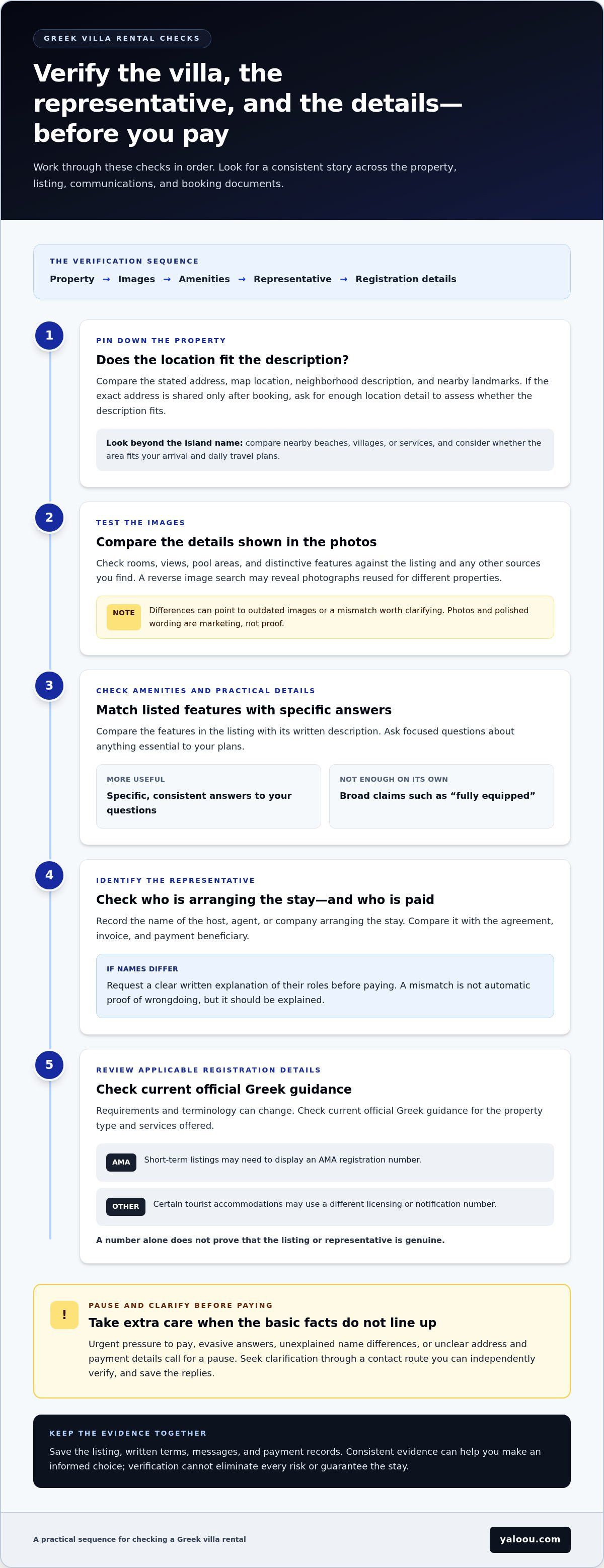
Before paying a deposit, work through these checks in order and save the evidence you use. The goal isn’t to prove every detail beyond doubt. It’s to see whether the property, the person arranging the stay, and the booking documents tell a consistent story. This is the practical core of how to verify legitimate luxury villa rentals in Greece.
- Pin down the property. Compare the stated address, map location, neighborhood description, and nearby landmarks. If the exact address is shared only after booking, ask for enough location detail to assess whether the description fits.
- Test the images. Compare rooms, views, pool areas, and distinctive features across the listing and any other sources you find. A reverse image search may reveal photographs reused for different properties. Differences can also point to outdated images or a mismatch worth clarifying.
- Check amenities and practical details. Compare the listed features with the written description and ask focused questions about anything essential to your plans. Look for specific, consistent answers rather than relying on broad claims such as “fully equipped.”
- Identify the representative. Record the name of the host, agent, or company arranging the stay. Compare it with the agreement, invoice, and payment beneficiary. If different names appear, request a clear written explanation of their roles before paying.
- Review applicable registration details. Greek short-term rental requirements and terminology can change. Check current official Greek guidance for the property type and services offered. Short-term listings may need to display an AMA registration number, while certain tourist accommodations may use a different licensing or notification number. A number alone doesn’t prove that the listing or representative is genuine.
Check the property and its location
Look beyond the island name. Compare the mapped location with the listing’s description of nearby beaches, villages, or services, then consider whether the area fits your arrival and daily travel plans. Two villas described as near the same destination can involve very different journeys. Think through how the location fits your itinerary and the experiences you want from the stay before you book.
Check the host, agent, and rental details
Ask for the booking terms in writing and make sure the property, stay dates, contracting party, and payment recipient align across the documents. A mismatch isn’t automatic proof of wrongdoing, but it should be explained before money changes hands. Keep copies of the listing, replies, agreement, and any registration details you review. Rules and public lookup processes may change, so rely on current official guidance rather than an old post or an unverified directory.
Minimum evidence to reconcile before booking: the property and location, the representative’s identity and role, the written booking terms, and the named payment recipient. Once those details align, plan the rest of your stay with greater clarity, from local arrangements to experiences that complement a Greek villa stay.
Compare Booking Terms and Payment Routes Before You Commit
A payment method is only one part of a booking’s risk profile. Before paying, compare the written agreement with the listing, invoice, and payment request. Check that they show the same contracting party, villa, dates, currency, total amount, payment schedule, and cancellation terms. If anything differs, ask for a clear written explanation and corrected documents before sending money.
Each payment route has different trade-offs. Protection depends on the platform or payment provider’s terms, your jurisdiction, the transaction type, and how promptly you report a problem. Review the rules that apply to your specific booking rather than assuming a particular method guarantees a refund.
Payment routePotential advantageWhat to consider
Platform checkout
The booking and payment may remain documented within the platform, with its own support process.
Coverage, exclusions, and dispute steps depend on the platform’s current terms. A request to pay elsewhere changes the route and may affect available support.
Card payment
The provider’s transaction record can help document when and how you paid.
Any dispute options depend on your card provider’s rules, the transaction, and timely reporting. A card payment is not a guaranteed reimbursement.
Direct bank transfer
The transfer creates a record showing the amount and recipient details.
Confirm the beneficiary independently and understand that recovery depends on the circumstances and the relevant financial institutions’ processes.
Review the contract and cancellation terms
Read the agreement before accepting or paying. It should clearly state the stay dates, occupancy, included services, total charges, deposit, balance schedule, and cancellation rules. Compare each item with the listing and payment request. For example, if the listing describes a service as included but the agreement treats it as an extra, resolve that difference in writing. Do the same if the invoice names a different party or currency.
Don’t rely on a verbal assurance to fix a material inconsistency. Ask for the documents to be updated so the agreed terms are clear to both sides, then keep the final version you accepted.
Assess the payment request
Check the payee’s name, amount, currency, and due date against the agreement. A last-minute change in bank details or a beneficiary name that doesn’t match the contracting party is a reason to stop and recheck through a previously established contact route. Don’t use new contact details supplied only alongside the changed instructions.
A traceable payment record shows what you sent and to whom; it doesn’t guarantee reimbursement. Save the listing, messages, invoice, agreement, and payment confirmation together in a secure folder. These records can help you explain the transaction if you need to raise a concern with the platform or payment provider. Payment checks are one part of how to verify legitimate luxury villa rentals in Greece; also confirm that the property and booking representative match the documents.
What to Do If You Suspect a Greek Villa Rental Scam
If something doesn’t add up, take a breath and act in order. Stop any further payments, preserve the evidence you already have, then contact the payment provider or booking platform promptly through its official channel. Don’t delete messages or rely on contact details included in a suspicious payment request. An organized response gives the relevant parties clearer information to assess what happened.
A poor stay or disagreement about a refund isn’t automatically fraud. A host may have failed to meet an agreed term, or the listing may have contained inaccurate information. Suspected deliberate deception is a separate concern, but avoid making a legal judgment before the facts are assessed. Describe what happened precisely: what was promised, what changed, who requested payment, and what you received.
Preserve evidence and contact your payment provider
Save screenshots and copies of the listing, its URL, messages, emails, contract, invoice, receipts, payment confirmations, and the account details you were given. Keep a simple timeline of key dates and events. Store the files securely, and don’t edit originals. Then contact your card issuer, bank, or booking platform using its official website, app, or contact information you already trust.
Explain the transaction and ask what dispute, chargeback, or transfer-recall procedures may apply. Options depend on the payment method, provider rules, jurisdiction, and facts. Ask what information they need and follow their instructions, but don’t assume you’re eligible for a particular process or that funds will be recovered.
Consider appropriate reporting and legal advice
Reporting options depend on where you are, where the transaction took place, and what the evidence shows. Use current official sources to identify the appropriate police, consumer-protection, or cross-border support channel. Authority names, complaint processes, and jurisdictional rules can change, so verify them before submitting a report. If you’re in immediate danger, contact the local emergency service using its official contact details.
For a substantial loss or complicated cross-border situation, consider qualified legal advice in the relevant jurisdiction. Bring your timeline and saved records so you can explain the matter clearly. Keep copies of reports and any case references, and note whom you contacted and when. These records help organize follow-up, though they can’t determine the outcome.
Use the same steady approach for future bookings: check the property, reconcile the representative and written terms, and keep a clear record of payment. Knowing how to verify legitimate luxury villa rentals in Greece can help you spot unanswered questions earlier, but no checklist removes every risk. Once the booking details are settled, explore Greek travel experiences as you shape the rest of your stay.
Book a Greek Villa Stay With a Clearer Plan
A considered booking starts with evidence, then leaves room for the pleasure of planning your stay. Confirm that the villa and its location match the listing. Reconcile the host or agent’s details with the agreement and payment request. Then choose a documented payment route and keep the records together. This sequence won’t remove every risk, but it gives you a clearer basis for deciding before you commit.
Use verification as part of trip planning
Keep the villa address or location details, arrival instructions, transport plans, host or representative contact information, booking terms, and payment records in one secure place. That makes it easier to find the right information while travelling and spot inconsistencies before departure.
Consider the practical journey, not just the island name. A villa’s distance from your arrival point, planned activities, and local services can shape how well it fits your itinerary. YAL’OOU arranges curated stays across Greek destinations including Mykonos, Paros, Antiparos, Athens, Aegina, Poros, Spetses, Syros, Tinos, Sifnos, Serifos, Milos, Poliaigos, Kimolos, Santorini, Ios, Koufonisia, Amorgos, Crete, Corfu, and Zakinthos. Compare locations using destination information for Greece, then assess each property against your actual plans. A popular area or luxurious presentation may inspire a trip, but neither establishes that a particular listing or payment request is genuine.
For a final sense-check, review your documents as one set. Do the property details, named parties, booking terms, and payment information align? If not, pause and resolve the discrepancy before treating the reservation as settled. A clear paper trail supports better decisions and makes the practical parts of travel easier to organize.
Explore a curated Greek stay
YAL’OOU offers handpicked high-end villa rentals in Greece, with concierge support and local supplier partnerships as part of its luxury travel services. Curated planning can help bring the villa and wider trip into focus, while your own checks of the listing, terms, and payment route remain essential. No presentation or planning approach should be treated as a guarantee against booking problems.
If you’re comparing stays in Mykonos or Paros, start with the location and the kind of trip you want to create. Then bring the key booking details into the same clear plan: property, parties, terms, payment, and arrival arrangements. With those pieces organized, it’s easier to shift your attention from administration to the island experience ahead.
Explore Greek villa and travel experiences as you shape the rest of your stay.
Make Your Greek Villa Plans With Confidence
A little care before booking can create more space to enjoy the trip you’re imagining. Treat verification as part of thoughtful travel planning, not a reason to lose the excitement. If a detail feels unclear, give yourself time to resolve it before moving forward. A confident decision comes from information that holds together, not pressure to act fast.
Keep your priorities in view as you choose where to stay: the pace you want, the places you hope to explore, and the kind of moments you want to make room for. Knowing how to verify legitimate luxury villa rentals in Greece helps you approach those plans with a clearer head, while still leaving room for spontaneity once you arrive.
Ready to shape the rest of your escape? Explore curated Greek villa and travel experiences and find inspiration for a stay that feels like your own. Your next Greek adventure can begin with a considered choice and plenty to look forward to.
Frequently Asked Questions
How can I check whether a Greek villa rental listing is legitimate?
Look for consistency across independent sources, not just within the listing. For a villa in Mykonos or Paros, compare the described area with the map, check whether distinctive photos appear elsewhere, and see whether the representative’s identity and booking details remain consistent in written replies. Ask a specific question about a feature shown in the listing. Clear, verifiable answers help you assess how to verify legitimate luxury villa rentals in Greece, though no single check proves a booking is risk-free.
What should I do if I have already paid for a villa that may be a scam?
Stop sending money and contact the bank, card issuer, or booking platform through its official channel as soon as possible. Explain what happened and ask what procedures may apply to your transaction. Preserve the original messages and payment instructions, and avoid continuing a conversation through newly supplied contact details until you can verify them. If the issue appears to be a disagreement about the stay rather than deliberate deception, describe the facts neutrally and keep the written exchange.
Can I verify a Greek short-term rental registration number online?
Don’t assume that seeing a registration number on a listing confirms the property or the person advertising it. Check current Greek official guidance, including information from AADE, for the applicable identifier and any current verification route. The AMA is relevant to many short-term rentals, while some tourist accommodations may use other licensing or notification details. Terminology and processes can change, so avoid relying on an old guide or treating an identifier as proof of the full booking.
Is it safe to pay a Greek villa owner by bank transfer?
A bank transfer creates a transaction record, but it doesn’t by itself confirm that the recipient controls the villa or guarantee that you can recover the funds. Before transferring, compare the beneficiary with the contracting party and get any explanation for a different name in writing. Be especially cautious if bank details change unexpectedly. If you’re considering another route, review the relevant platform or payment provider’s terms because procedures and protections vary.
What evidence should I save if I suspect a villa rental scam?
Keep a dated record of the booking from the first contact onward. Save the original listing page or screenshots, the URL, emails and messages, draft and signed agreements, invoices, payment requests, receipts, and confirmation from your bank or card provider. Preserve the account or beneficiary details you were sent, including any changed instructions. A short timeline noting what happened and when can make it easier to explain the situation to a platform, financial institution, or reporting body.
Can I get my money back after a fake villa booking in Greece?
It’s possible in some situations, but no one can promise reimbursement. The outcome can depend on how you paid, your provider’s rules, the transaction details, the evidence available, and how promptly you report the concern. Contact the provider that handled the payment and ask what process applies to your case. Keep its reference numbers and instructions. If the facts cross borders or involve a substantial loss, consider seeking qualified advice in the relevant jurisdiction.
Should I book directly with a villa owner or through a booking platform?
Neither route is automatically best for every traveler. A platform may keep booking communications and payment records in one place, but its terms determine what support it provides. A direct arrangement may involve dealing with the representative yourself, so clear written terms and a documented payment route matter. Compare the cancellation rules, who handles questions, and what happens if plans change. For a stay around Athens or the islands, choose the route whose terms you understand and can keep on record.
Disclaimer
The YAL’OOU Travel Guide is curated with care to inspire and inform discerning travelers. While every effort is made to ensure the accuracy and relevance of the information provided, all content is offered for general guidance only and may evolve over time.
Details such as local regulations, availability, pricing, and services are subject to change without prior notice. We encourage guests to seek personalized advice and confirm arrangements directly when planning their journeys.
YAL’OOU accepts no liability for any inaccuracies, omissions, or outcomes arising from the use of this information. The Travel Guide may feature recommendations, insights, and selected third-party experiences, presented solely as a source of inspiration and not as formal endorsements.
By accessing this section of our website, you acknowledge and accept this disclaimer as part of your experience with YAL’OOU.