
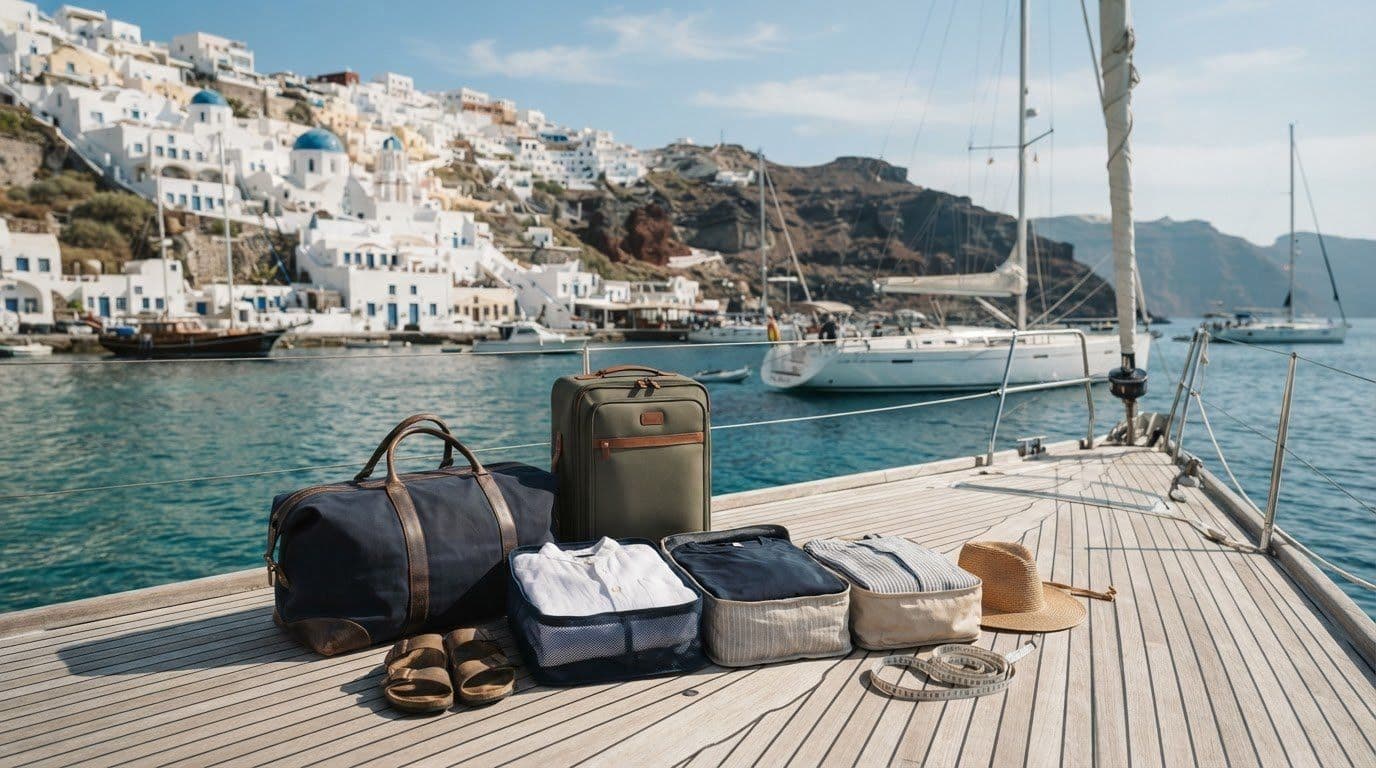
The suitcase that glides through the airport may be the one that’s hardest to stow aboard. That’s why luggage size limitations and soft bag recommendations for charter yachts depend less on a universal measurement and more on the vessel and your travel plans. For a Greek island escape, choosing a bag that is easy to handle and suited to the journey can make the transition from flight to yacht feel more effortless.
Airline baggage allowances and yacht storage are separate considerations. A rigid case may meet your flight requirements but be awkward to handle in a cabin with limited or unusually shaped storage. A soft bag can be more adaptable, but it still needs to be a manageable size when packed.
This guide explains how to compare bag styles, measure your luggage after packing, and choose what to bring. It also covers which details to share during charter planning, so luggage can be considered alongside your itinerary and vessel. A little preparation leaves more room to enjoy an unhurried Greek yacht journey.
Key Takeaways
- Choose a bag for flexibility and easy handling, then compare how different styles suit your charter plans.
- Measure the packed bag at its fullest points, including handles, wheels, and external pockets.
- Use luggage size limitations and soft bag recommendations for charter yachts as planning guidance, not as a universal limit.
- Pack versatile clothing and essential personal items, and leave less-used extras behind.
- Share the number of bags, their packed dimensions, and any rigid or protruding features during charter planning.
Why Soft Bags Are Often the Practical Choice for a Charter Yacht
Flexible luggage can be easier to handle and reposition during a yacht journey. A soft-sided bag may adjust to available space, while a rigid suitcase keeps the same outer shape wherever it goes. That flexibility is useful, but it does not guarantee that a bag will fit a particular storage area. Useful luggage size limitations and soft bag recommendations for charter yachts start with the bag you plan to bring and the charter you’re taking.
Compare three things: material, shape, and packed size. A soft bag can still be bulky when full, while a structured case may be compact but less adaptable. Think, too, about how you’ll carry it and what you need to access. The right bag is one you can manage comfortably and pack for your itinerary, rather than one chosen by its label alone.
This short video offers another perspective on packing for a yacht charter:
Soft duffel or hard suitcase: what changes in practice?
A duffel bag is typically soft-sided, with a flexible body that can be easier to carry and reposition than a hard-shell case. It may adapt to available space, while a rigid suitcase keeps its shape and can provide a more structured way to organise belongings. Consider access as well: a duffel’s main opening may make clothing easy to reach, while compartments in a suitcase can help keep smaller items organised. Compare the design and packed shape, not just the bag type.
Soft-sided does not automatically mean small or lightweight. A large duffel packed full may be cumbersome to lift or store. Check the bag after packing, including straps and anything attached to the outside. A compact structured case may suit someone who values organised compartments or firmer protection for particular belongings, provided its fixed shape works with the travel plan.
Why charter yacht luggage advice varies
Vessel layout and itinerary both shape what’s practical. The length and pace of your trip, how the luggage will be handled, and what you intend to bring all affect your choice. A yacht’s general profile alone cannot establish a personal luggage allowance. Explore the Greek yacht charter options as part of planning, and consider your luggage alongside the specific charter rather than relying on a generic measurement.
Luggage suitability depends on the specific charter context. Share the number of bags, their packed dimensions, and any details that affect how they’re handled. This gives the planning conversation useful information without assuming every yacht has the same layout or storage. The goal is a bag that’s manageable and suited to the journey, leaving you free to settle into the unhurried pace of a Greek yacht charter.
How to Assess Luggage Size Before Your Yacht Charter
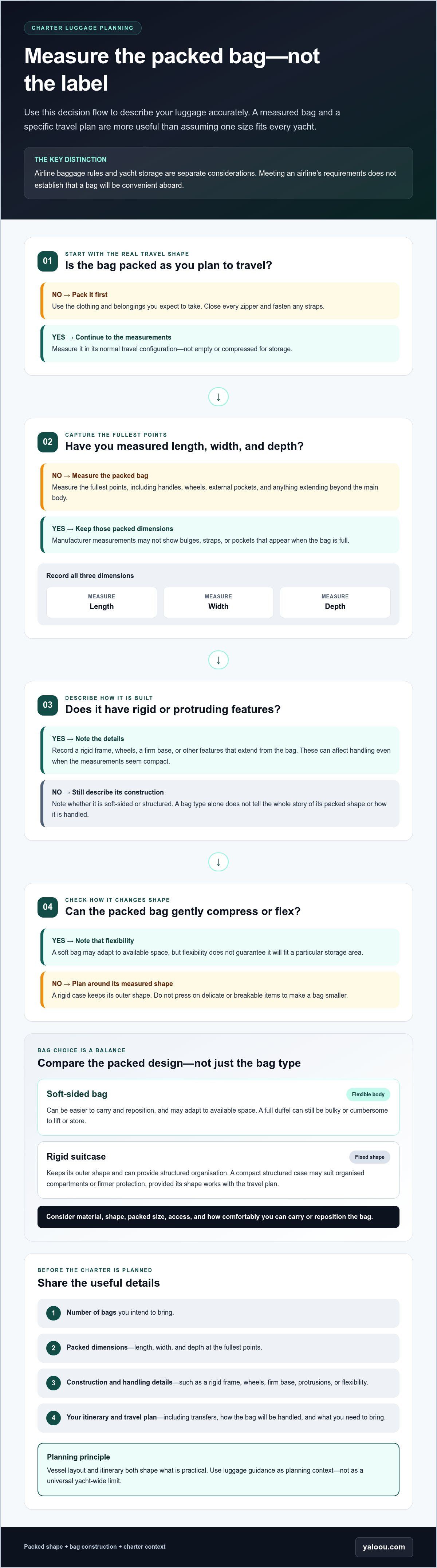
Start with the bag you intend to bring, packed as you’ll travel with it. Manufacturer measurements may not reflect bulges, straps, or pockets that appear once the bag is full. Measuring its actual packed shape gives you useful details to share during charter planning, without relying on an assumed yacht-wide limit.
A simple pre-trip bag measurement checklist
Measure the bag in its normal travel configuration, not while it’s empty or compressed for storage. These steps will give you a clearer picture of the space it takes up and how it may be handled.
- Pack it as planned. Use the clothing and belongings you expect to take. Close every zipper and fasten any straps.
- Measure length, width, and depth. Measure the fullest points of the packed bag. Include handles, wheels, external pockets, and anything else that extends beyond the main body.
- Note its structure. Record whether it has a rigid frame, wheels, a firm base, or other protruding features. These can affect handling even when the measurements seem compact.
- Test its flexibility. See whether the bag can gently compress or change shape. Don’t press on delicate or breakable items just to make it smaller.
- Compare packed and empty shapes. A soft bag may fold down when empty but expand substantially when filled. Use the packed dimensions for planning.
Keep the measurements with a short note about the bag’s construction. That gives the charter-planning conversation more useful detail than calling it “small” or “soft.” It also helps distinguish bags that sound similar but behave differently once packed.
Match your luggage to the journey
Flight baggage rules and yacht luggage considerations are separate. Check the specific airline’s current allowance for the bag you plan to fly with, then consider how its shape and packed size will work for the yacht portion of your trip. Meeting an airline’s requirements does not establish that a bag will be convenient aboard.
Think through the journey from door to cabin. Will you carry the bag through transfers, handle it more than once, or need quick access to particular items? A wheeled case may roll conveniently over some surfaces, while a soft bag with comfortable handles may be easier to lift or reposition. The better choice depends on your route, contents, and how the luggage will be handled.
Your itinerary also influences what you pack and how much space your belongings take up. As you shape your plans, explore Greek yacht experiences and consider how each part of the journey affects your luggage choices.
Share the bag’s packed dimensions and any rigid or protruding features during charter planning. That makes it possible to consider practical details in context instead of guessing. Luggage size limitations and soft bag recommendations for charter yachts are most useful when they’re based on a measured bag and a specific travel plan.
Choosing Luggage for Different Charter Yacht Plans
Choose luggage with the whole charter in mind, not just the time spent aboard. Your travel arrangements, how often the bag will be handled, and what you need to reach during the journey all matter. A flexible bag may suit one plan, while a compact structured case may suit another. Neither style is right for every guest.
Use this comparison to assess how different designs behave. It covers general handling considerations, not the storage capacity of any particular yacht.
Bag typeFlexibility and structureHandling and packing accessPlanning consideration
Soft duffel
Flexible body, little built-in structure
Often easy to carry; access depends on the opening and internal organisation
Consider how it holds its shape when fully packed
Structured soft-sided bag
Some shape support with more give than a rigid case
May offer easier organisation; handles and added structure affect handling
Check whether the packed form can adapt to the journey
Hard-shell suitcase
Rigid shape that won’t compress
Wheels can help with rolling; compartments may keep belongings organised
Account for the fixed outer dimensions and how it will be carried or moved
As you compare options, explore the YAL’OOU yacht fleet as part of shaping your charter plans. YAL’OOU’s fleet includes the Tesoro 40 Inboard, Baglietto 100, and 83 Tecnomar Velvet. The aim is not to match a bag to an assumed capacity. Instead, consider your actual itinerary and travel arrangements, then share relevant luggage details during planning. Luggage size limitations and soft bag recommendations for charter yachts are planning prompts, not universal measurements.
When a compact soft bag suits the trip
A compact soft bag can be convenient if you want luggage that’s straightforward to carry and adaptable during transfers and boarding. Keep frequently used items, such as travel documents or a light layer, in a small personal bag so you don’t need to reopen your main luggage each time. This is a practical option, not a required configuration. Choose based on what you’re bringing and how you’ll travel.
When to think carefully about a structured case
Some travellers prefer a structured case because compartments help organise belongings or a firmer exterior suits the items they’re carrying. Assess the case fully packed, including its fixed shape, wheels, and handles, rather than relying on a label such as “carry-on” or “compact.” Include the packed dimensions in charter planning so the case can be considered alongside the vessel and travel arrangements.
Let your itinerary guide the decision. If you’re exploring Greek yacht experiences, consider what you’ll need close at hand and how your bag will move with you throughout the journey. A considered luggage choice keeps practical details simple, so you can focus on the experience.
Charter Yacht Packing: What to Bring and Leave
Pack for comfort and ease, not for every possibility. A useful, compact set of belongings is simpler to carry and manage throughout a yacht journey. Focus on versatile clothing and essential personal items, then leave duplicates and bulky packaging behind. This is not a complete destination packing list. It’s a way to make what you bring work harder while keeping luggage manageable.
Pack a compact, useful set of essentials
Choose items that serve more than one purpose where practical. Clothing that can be layered or worn in different settings helps avoid packing separate outfits for every plan. Think through what you’ll genuinely use, and remove “just in case” extras that duplicate something already in your bag.
Group small belongings so they don’t spread through the main compartment. A pouch for toiletries and another for chargers or personal accessories can keep things easy to find. Keep items you’ll need during travel separate from belongings you can leave packed until you arrive.
- Keep close: travel documents, phone, and items needed during transfers.
- Pack together: toiletries and small accessories, using compact organisers where helpful.
- Choose thoughtfully: versatile clothing and essential personal items suited to your plans.
- Leave out: duplicate items, unnecessary extras, and bulky retail packaging.
Accessible packing makes a difference. Put transfer essentials in a small personal bag or an easy-to-reach pocket, rather than burying them under clothing. That way, you can find what you need without unpacking the main bag during each leg of the journey.
A final luggage check before departure
Once you’ve edited your packing list, close the bag as you’ll carry it and check its shape. Remove outer packaging that adds bulk without protecting anything you need. Recheck the packed dimensions, including handles, wheels, and pockets, and make sure the bag isn’t stretched so tightly that it’s difficult to close or handle.
Then do a quick access test. Can you reach your documents and transfer essentials without emptying the bag? Are small items grouped, and have you removed duplicates? Reviewing the packed bag can help you avoid carrying items that add volume without adding much value.
A yacht-friendly bag is manageable, thoughtfully packed, easy to access, and suited to the charter plan. That’s a more useful checklist than packing to an assumed universal limit. The practical side of luggage planning fits naturally into shaping a considered trip. Explore Greek yacht experiences as you plan what to bring and how you want the journey to feel.
Make Luggage Planning Part of Your Greek Yacht Charter
A smooth charter begins before you reach the marina. Choose a bag that suits your needs, measure it once packed, and consider how it fits into the wider journey. There’s no single measurement that answers every luggage question. A practical plan takes the charter and travel arrangements into account.
Sharing useful luggage details makes planning more specific. A bag’s dimensions and construction offer more context than a general description such as “medium suitcase.” They also help connect your luggage choice to your itinerary and the yacht selected for your experience, without assuming every vessel has the same layout or storage.
What to share during charter planning
Include the number of bags, each bag’s packed dimensions, and any handling details that could affect the journey. For example, note whether a case has wheels or a rigid frame, or whether a soft bag can change shape. Mention which items need to stay accessible during transfers. These details help shape practical planning around your charter, rather than a generic luggage rule.
Itinerary context matters. A bag that works well for one set of travel arrangements may be less convenient if it needs to be moved between several parts of the journey. Think through how you’ll carry it, when you’ll need particular belongings, and what you intend to bring. Share that context alongside your measurements.
If you’re considering the Tesoro 40 Inboard, Baglietto 100, or 83 Tecnomar Velvet, treat the yacht choice as part of the planning conversation, not as a basis for guessing luggage capacity. Your actual bag and charter context are more useful guides than a yacht’s name or general category.
From packing checklist to a more personal charter
The most useful takeaway from luggage size limitations and soft bag recommendations for charter yachts is simple: select a manageable bag, assess it fully packed, and share the details as your plans take shape. A considered approach keeps practical decisions clear and the focus on the experience ahead.
YAL’OOU brings privacy, personal service, and authentic Greek hospitality to yacht experiences. Thoughtful luggage planning is one small part of an unhurried journey. It helps you arrive prepared, settle in, and spend less time dealing with bags. Keep notes about bag count, dimensions, and handling needs close as you refine your charter plans.
Ready to shape the journey around what matters to you? Explore private yacht experiences and begin imagining your time on the water.
Let the Journey Begin with Ease
The details you plan before departure can shape how relaxed the journey feels once it begins. Treat luggage choices as part of the experience, not a separate packing puzzle. The right approach to luggage size limitations and soft bag recommendations for charter yachts is personal: it should support your travel plans and make room for the pace you want from your time in Greece.
YAL’OOU coordinates private yacht experiences and charter logistics, bringing practical planning into the wider picture of your trip. Whether you’re considering Mykonos, Paros, Antiparos, Athens, Aegina, Poros, Spetses, Syros, Tinos, Sifnos, Serifos, Milos, Poliaigos, Kimolos, Santorini, Ios, Koufonisia, Amorgos, Crete, Corfu, or Zakinthos, a considered luggage plan helps keep the focus on the moments that matter.
Explore private yacht experiences in Greece and take the next step toward a journey shaped around you.
Frequently Asked Questions
Can I bring a hard suitcase on a charter yacht?
Yes, a hard suitcase isn’t automatically ruled out, but its fixed shape may be less adaptable than a soft-sided bag. Consider what you’re carrying and how the case will be handled between the airport, transfers, and yacht. Measure it when packed, including wheels and handles, and share its dimensions during charter planning. This gives the planning team useful context without assuming every yacht has the same luggage allowance.
What size luggage should I bring on a yacht charter?
There’s no single size that suits every yacht charter. The practical choice depends on the vessel and your trip, so a generic measurement can be misleading. For luggage size limitations and soft bag recommendations for charter yachts, focus on a bag you can handle comfortably and that suits your travel arrangements. Record its dimensions when packed and share them during planning rather than guessing at onboard storage.
Are soft bags better than hard suitcases for yacht charters?
Soft bags are often recommended because they can adapt more readily to handling and storage situations. Still, a large, fully packed duffel may be cumbersome, while a compact hard case may suit someone who wants organised compartments. Compare how each option behaves when packed, how easy it is to carry, and what you need to access. The better choice is the one that fits your particular journey.
How do I measure luggage for a yacht trip?
Pack the bag as you intend to travel, then measure its length, width, and depth at the fullest points. Include anything that sticks out, such as wheels, handles, or outside pockets. Fasten straps as they’ll be during travel. Note whether the bag has a rigid frame or can safely compress, then share the measurements and those details during charter planning.
Should I follow airline baggage limits or yacht luggage guidance?
Treat them as separate checks. Your airline’s baggage policy governs the flight, while practical yacht luggage needs depend on the charter arrangements. For a Greek itinerary involving places such as Mykonos, Paros, Antiparos, Athens, Aegina, Poros, Spetses, Syros, Tinos, Sifnos, Serifos, Milos, Poliaigos, Kimolos, Santorini, Ios, Koufonisia, Amorgos, Crete, Corfu, or Zakinthos, plan for the whole route and share your packed bag details.
What should I pack in a soft bag for a yacht charter?
Prioritise useful essentials that match your itinerary and personal needs. Versatile clothing can work across different plans, while a small pouch keeps toiletries or charging accessories together. Keep travel documents and items you’ll need during transfers easy to reach, rather than burying them under packed belongings. Before leaving, remove duplicate items and bulky packaging. A focused bag is easier to manage than one filled for every hypothetical situation.
Can I use a wheeled duffel on a yacht charter?
A wheeled duffel can suit some travellers, but its wheels, frame, and handle affect the shape and handling of the complete bag. Don’t judge it by the soft fabric alone or by the dimensions of its main compartment. Pack it for travel, check how it moves when full, and consider whether you’ll need to lift or reposition it along the way. Share its overall dimensions during charter planning.
Disclaimer
The YAL’OOU Travel Guide is curated with care to inspire and inform discerning travelers. While every effort is made to ensure the accuracy and relevance of the information provided, all content is offered for general guidance only and may evolve over time.
Details such as local regulations, availability, pricing, and services are subject to change without prior notice. We encourage guests to seek personalized advice and confirm arrangements directly when planning their journeys.
YAL’OOU accepts no liability for any inaccuracies, omissions, or outcomes arising from the use of this information. The Travel Guide may feature recommendations, insights, and selected third-party experiences, presented solely as a source of inspiration and not as formal endorsements.
By accessing this section of our website, you acknowledge and accept this disclaimer as part of your experience with YAL’OOU.