
What if the passenger limit in a yacht’s paperwork isn’t the amount available for your injury? Maritime passenger insurance coverage limits on chartered Greek yachts can look reassuring at a glance, but per-person, per-incident, and policy-period limits answer different questions.
It’s reasonable to expect a yacht’s liability insurance to protect guests, but that cover serves a different purpose from personal travel insurance. Your own policy may address eligible medical costs, trip cancellation, or belongings, while vessel liability cover may respond to certain claims against an insured party. Greek rules set baseline third-party insurance requirements for some vessels, yet a headline limit alone doesn’t show what applies to your circumstances.
This guide explains the main layers of protection, where limits and exclusions can matter, and how to review the charter documents, insurance certificate, and territorial wording before departure. You’ll come away with clearer expectations about passenger liability and what separate cover may be relevant. Understanding these details is one practical part of preparing for a Greek voyage, alongside route and charter planning.
Key Takeaways
- Learn how vessel liability cover differs from personal travel insurance, so you can see which policy may address each kind of risk.
- Understand how per-person, per-incident, and aggregate limits work, and why deductibles, exclusions, and defence costs matter.
- Compare protection types by whose interests they serve and which policy wording deserves a closer look.
- Review the charter agreement and insurance documents for insured parties, limits, exclusions, and voyage scope before departure.
- Use this guide to make sense of maritime passenger insurance coverage limits on chartered Greek yachts and prepare with clearer expectations.
What passenger insurance means on a chartered Greek yacht
Vessel liability cover and a passenger’s personal insurance serve different purposes. The yacht’s policy may respond to certain claims alleging that the vessel owner or operator is legally responsible for an injury. Your own travel policy may instead address eligible medical expenses, cancellation, or assistance. Neither label alone tells you which protection applies to a particular event.
In plain English, “passenger liability insurance” describes cover for specified legal liabilities involving passengers. It isn’t a universal policy name or a promise that every onboard accident is covered. For broader context on marine insurance and protection and indemnity cover, see Understanding Marine Insurance.
To see why passenger numbers and vessel category can matter, watch this video:
What does passenger liability insurance generally address?
Depending on the policy, liability cover may apply to claims connected with passenger or third-party injury for which an insured party is legally liable. It is not automatically a fund that reimburses a guest’s treatment costs, pays for medical evacuation, or arranges travel assistance. Those benefits may sit under personal travel insurance or another separate policy, each with its own eligibility rules and limits.
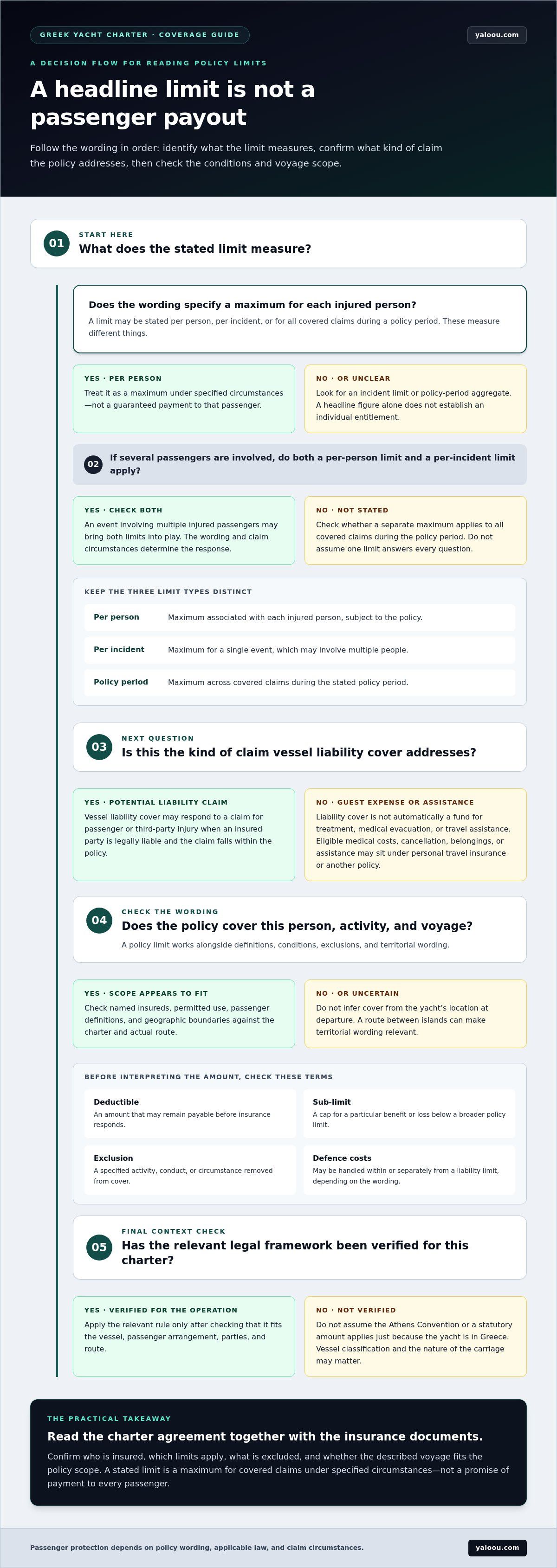
Coverage limits are the maximum amounts an insurer may pay for covered claims under specified circumstances, subject to the policy wording and applicable law. A stated limit is not a guaranteed payout to each passenger. The claim must fall within the cover, and the policy may define how limits apply, who qualifies as an insured party, and which events are excluded.
Why a Greek yacht charter needs context
Start with the actual voyage, not just the word “yacht.” Vessel type, charter arrangement, route, and the policy’s territorial scope can all shape which terms apply. A privately arranged, crewed charter is not automatically treated like scheduled passenger transport; relevant rules and insurance wording depend on the vessel and operation. Avoid assuming that one passenger limit applies to every Greek charter.
Read the charter agreement alongside the insurance documents. Pay attention to named insureds, permitted use, passenger definitions, and geographic boundaries. A route between islands can make territorial wording especially relevant. Check that the described voyage fits the policy’s scope rather than inferring coverage from the yacht’s location at departure. For a broader look at how crew, routes, and guest logistics shape a Greek charter, explore this Greek yacht charter guide.
YAL’OOU coordinates crewed yacht charters and tailored routes across Greece. Its Greek yacht charter options form part of a considered voyage plan. Reviewing insurance is a separate step: read the wording before departure and keep the relevant documents accessible while you travel.
How maritime passenger coverage limits work on Greek charters
A policy limit only makes sense once you know what it measures. The wording may set a maximum for each injured person, each incident involving multiple people, or all covered claims during a policy period. These are distinct structures, not universal defaults for every Greek charter. A high figure in one category doesn’t tell you the available amount in another.
Never infer an individual passenger entitlement from a headline limit alone. For example, a hypothetical policy might state one maximum per person and a separate, lower maximum for a single event. If several passengers are injured in the same event, both limits could be relevant. The actual response would depend on the policy language, applicable law, and circumstances of the claim, not this simplified example.
Which legal frameworks may be relevant?
The Athens Convention concerns the carriage of passengers and their luggage by sea, but its relevance can’t be assumed from a yacht’s location in Greece. Vessel classification, the nature of the carriage, the parties, and the route may affect whether a convention or national or EU rules apply. The International Maritime Organization outlines the convention’s liability framework on its IMO Regulations on Passenger Liability page. Treat it as context, not proof that a particular charter falls within its scope.
Before relying on a statutory amount or requirement, check the current legal text against the specific vessel, passenger arrangement, and voyage. A privately arranged crewed charter and scheduled passenger service may raise different questions. Don’t transfer a figure or rule from one type of operation to another without verifying that it applies.
What a policy limit does, and does not, tell you
Limits work alongside conditions that define who is insured, which events qualify, and where the policy applies. Other terms can affect the practical value of cover:
- Deductibles specify an amount that may remain payable before insurance responds.
- Sub-limits cap payment for a particular benefit or type of loss below a broader policy limit.
- Exclusions remove specified activities, conduct, or circumstances from cover.
- Defence costs may be handled within or separately from a liability limit, depending on the wording.
Consider a clearly hypothetical case: a guest is injured during an onboard activity. The policy might define whether that activity is covered, which party is insured, and whether legal costs reduce the amount available for a settlement. This example predicts no claim outcome. It shows why the clauses around a limit matter as much as the number itself.
When reviewing maritime passenger insurance coverage limits on chartered Greek yachts, compare each limit with its definitions, exclusions, and territorial scope. Those details also help you plan the practical side of a Greek voyage. Explore Greek yacht experiences as part of shaping a considered itinerary.
Compare vessel liability, travel insurance, and other passenger protection
These policies can address different people and different losses. A yacht’s liability cover may respond to a covered claim against an insured vessel owner or operator. Personal travel insurance may protect the traveller against specified expenses. Optional activity-related cover may apply to particular sports or excursions, subject to its own terms. Policies vary, so don’t assume one arrangement applies to every charter.
Protection layerWho it may insurePotential purposeTerms to inspect
Vessel liability
The insured owner, operator, or other parties named in the policy
Covered legal liability for specified injury or damage claims
Passenger definitions, covered operations, limits, exclusions, territorial scope, and defence costs
Personal travel insurance
The traveller named or eligible under the policy
Possible reimbursement for eligible medical costs, trip interruption, or evacuation
Medical limits, sailing and water-sport terms, pre-existing conditions, excesses, and assistance conditions
Optional activity-related cover
The participant or other insured parties defined in the wording
Specified risks linked to an activity, where the policy provides for them
Covered activities, equipment or location restrictions, safety conditions, and exclusions
What personal travel insurance may cover
Your travel policy may include benefits for medical expenses, trip interruption, or evacuation, but these are not automatic. Check the benefit definitions, limits, claim conditions, and any requirement to use an assistance service. Sailing, water sports, and offshore activities can have separate terms or exclusions. Read your policy documents and identify the exact activity and itinerary described, rather than assuming general travel cover includes every part of a yacht trip.
Where vessel liability and personal cover may differ
Liability insurance generally concerns a claim alleging legal responsibility by an insured party. Personal cover concerns losses the traveller claims under their own policy, subject to its conditions. One may not replace the other, and neither necessarily responds to every expense. For instance, if a guest slips aboard and needs treatment, a liability claim and a personal medical claim would be assessed under different policy terms. This example doesn’t determine fault or predict payment.
For maritime passenger insurance coverage limits on chartered Greek yachts, compare the policyholder, beneficiary, and covered event, not just the policy title. Note whether medical costs are paid directly, reimbursed, or excluded, and whether activity cover requires advance arrangements. Keep the documents for each layer together so the distinctions are easy to review before departure.
Vessel choice and route planning go hand in hand. Explore YAL’OOU yacht charter options as you consider the kind of Greek voyage you want. Then assess each relevant policy against those plans, without assuming that choosing a vessel determines a passenger’s personal cover.
Review charter documents and coverage before sailing in Greece
Give the paperwork a focused review before departure. The charter agreement describes the arrangement, while insurance documents set out who and what may be covered. Compare both with the planned route and activities. This sequence helps you identify questions early without treating a certificate or headline limit as a complete explanation of protection.
A practical policy and charter-document checklist
Gather the charter agreement, policy schedule or certificate, full policy wording, and any relevant personal travel policy. Then work through these checks:
- Identify insured parties. See how the documents describe the vessel, owner or operator, crew, and guests. Check whether named passengers or defined classes of people are included.
- Read the limits. Match each stated amount to its basis, such as per person, per event, or policy period. Note any deductible or sub-limit that may affect a particular benefit.
- Check exclusions and conditions. Find the definitions, exclusions, and claims procedure. Look for conditions tied to activities, conduct, or how and when a claim must be reported.
- Compare the voyage scope. Check that the stated territory, permitted use, and planned itinerary align. Greek island routes can span different ports and areas, so compare the actual plan with the wording rather than assuming the whole route is covered.
Keep insurer or assistance contact details accessible, along with the policy reference. Note any claims-notification deadline and what the wording says to preserve, such as receipts, medical records, incident details, or correspondence. These requirements are policy-specific; recording them is useful preparation, not a substitute for professional advice.
Questions that clarify protection without assuming a claim
Use the wording to answer practical questions. Does personal cover describe medical expenses, repatriation, or emergency response, and under what conditions? Are planned water activities included, restricted, or excluded? Would a route change affect the stated territorial scope? Compare answers across the charter documents and personal policies. If clauses conflict or remain unclear, seek qualified interpretation before relying on an assumption.
For maritime passenger insurance coverage limits on chartered Greek yachts, record the exact clause or page that supports each answer. This makes it easier to distinguish what the documents state from what still needs clarification. Keep relevant records during the trip, and follow the policy’s own notification and documentation instructions if an incident occurs.
Route planning is part of this review. Compare your intended ports and sailing area with Greek island yacht itineraries as you shape a well-coordinated voyage. With your documents and route aligned, plan your Greek yacht experience with clearer expectations for the journey.
Plan a Greek yacht charter with clear expectations about protection
A well-prepared voyage brings two kinds of planning together: understanding your insurance documents and shaping a route that suits your trip. Keep them distinct. Insurance wording determines whether a particular person, activity, or location falls within a policy. Route and crew coordination help organise the charter experience, but they don’t determine or guarantee an insurance outcome.
Turn coverage questions into better voyage planning
Use your intended destinations, charter duration, and planned activities as a checklist for reviewing your policies. A route that includes several islands, for example, gives you specific locations to compare with territorial wording. If you’re considering swimming, watersports, or other activities, check how your personal policy treats each one. A change to the route or plans is also a reason to reread the relevant terms.
Before departure, bring together the charter agreement, relevant vessel insurance documents, and each guest’s personal policy details. Note the clauses that explain covered people and activities, geographic scope, emergency procedures, and claim notification. If the wording is unclear, qualified insurance or legal interpretation is separate from charter planning. For a broader perspective on preparing a private voyage, see this luxury yacht charter planning guide.
- Match policy territory to the planned destinations.
- Compare activity terms with the experiences you expect to enjoy.
- Keep policy references and emergency contacts accessible to the group.
- Review any itinerary change against the relevant wording.
This approach turns maritime passenger insurance coverage limits on chartered Greek yachts from an abstract figure into practical questions. It won’t establish that a claim is covered, but it can help you spot uncertainty before the journey begins and seek appropriate interpretation in good time.
Explore a considered Greek charter experience
Once the policy review is underway, give the itinerary the same thoughtful attention. YAL’OOU coordinates crewed yacht charters, tailored routes, crews, and guest logistics across Greek destinations. A considered plan can bring together the places you hope to visit and the pace you want from the voyage, while keeping insurance interpretation a separate matter.
For more planning context, explore YAL’OOU’s Greek charter experiences. Enjoy the anticipation of the islands with clear expectations, the right documents close at hand, and a voyage plan shaped around your priorities.
Explore Greek charter experiences and start imagining your time on the water.
Set the course for a more considered Greek escape
Clear expectations make it easier to focus on the experience you want from your time at sea. Treat maritime passenger insurance coverage limits on chartered Greek yachts as one part of your preparation, and let your chosen destinations, pace, and activities guide the questions you resolve before departure. The aim isn’t to remove every uncertainty. It’s to make informed choices and begin the voyage feeling prepared.
With protection questions handled separately, you can turn your attention to the journey itself. YAL’OOU coordinates daily and weekly crewed yacht charters across Greek destinations, with tailored routes and crew coordination to support a seamless charter experience. Picture island-to-island days shaped around your plans, with the freedom to enjoy Greece from the water.
Explore curated Greek yacht charter experiences and start planning a voyage that feels like your own.
Frequently Asked Questions
Is passenger insurance compulsory on a chartered yacht in Greece?
Greek law requires certain pleasure and small tourist vessels under 300 gross tonnage to carry third-party liability insurance, but that is vessel insurance, not a requirement for every guest to buy personal travel insurance. The rule’s application depends on the vessel and operation. Before sailing, review the onboard insurance certificate and charter documents for the specific yacht, and consult a qualified professional if you need advice on how current law applies.
Does yacht liability insurance cover every passenger’s medical bills?
No. Vessel liability insurance shouldn’t be treated as automatic medical cover for every guest. It may respond to specified liability claims, while medical expenses or emergency assistance may fall under a passenger’s own travel policy, if included. For example, a guest who needs treatment may need to check their personal policy’s medical-benefit procedure separately from any vessel-related claim. Follow the relevant policy instructions and retain medical records and receipts.
Can my travel insurance cover me while sailing in Greece?
It may, but cover depends on your policy and the activity. Before travelling, search the wording for sailing, yacht trips, watersports, and offshore activities. Check any restrictions based on whether you’re a passenger or participating in an activity, along with medical and evacuation conditions. If your plans include swimming or watersports near Mykonos or Paros, don’t assume general holiday cover applies. Look for wording that addresses those activities specifically.
How much passenger insurance coverage does a Greek yacht charter include?
There isn’t one universal amount that applies to every Greek yacht charter. Cover and limits depend on the vessel, charter operation, applicable rules, and policy terms. Check the yacht’s insurance certificate and policy schedule for the limits and how they apply, including any per-person or per-incident caps. A headline figure alone doesn’t establish what an individual passenger could receive. Seek qualified interpretation if a limit or legal requirement is unclear.
What happens if a passenger is injured on a chartered Greek yacht?
Prioritise immediate safety and medical care, then notify the skipper or crew so the incident can be recorded. Follow emergency and reporting instructions in the relevant policies. Note the time, location, and circumstances, and keep medical documents, receipts, and relevant communications. Avoid assuming who is legally responsible or which insurer will pay. Each policy has its own notification procedure and deadlines, so use the documents rather than relying on a general timeline.
Are yacht crew covered by the same insurance as passengers?
Not necessarily. Crew may be insured under different sections or policies from passengers, and the scope can depend on their role, employment arrangement, and the vessel’s cover. A passenger-liability clause alone doesn’t show whether crew injury or medical needs are included. When reviewing charter paperwork, check how it describes crew protection separately from guest cover. The wording and applicable rules determine the answer for a particular yacht and voyage.
Does passenger coverage apply to every Greek island on an itinerary?
Not automatically. The policy’s territorial wording and the insured voyage determine where cover may apply, so compare them with the planned route and any changes. This matters whether you’re sailing near Athens and Aegina, through Mykonos, Paros, Antiparos, Syros, Tinos, Sifnos, Serifos, Milos, Poliaigos, Kimolos, Santorini, Ios, Koufonisia, Amorgos, Crete, Corfu, Zakynthos, Poros, or Spetses. Don’t infer scope from a Greek itinerary alone.
What documents should I review before a Greek yacht charter?
Review the signed charter agreement, the yacht’s insurance certificate or schedule, and the full relevant policy wording, including definitions, exclusions, and claims instructions. Read your own travel policy too, especially sections on medical treatment, evacuation, and planned activities. Keep copies of policy references, emergency contacts, and any required travel documents accessible to your group. If documents use unclear or conflicting terms, get qualified insurance or legal guidance before departure.
Disclaimer
The YAL’OOU Travel Guide is curated with care to inspire and inform discerning travelers. While every effort is made to ensure the accuracy and relevance of the information provided, all content is offered for general guidance only and may evolve over time.
Details such as local regulations, availability, pricing, and services are subject to change without prior notice. We encourage guests to seek personalized advice and confirm arrangements directly when planning their journeys.
YAL’OOU accepts no liability for any inaccuracies, omissions, or outcomes arising from the use of this information. The Travel Guide may feature recommendations, insights, and selected third-party experiences, presented solely as a source of inspiration and not as formal endorsements.
By accessing this section of our website, you acknowledge and accept this disclaimer as part of your experience with YAL’OOU.