
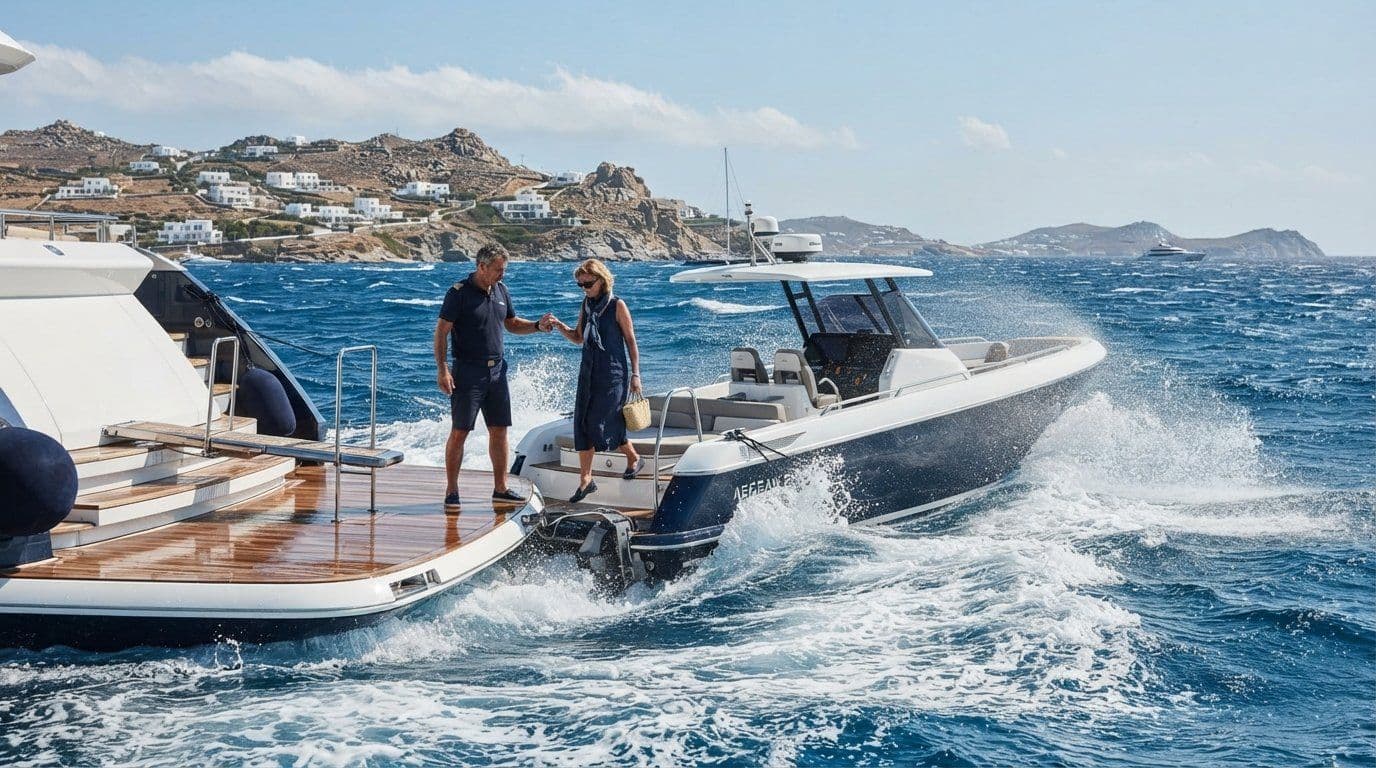
Imagine standing on the swim platform of a 50-meter superyacht while the Aegean churns with a Force 7 Meltemi blow. The tender looks small against the whitecaps, and the thought of that first step across the gap feels more like a leap of faith than a luxury transfer. You're not alone in that hesitation. Even the most seasoned charter guests feel a twinge of anxiety when the "square chop" of the Cyclades turns a simple trip to shore into a wet, bumpy ordeal. Implementing rigorous superyacht tender safety protocols in choppy Greek waters is the only way to turn these challenging conditions into a seamless, dry experience.
We understand that luxury shouldn't stop when the wind picks up. It's why modern standards have evolved to prioritize your comfort as much as your security. In this 2026 checklist, you'll master the essential safety standards and operational protocols that ensure seamless guest transfers during the Aegean’s challenging Meltemi season. We'll break down the specific equipment that makes a tender "sea-kindly," from deep-V hulls like the Tesoro 40 to shock-mitigation seating. You'll gain a clear understanding of what to expect from an expert crew, giving you the confidence to step off the mothership and into the adventure without a second thought.
Key Takeaways
- Learn why the Aegean's "square chop" requires specialized handling and equipment compared to standard oceanic swells.
- Master the essential superyacht tender safety protocols in choppy Greek waters to guarantee dry, secure guest transfers even during peak Meltemi season.
- Discover why technical features like Deep-V hull architecture and inboard engines are non-negotiable for stability in the Cyclades.
- Understand the boarding etiquette and timing techniques used by expert crews to eliminate anxiety during rough-water transitions.
- See how YAL’OOU integrates high-level maritime safety into a seamless VIP concierge experience for ultimate peace of mind.
Understanding the Aegean "Meltemi" and Its Impact on Tender Safety
The Aegean Sea operates under a unique set of meteorological rules, primarily driven by the Aegean Meltemi winds. These powerful, dry north winds define the summer season across the Cyclades. While they provide a refreshing breeze on land, they can transform a calm bay into a challenging sea state within minutes. Mastering superyacht tender safety protocols in choppy Greek waters begins with a deep respect for these patterns. It’s not just about engine power; it’s about understanding how wind and geography interact to create the conditions you’ll face during a transfer.
To better understand the dynamics of handling a vessel in these conditions, watch this helpful video:
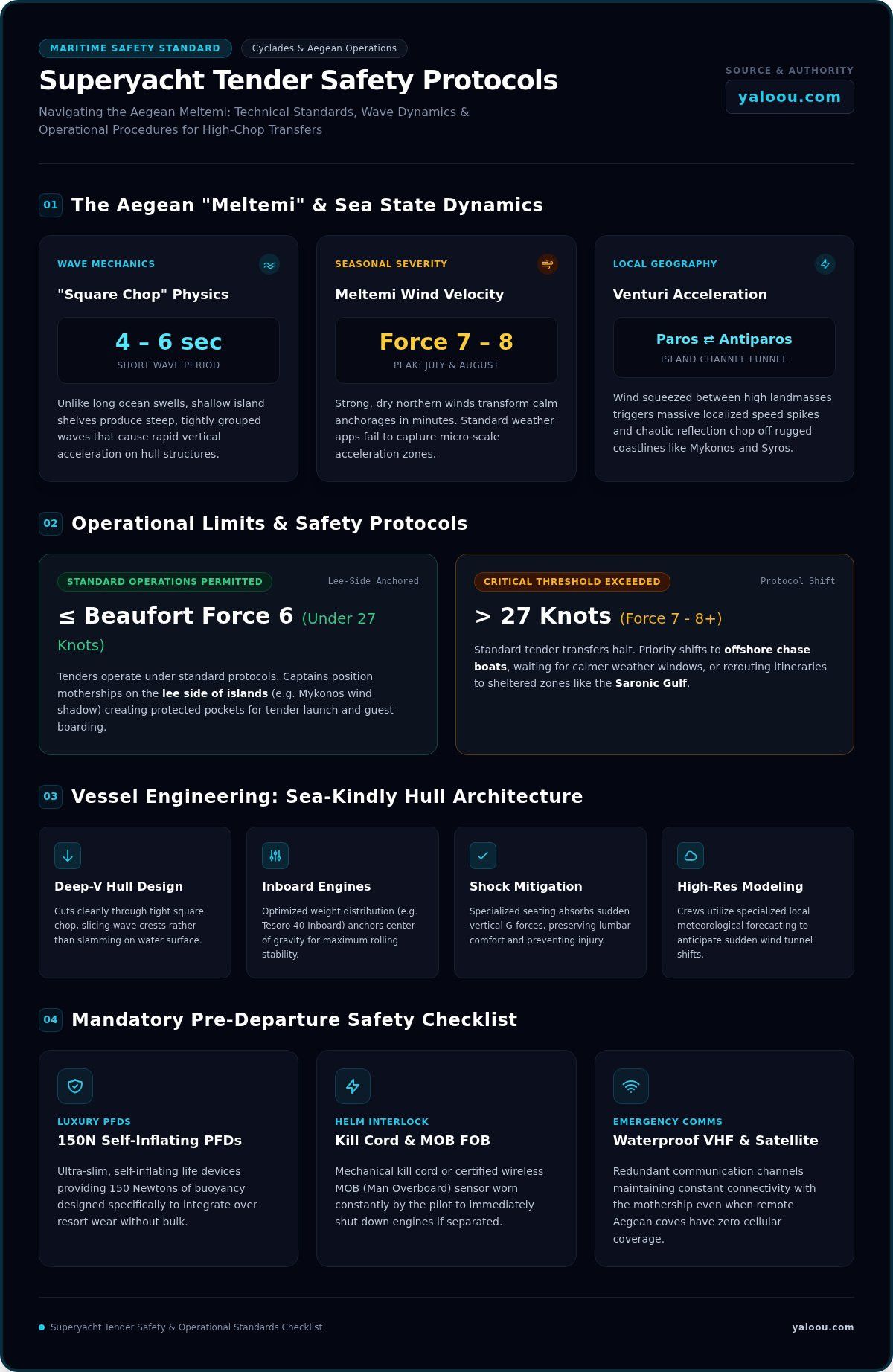
Aegean waves are distinct from the long, rolling swells of the open ocean. Because the sea is relatively shallow between island shelves, it produces what sailors call "square chop." These waves are steep, tightly grouped, and have short periods of only 4 to 6 seconds. When these waves hit the rugged coastlines of Mykonos or Syros, they reflect back, creating a confused sea state. This leads to rapid vertical acceleration, which is why specialized hull designs are a requirement for guest comfort.
The Local Science of Greek Sea Conditions
Geography plays a major role in wind intensity. When the Meltemi is squeezed between high landmasses, such as the channel between Paros and Antiparos, it triggers a venturi effect. This accelerates wind speeds significantly compared to the open sea. The Meltemi wind season typically peaks in July and August, often reaching sustained Force 7 or 8 conditions. Local expertise is vital here, as generic weather apps rarely account for these localized wind tunnels. Our crews rely on high-resolution modeling to predict these shifts before they impact your journey.
Risk Assessment in the Cyclades
Proactive safety means choosing the right anchorage. Captains prioritize the "lee side" of islands, using the natural elevation of places like Mykonos to create a wind shadow. This provides a calm pocket for launching stable vessels like the Tesoro 40 Inboard. Standard superyacht tender safety protocols in choppy Greek waters suggest a safety threshold of Beaufort Force 6. Once winds exceed 27 knots, the priority shifts to utilizing offshore chase boats or waiting for a calmer window. For weeks when the Cyclades are particularly active, the Saronic Gulf offers a protected alternative with significantly more sheltered routes.
Pre-Departure Safety Checklist: Essential Protocols for Choppy Conditions
Safety on a superyacht tender isn't a formality; it's the foundation of a relaxed journey. Before the engines even turn over, a professional crew executes a series of precise checks. These superyacht tender safety protocols in choppy Greek waters ensure that the transition from mothership to shore remains a highlight of your day, not a source of stress. It's about proactive management so you can focus on the horizon.
Every transfer begins with a concise guest briefing. You should be informed about seating arrangements, the location of life-saving equipment, and the expected sea state. In 2026, the bulky orange vests of the past have been replaced by modern luxury. Premium fleets utilize ultra-slim, self-inflating PFDs that integrate seamlessly with high-end resort wear. These devices provide 150N of buoyancy without compromising your style or comfort while you're underway.
Technical safety is equally vital. The pilot must always wear a mechanical kill cord or a certified wireless MOB fob. This ensures the engine cuts immediately if the pilot is separated from the helm. In remote Greek coves where cellular service often vanishes, the crew maintains constant contact with the mothership via waterproof VHF radios and satellite backups. This redundant communication is a core requirement of the Large Commercial Yacht Code, ensuring that support is always a single button away.
Crew Readiness and Certification
A high-performance tender is only as safe as its pilot. All YAL’OOU pilots hold Powerboat Level 2 certifications or equivalent commercial endorsements. During heavy chop, a "Deckhand Support" is mandatory. This second crew member manages the lines and provides a steady hand for guests during the boarding process. Since wind and engine noise can drown out speech, the crew uses standardized hand signals to coordinate movements with the mothership's bridge. This silent coordination is a hallmark of a professional team.
The Equipment Safety Audit
The tender itself must be "Aegean-ready" before leaving the swim platform. This includes checking bilge pump redundancy to handle the heavy spray typical of a Meltemi blow. High-grip, non-slip flooring is essential to prevent slips on wet decks when the boat is pitching. Finally, every trip carries an emergency "Go-Bag" containing a first aid kit, thermal blankets, and signaling devices. These small details create a secure environment where safety is handled invisibly but thoroughly. Planning your next island hop? Explore our bespoke experiences to see how we blend safety with pure Aegean luxury.
Technical Excellence: Choosing the Right Tender for the Cyclades
Not all boats are created equal when the Meltemi rises. In the Cyclades, technical excellence is the difference between a smooth transfer and a spine-jarring ordeal. While many believe any RIB can handle the Med, the steep, short-period chop of the Aegean demands specialized naval architecture. Deep-V hull architecture, typically featuring a 24 to 26 degree transom deadrise, is essential. This sharp entry angle slices through waves rather than slamming against them, maintaining momentum and guest comfort. These technical choices are the backbone of effective superyacht tender safety protocols in choppy Greek waters.
Center of gravity is the next critical factor. Inboard engines offer a significant stability advantage over outboards. By housing the engine weight low and central within the hull, the tender experiences less vertical oscillation and pitching. This weight distribution is a luxury necessity in Greece, providing a "planted" feel that outboards often lack in 2-meter swells. Beyond stability, guest attire remains a priority. High-performance tenders utilize aggressive spray rails and significant hull flare to deflect water downward and away. This ensures that even in spray-heavy conditions, you arrive at the beach club looking as sharp as when you left the mothership. All these elements align with the latest SOLAS safety standards for craft operating in adverse weather.
Spotlight on the Tesoro 40 Inboard
The Tesoro 40 Inboard is a masterclass in Aegean-specific design. Its walk-around deck is a game-changer for safety, allowing guests to move securely without climbing over upholstery while the boat is in motion. The Tesoro 40 maintains exceptional seakeeping and directional stability even when facing Beaufort 5 conditions. It's a vessel that understands the unique rhythm of Greek waters, providing a stable platform for Mykonos transfers even when the wind hits 20 knots.
The Baglietto 100 Tender Integration
Managing these tenders requires a mothership with equal technical prowess. Large yachts like the Baglietto 100 utilize hydraulic swim platforms to simplify deployment in rough seas. These platforms submerge slightly, creating a stable water-level dock that minimizes the vertical gap guests must navigate. Integrating these high-spec superyacht tender safety protocols in choppy Greek waters is a core part of a premium crewed yacht charter Greece experience. It ensures that the excitement of the journey never compromises the safety of the destination.
Guest Communication and Boarding Etiquette in Rough Seas
Mastering the technical side of a vessel is only half the battle. The other half is the "human element" of safety. Even the most advanced hull can't compensate for poor boarding technique or guest anxiety. Effective superyacht tender safety protocols in choppy Greek waters rely on clear communication between the crew and guests. It's about transforming a potentially stressful transition into a coordinated, professional maneuver. When you understand the "why" behind the crew's instructions, the Aegean swell becomes just another part of the adventure.
The most important principle you'll learn is the "One Hand for the Boat" rule. This timeless yachtsman’s law dictates that you should always keep one hand free to grip a rail or handle while the other carries out your task. It sounds simple, but it's your primary defense against sudden movements. Timing is the second pillar of a safe transfer. A professional crew will never rush you. They watch the wave cycle, waiting for the precise moment when the tender reaches the peak of the swell and experiences a split-second of neutral buoyancy. That's when you step. It’s a rhythmic process that ensures stability and keeps you dry.
Once onboard, your choice of seat matters. Physics dictates that the aft (rear) and center sections of the boat provide the smoothest ride. The bow acts like a lever, experiencing the most vertical movement, while the stern remains closer to the pivot point. If you’re prone to seasickness, sitting aft and keeping your eyes on the horizon helps your brain sync with the boat's motion. Remember, the captain always has the final word. If the Meltemi gusts exceed safe operational limits, they'll make the call to delay or cancel a transfer. This isn't an inconvenience; it's the ultimate luxury service, prioritizing your well-being above all else. Secure your next Aegean adventure by exploring our exclusive yachting experiences.
The Art of the Safe Embarkation
Boarding in a 1.5-meter swell requires a specific technique known as the "Sailor’s Grip." Instead of holding hands, you and the crew member lock wrists. This creates a much stronger, non-slip connection that can support your full weight if the boat shifts unexpectedly. You should never attempt to board while carrying bags or personal items. The crew will always take your belongings first, leaving both your hands free to focus on the transition. While "no shoes" is the standard yachting rule, choppy transfers are the exception. High-grip, non-marking boat shoes provide the traction you need on a pitching deck, and your crew will advise when it's safer to keep them on.
Comfort During the Crossing
Modern tenders are designed with your comfort in mind, but you should still use the environment to your advantage. The tender’s T-top or Bimini frame isn't just for sun protection; it's a reinforced grab rail designed to handle significant loads. If the ride feels too intense, don't hesitate to speak up. A quick eye-line technique, focusing on a fixed point on the distant island rather than the moving water, can prevent motion sickness before it starts. Open communication is a key part of superyacht tender safety protocols in choppy Greek waters. If you need the pilot to adjust the trim or slow down, just ask. A professional pilot will always prioritize a comfortable "dry ride" over sheer speed.
The YAL’OOU Commitment: Elevating Safety to a Luxury Standard
Safety isn't just a checklist at YAL’OOU Exclusive Yachting & More; it's the foundation of our service philosophy. We believe true luxury is the freedom to explore without a single worry. By integrating rigorous superyacht tender safety protocols in choppy Greek waters, we turn the Aegean’s intensity into a controlled, exhilarating backdrop for your holiday. Our commitment starts long before you step on deck. Every vessel in our fleet undergoes a comprehensive pre-trip safety audit. We check everything from engine telemetry to the latest emergency signaling equipment. This isn't just maintenance; it's maritime security delivered with a high-end concierge touch.
We hand-pick our crews based on more than just their commercial endorsements. We look for deep-seated local roots. Our captains understand the subtle shifts in wind and water that generic weather models miss. This localized expertise ensures that your bespoke experiences in Mykonos and Paros remain flawless. Whether you're heading to a private beach club or a hidden cove, the logistics are managed with surgical precision. We bridge the gap between elite hospitality and professional seamanship. You don't just get a transfer; you get a team dedicated to your absolute peace of mind.
Local Expertise in the Cyclades
Knowledge is our most powerful safety tool. Our captains possess an intimate, lived-in map of the Mykonos and Paros coastlines. They know exactly which bays offer a calm wind shadow when the Meltemi peaks. We don't just follow a static path. We adjust itineraries in real-time based on high-resolution 2026 wind forecasts. If a channel looks too rough, we find a sheltered alternative that keeps the champagne in the glass and the spray off your clothes. A YAL’OOU managed charter means you never have to stress about the "Island of Winds." We handle the complexity so you can enjoy the view.
Your Next Step to a Safe Aegean Adventure
Planning a safe, luxury Greek odyssey starts with the right partner. During your booking process, you can request specific tender requirements or discuss any concerns about motion sickness with your concierge. A crewed charter provides the ultimate advantage: a dedicated team focused entirely on your comfort. By integrating advanced superyacht tender safety protocols in choppy Greek waters, we ensure your holiday remains focused on pure pleasure. Don't let the Aegean swell dictate your holiday plans. Contact YAL’OOU Exclusive Yachting & More to plan your safe, luxury Greek odyssey today. We're ready to show you the islands as they were meant to be seen.
Master the Aegean with Confidence
Navigating the Cyclades during the Meltemi season requires more than just a sturdy boat; it demands a synergy of advanced naval architecture and elite seamanship. As we've explored, the difference between a jarring ride and a seamless transfer lies in the details, from the deadrise of a hull to the precise timing of a swell. Implementing these superyacht tender safety protocols in choppy Greek waters ensures that your journey remains defined by luxury rather than the elements. By choosing the right equipment and trusting in established maritime standards, you turn potential anxiety into effortless exploration.
YAL’OOU Exclusive Yachting & More brings this vision to life through a relentless focus on guest security. Our expert crews, each with over 10 years of Aegean navigation experience, utilize high-stability assets like the Tesoro 40 to maintain comfort in all conditions. We don't just follow routes; we craft bespoke safety-first itineraries that prioritize your well-being across the Cyclades. Don't let the wind limit your discovery of Greece's most iconic destinations. Explore the YAL’OOU Fleet and Plan Your Safe Greek Charter today. Experience the freedom of the Mediterranean, backed by the highest standards of professional care.
Frequently Asked Questions
Is it safe to use a superyacht tender during the Meltemi winds?
Yes, it's safe provided the crew follows established superyacht tender safety protocols in choppy Greek waters and the wind stays within operational limits. Expert captains in Mykonos use "wind shadows" and high-spec chase boats to ensure guest comfort. However, safety always overrides the schedule. If conditions exceed Beaufort Force 6, transfers are typically delayed until a safer weather window opens to ensure everyone's security.
What is the maximum wind speed for safe tender transfers in Greece?
Most commercial yacht safety management systems set a strict threshold of Beaufort Force 6, which is 22 to 27 knots, for standard guest transfers. While high-performance tenders can physically handle more, guest comfort usually dictates a lower limit. In the Cyclades, localized gusts can exceed the average forecast. Captains monitor real-time sea states at ports like Parikia or Mykonos Town before departing the mothership.
Should I wear a life jacket on a superyacht tender?
Yes, wearing a life jacket is a mandatory safety requirement during choppy conditions or high-speed crossings. Modern 2026 standards provide ultra-slim, self-inflating PFDs that are lightweight and unobtrusive. These luxury life jackets integrate easily with your resort wear, ensuring you remain protected without sacrificing style. A professional crew will always provide a briefing on how these devices activate automatically upon water contact during your transfer.
How do I avoid getting seasick on a choppy tender ride?
Sit in the aft section of the boat and keep your eyes on the fixed horizon to help your brain sync with the motion. Avoid looking down at your phone or reading while underway. Choosing a stable, inboard-powered tender also reduces the jarring vertical movement that triggers motion sickness. If you're prone to nausea, notify the crew beforehand so they can adjust the trim for a smoother ride.
What makes the Tesoro 40 a better tender for Greek waters?
The Tesoro 40 Inboard features a Deep-V hull and a low center of gravity that is perfectly suited for the short, steep chop of the Aegean. Unlike outboard models, the inboard engine placement keeps the boat "planted" in 1.5-meter swells. Its walk-around deck and high freeboard provide a secure environment for guests moving between the mothership and the shore in windier regions like Mykonos or Paros.
What happens if the water is too choppy for the tender to reach the shore?
The captain will prioritize your safety and either wait for the wind to drop or redirect the yacht to a more sheltered lee-side bay. In some cases, VIP ground transfers can be arranged from a calmer port to your final destination. Safety is never compromised for convenience. Our concierge team coordinates these logistics behind the scenes to ensure your luxury itinerary remains seamless and stress-free.
Do I need special shoes for boarding a tender in rough seas?
High-grip, non-marking boat shoes are highly recommended when boarding in rough conditions to prevent slips on wet decks. While yachting usually involves being barefoot, the pitching of a tender in a Meltemi blow requires better traction. If you don't have boat shoes, the crew will assist you using the "Sailor's Grip" technique to ensure you have a stable, wrist-to-wrist connection during the entire transition.
Are children safe on tenders during choppy conditions?
Children are safe provided they follow superyacht tender safety protocols in choppy Greek waters, including wearing correctly fitted child-size life jackets. We recommend seating children in the most stable part of the boat, usually aft and center, with an adult. Our experienced crews are trained to handle family transfers with extra care, ensuring a gentle pace and providing additional physical support during the boarding process.
Disclaimer
The YAL’OOU Travel Guide is curated with care to inspire and inform discerning travelers. While every effort is made to ensure the accuracy and relevance of the information provided, all content is offered for general guidance only and may evolve over time.
Details such as local regulations, availability, pricing, and services are subject to change without prior notice. We encourage guests to seek personalized advice and confirm arrangements directly when planning their journeys.
YAL’OOU accepts no liability for any inaccuracies, omissions, or outcomes arising from the use of this information. The Travel Guide may feature recommendations, insights, and selected third-party experiences, presented solely as a source of inspiration and not as formal endorsements.
By accessing this section of our website, you acknowledge and accept this disclaimer as part of your experience with YAL’OOU.