
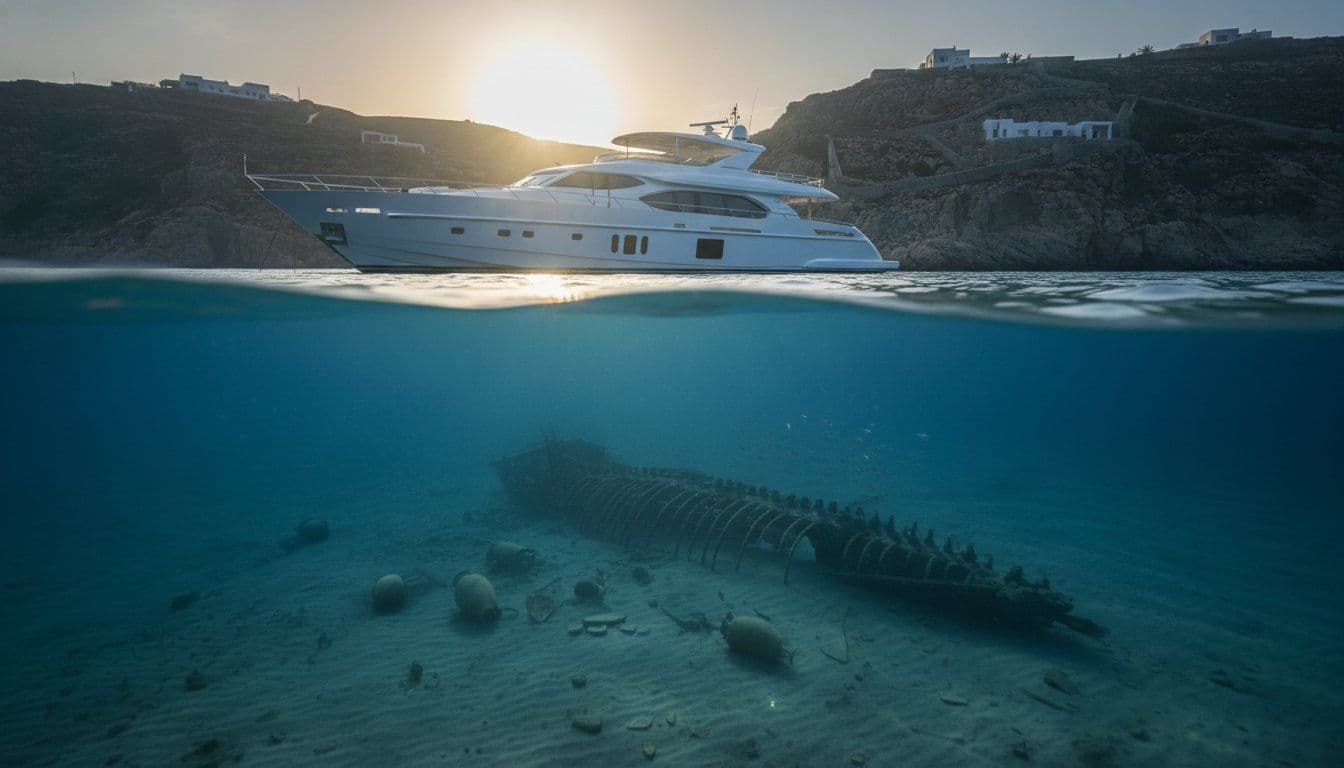
What if your next Greek holiday wasn't about the white-washed houses on the cliffs, but the silent, haunting histories resting sixty meters below your keel? Exploring the Aegean's depths is an exhilarating ambition, yet many travelers worry that complex regulations and generic itineraries will keep them from the truly legendary wrecks. You want an expedition that feels like a genuine discovery, not a crowded tourist trap. Selecting the right yacht charter for exploring shipwreck sites Greece is the only way to bridge the gap between rugged underwater exploration and total luxury.
It's natural to feel overwhelmed by the technicalities of onboard compressors or the strict 2026 diving permits for protected archaeological zones. We're here to simplify the process. You'll discover how to select a vessel equipped with the specific tenders and technology needed to reach remote locations like the newly opened sites at Fourni and Thymaina. We'll also help you identify crews with the deep historical expertise required to bring these silent wrecks to life. From navigating the new e-Charter Permission system to curating an itinerary of hidden gems, this guide ensures your journey into the deep is as seamless as it is unforgettable.
Key Takeaways
- Understand why the Aegean’s unique salinity and ancient trade history make it the world’s premier destination for underwater discovery.
- Discover how to time your visits to iconic locations like Navagio Beach and the Peristera wreck to enjoy these haunting sites in total privacy.
- Learn exactly what to look for in a yacht charter for exploring shipwreck sites Greece, including essential stability features and shallow-draft technical specs.
- Navigate the Greek Ministry of Culture’s latest 2026 regulations to ensure your dive expedition remains fully compliant and respectful of maritime heritage.
- See how to blend technical exploration with luxury lifestyle services, from private chef dining to bespoke itineraries tailored for every skill level.
Why Greece is the Premier Destination for Shipwreck Exploration Charters
Greece isn't just a holiday destination; it's a maritime graveyard in the most beautiful sense. For millennia, the Aegean served as the central highway of the ancient world. Narrow straits, hidden reefs, and sudden Meltemi winds combined with heavy trade traffic to create a unique underwater archive. Unlike other regions where wrecks are scattered, the Greek seabed holds a dense concentration of history. From Bronze Age amphorae carriers to sleek modern freighters and WWII aircraft, the diversity is staggering. It's a playground for the curious that stretches across thousands of islands.
The Aegean's high salinity and stable temperatures act as a natural preservative. This environment keeps wooden hulls and delicate artifacts in remarkable condition for centuries. In 2026, we're seeing a massive shift toward experiential luxury. Travelers don't just want a sun deck; they want a story. A yacht charter for exploring shipwreck sites Greece offers that narrative, turning a holiday into a personal voyage of discovery. You're not just a passenger. You're an explorer with a five-star base of operations.
To better understand the magic of these itineraries, watch this helpful video:
The Appeal of Underwater Archaeology
There's a raw power in seeing history in situ. Museums are great, but they can't replicate the thrill of hovering over a 2,000-year-old cargo bed in the clear waters of the Sporades. These less-frequented island chains hide treasures that land-based tours simply can't reach. To plan your own route, you can consult this list of shipwreck sites in Greece to see the sheer scale of what's waiting beneath the waves. A private yacht provides the mobility to reach these remote coordinates on your own schedule, far from the noise of commercial dive boats. It's about finding that perfect, silent moment between the past and the present.
Defining the Exploration Charter
An exploration charter is different from a standard cruise. It's an active pursuit. While a typical holiday focuses on the destination, this journey focuses on the depth. You aren't just sailing; you're investigating. 2026 is the year of the 'Deep Blue' adventure, where high-end technology meets historical curiosity. Specialized guides and marine historians can join your crew to provide context for every dive. This transforms a simple swim into a masterclass in maritime history. You can explore these curated bespoke experiences to see how we blend high-end service with technical curiosity. It's about combining the freedom of the sea with a deep respect for the secrets it keeps.
Top Greek Shipwreck Sites to Include in Your Yacht Itinerary
Greece offers a spectrum of underwater sites that cater to every level of interest. Whether you're a casual snorkeler or a technical diver, a yacht charter for exploring shipwreck sites Greece provides the necessary platform to reach these historical markers. The freedom of a private vessel means you aren't bound by the rigid schedules of commercial dive boats. You can drop anchor exactly when the light is right and the crowds are thin.
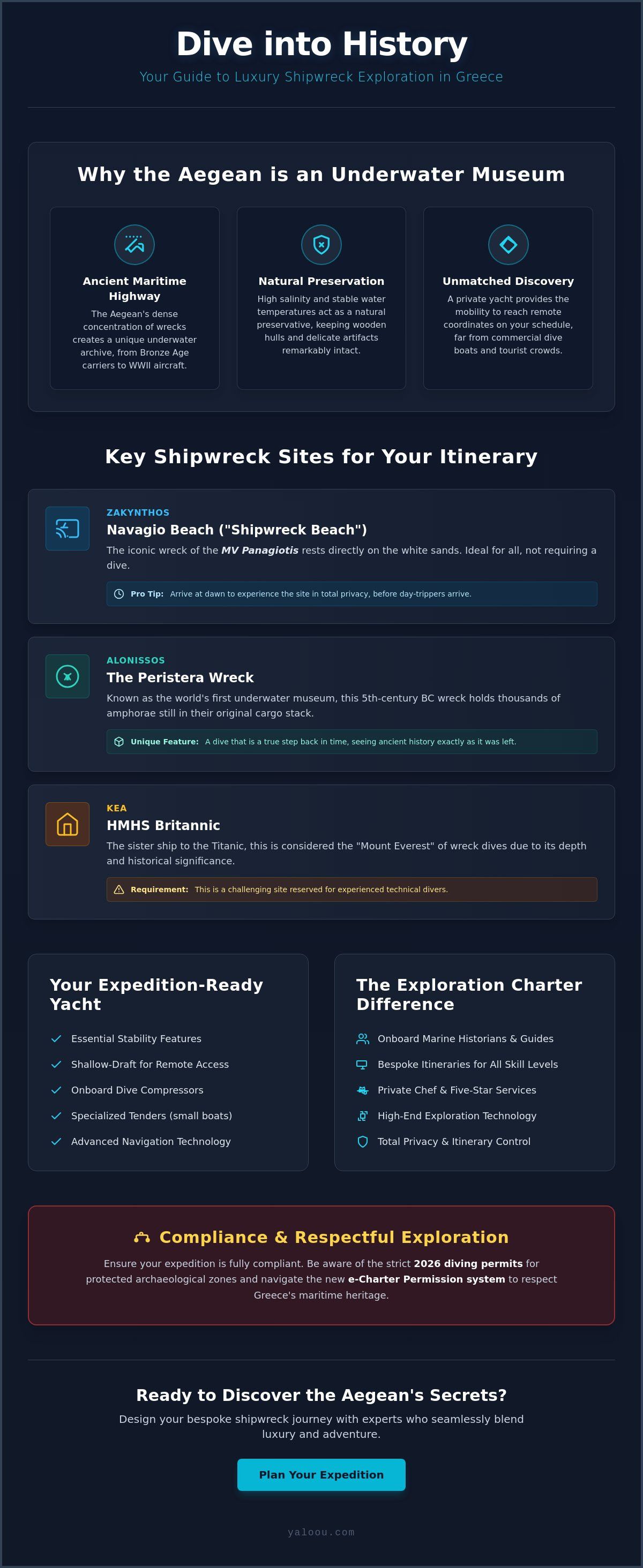
Navagio Beach in Zakynthos is the most famous site on the list. The Panagiotis wreck sits directly on the white sands, framed by towering limestone cliffs. To truly experience it without the swarm of day-trippers, arrive at dawn. The morning light hitting the rusting hull creates a hauntingly beautiful scene. For those who want to see history underwater, the Peristera wreck off Alonissos is a game-changer. It's the world's first underwater museum. Here, divers can see thousands of 5th-century BC amphorae still in their original stack on the seabed.
If you're looking for the "Mount Everest" of wrecks, head to Kea. The Britannic, sister ship to the Titanic, lies at a depth of 122 meters. It's strictly for technical divers, but even seeing the site from the surface carries a heavy weight of history. For those interested in 20th-century aviation, the waters around Naxos hide downed WWII Beaufighter aircraft. These aluminum ghosts are remarkably intact and offer a unique glimpse into the 1940s Aegean theater.
The Ionian Sea: Giants and Grottos
The Ionian islands are famous for their dramatic geology and deep waters. Navagio is the star, but the HMS Perseus submarine near Kefalonia is the connoisseur's choice. Resting at 52 meters, it's one of the most intact WWII submarines in the world. Exploring these depths is best done while enjoying the full luxury yacht rental 2026 experience, where your vessel serves as both a high-tech dive base and a sanctuary for post-dive relaxation.
The Cyclades and Saronic Gulf: Ancient and Modern History
The Cyclades offer a perfect mix of shallow and deep sites. The Kyra Leros wreck is ideal for those who prefer snorkeling. It's shallow and vibrant with marine life. Near Antiparos and Paros, you'll find sprawling ancient amphorae fields that tell the story of ancient trade routes. Closer to Athens, Patroklos Island hosts the Karyanda wreck. It's a modern freighter that's easily accessible for a day trip.
Before you dive, always check the official regulations for wreck diving. Greece is protective of its heritage, and for good reason. These rules ensure that these sites remain for future generations. If you're ready to map out your own path, you can explore curated maritime experiences that prioritize both discovery and comfort.
Selecting the Ideal Vessel for a Shipwreck Expedition
Not every luxury boat is built for deep-sea discovery. Choosing a yacht charter for exploring shipwreck sites Greece requires looking beyond the thread count of the linens. You need a vessel that functions as a mobile base camp. Stability is your first priority. While sailing yachts offer a classic feel, motor yachts provide the steady, vibration-free platform required for heavy diving gear and safe water entry. They handle the weight of specialized equipment without compromising on comfort.
Many of the best sites sit in shallow coastal waters or narrow bays. A low draft is essential. It lets you get close to the action without risking the hull on submerged rocks. Look for specific technical features like hydraulic swim platforms that lower directly into the water. This makes emerging from a dive with twenty kilograms of gear effortless. Onboard dive compressors and Nitrox capabilities are non-negotiable for serious expeditions. They give you the freedom to stay on-site for days rather than heading back to port for air refills. Your "chase boat" or tender must also be high-performance. It needs to transport a full dive team and heavy tanks into remote coves where the mother ship can't follow.
Motor Yachts vs. Expedition Vessels
The Baglietto 100 is a perfect example of a high-speed platform that lets you hit multiple sites across different islands in a single day. For 2026, we're seeing a massive trend toward "Explorer" style yachts. These vessels prioritize massive deck space for storing SCUBA tanks and even underwater ROVs. This shift is fueled by the expansion of Greece's accessible underwater museums, which now demand more sophisticated equipment for full exploration. You want a boat that matches your ambition.
The Role of the Crew
A great boat is only half the equation. You need a captain who knows the "secret" anchorages that don't appear on standard charts. Having an onboard PADI instructor or a marine archaeologist can turn a simple dive into a vivid history lesson. They know the stories behind the rust and the coral. We take this selection process seriously. YAL’OOU meticulously vets every team to provide specialized crewed yacht charter Greece experiences. This ensures your crew isn't just serving drinks; they're facilitating your next big discovery. It's about having experts on hand who understand both the technology and the history of the Aegean.
Logistics and Regulations for Wreck Diving and Exploration
Greek waters are a shared heritage, and the Ministry of Culture takes its role as protector seriously. When you book a yacht charter for exploring shipwreck sites Greece, understanding the legal framework is essential for a smooth journey. The "look but don't touch" rule is absolute. Taking even a small fragment of pottery or a piece of metal from a site is a criminal offense. Disturbing an archaeological site can lead to heavy fines or vessel impoundment. It's about respect for history, not just compliance with the law.
If you're bringing professional camera rigs or drones, don't assume you can just start filming. Specific permits are required for commercial-grade underwater photography at protected sites. These regulations help prevent the commercial exploitation of sensitive locations. Your crew can help handle this paperwork well before you arrive. Weather is your biggest variable. The Meltemi winds in the Cyclades can reach Force 7 or 8 during July and August. This often makes exposed wreck sites inaccessible. Your itinerary must remain flexible to accommodate these shifts in the Aegean climate.
Safety Protocols for Remote Exploration
Remote exploration demands a higher level of preparation. Athens and Crete house the primary hyperbaric chambers in Greece. If you're diving deep in the Dodecanese or the Sporades, your emergency plan must be airtight. We ensure all vessels have oxygen kits and satellite communication for immediate response. Never penetrate a wreck without a professional dive master. The confined spaces and silt of a sunken vessel are dangerous for the uninitiated. It's a non-negotiable safety standard that protects both you and the wreck itself.
Planning the Perfect Route
A great expedition balances intensity with relaxation. Mix your morning wreck dives with afternoons at exclusive destinations like Mykonos or Spetses to decompress in style. Starting your journey in Athens provides the most efficient access to both the Saronic and Cyclades wrecks. This central hub lets you pivot based on the wind forecast. Always allocate at least two "weather days" in a week-long charter. This buffer ensures you don't miss that one priority site due to a sudden swell or change in sea state. It's the difference between a rushed trip and a successful discovery.
Ready to plan your mission? You can explore our specialized maritime itineraries to find the perfect balance of adventure and luxury.
Designing Your Bespoke Shipwreck Journey with YAL’OOU
We don't just rent boats. We build expeditions. A YAL’OOU yacht charter for exploring shipwreck sites Greece merges technical precision with absolute comfort. You shouldn't have to choose between a deep-sea discovery and a chilled bottle of vintage champagne. Our team handles the complex logistics of diving permits and site access so you can focus on the history waiting below. We bridge the gap between rugged underwater exploration and the high-end lifestyle you expect. Every detail is calibrated to your specific curiosity.
Personalization is at the heart of our approach. We customize itineraries to match your pulse. If you're a beginner snorkeler, we'll guide you to shallow, sun-drenched sites like the Kyra Leros. For technical divers, we coordinate the gear and expertise needed for the deep wrecks of Kea or the Ionian. The experience starts long before you reach the marina. Our VIP ground transfers bring you directly to your vessel. Onboard, a private chef curates a menu designed for your day. You might need high-energy meals for a double-dive schedule or an elegant multi-course dinner to celebrate a successful find. We also look beyond the deck. We can integrate luxury experiences like private island dinners or sunset wine tastings at ancient ruins near your dive sites.
Our Curated Fleet for Exploration
The right tool makes the discovery possible. For quick, high-impact day-trip wreck hunting, the Tesoro 40 Inboard is an unmatched choice. It's fast, agile, and perfect for reaching shallow sites where larger vessels can't linger. We match every client with yachts that carry the specific tech they need, from advanced sonar to high-spec stabilizers. Privacy is our baseline. We ensure your time in every port remains exclusive. You won't just visit these sites; you'll own the moment.
Get Started on Your 2026 Adventure
The best expedition crews for 2026 are already being scouted. Don't leave your discovery to chance. Consult with our charter brokers to define your specific exploration goals. We help you secure the specialists, the technology, and the vessel that fits your vision perfectly. Your journey into the Aegean's past starts with a single conversation. Contact YAL’OOU to start planning your shipwreck charter today and claim your piece of the deep blue. The secrets of the Aegean are waiting for those bold enough to look.
Claim Your Place in the Aegean's Legacy
The silent world beneath the Greek waves isn't out of reach anymore. You've learned how to navigate the 2026 regulations and what technical gear a true mission requires. A yacht charter for exploring shipwreck sites Greece is more than a holiday. It's the freedom to find history where others only see blue water. You now have the roadmap to select a vessel that serves as a high-tech base camp for your curiosity.
We're ready to bring your vision to life. YAL’OOU offers expert local knowledge of hidden archaeological sites and access to the most technically equipped fleet in the Aegean. From securing specialized dive masters to providing 24/7 VIP concierge support for all logistics, we handle the complexity. You focus on the discovery. Don't let these hauntingly beautiful stories remain submerged. The past is waiting for you to find it.
Design Your Bespoke Shipwreck Expedition with YAL’OOU
Frequently Asked Questions
Is it legal to dive on shipwrecks in Greece?
It's legal to dive on many shipwreck sites in Greece, provided you follow the strict regulations set by the Ministry of Culture. While recreational diving is permitted at designated underwater museums and open archaeological zones, many historical wrecks remain protected. You must never disturb the site or remove any artifacts. Your crew will typically handle the necessary permits to ensure your expedition stays fully compliant with Greek maritime law.
Do I need a special certification to visit shipwreck sites?
Certification requirements depend entirely on the depth and complexity of the site you choose to visit. Shallow wrecks like the Kyra Eleni are accessible to PADI Open Water divers, while deeper legends like the Britannic require advanced technical certifications. If you aren't certified, many charters can arrange for an onboard instructor to provide introductory courses. Always verify the specific depth of your target wrecks before finalizing your itinerary.
What is the best time of year for a shipwreck charter in the Aegean?
The best time for a yacht charter for exploring shipwreck sites Greece is during May, June, September, or October. These shoulder seasons offer calm seas and excellent underwater visibility for photography. July and August often bring the Meltemi winds; these can create swells that make it difficult to anchor safely near exposed wreck sites. The water remains warm enough for diving well into October, providing a longer window for exploration.
Can children participate in shipwreck exploration charters?
Children can certainly participate, especially at shallow sites where snorkelling is possible. Many wrecks sit in just a few meters of water, making them perfect for younger explorers to view from the surface. For SCUBA diving, children must meet the minimum age and health requirements set by organizations like PADI. We recommend focusing on "ghost ship" stories and surface viewing to keep the experience engaging and safe for younger guests.
Which Greek island has the most accessible shipwrecks for snorkellers?
Zakynthos and Mykonos offer some of the most accessible wrecks for those who prefer staying near the surface. The Panagiotis at Navagio Beach is world-famous and rests directly on the sand, while the Anna II near Mykonos sits in relatively shallow water with great visibility. These sites allow you to appreciate maritime history without the need for heavy SCUBA gear or deep-water technical training.
What equipment should I expect on an exploration-ready luxury yacht?
An exploration-ready yacht should feature onboard dive compressors, Nitrox capabilities, and a hydraulic swim platform for easy water access. You'll also need a high-performance tender to reach remote coves where the main yacht cannot anchor safely. Advanced sonar and GPS are essential for locating specific underwater coordinates. Top-tier charters also provide high-quality masks, fins, and wetsuits to ensure your comfort during every underwater session.
Are there any shipwrecks near Mykonos or Paros?
Yes, both islands are close to significant underwater sites that are perfect for a day trip. Mykonos is home to the Anna II, a sunken cargo ship that's now vibrant with marine life. Near Paros and Naxos, you'll find the Marianna wreck and several downed WWII aircraft. These sites are easily integrated into a standard Cycladic itinerary, allowing you to balance high-end beach clubs with silent, underwater discovery.
How do I ensure my yacht charter is environmentally responsible near wreck sites?
Responsible exploration starts with proper anchoring techniques to avoid damaging the wreck or surrounding reefs. Your captain should use permanent moorings where available or anchor only in sandy patches. Maintain neutral buoyancy to avoid touching the structure, as oils from skin can accelerate the corrosion of historical metal. Using reef-safe sunscreen and following a strict waste policy ensures these historical treasures remain intact for the next generation of explorers.
Disclaimer
The YAL’OOU Travel Guide is curated with care to inspire and inform discerning travelers. While every effort is made to ensure the accuracy and relevance of the information provided, all content is offered for general guidance only and may evolve over time.
Details such as local regulations, availability, pricing, and services are subject to change without prior notice. We encourage guests to seek personalized advice and confirm arrangements directly when planning their journeys.
YAL’OOU accepts no liability for any inaccuracies, omissions, or outcomes arising from the use of this information. The Travel Guide may feature recommendations, insights, and selected third-party experiences, presented solely as a source of inspiration and not as formal endorsements.
By accessing this section of our website, you acknowledge and accept this disclaimer as part of your experience with YAL’OOU.