
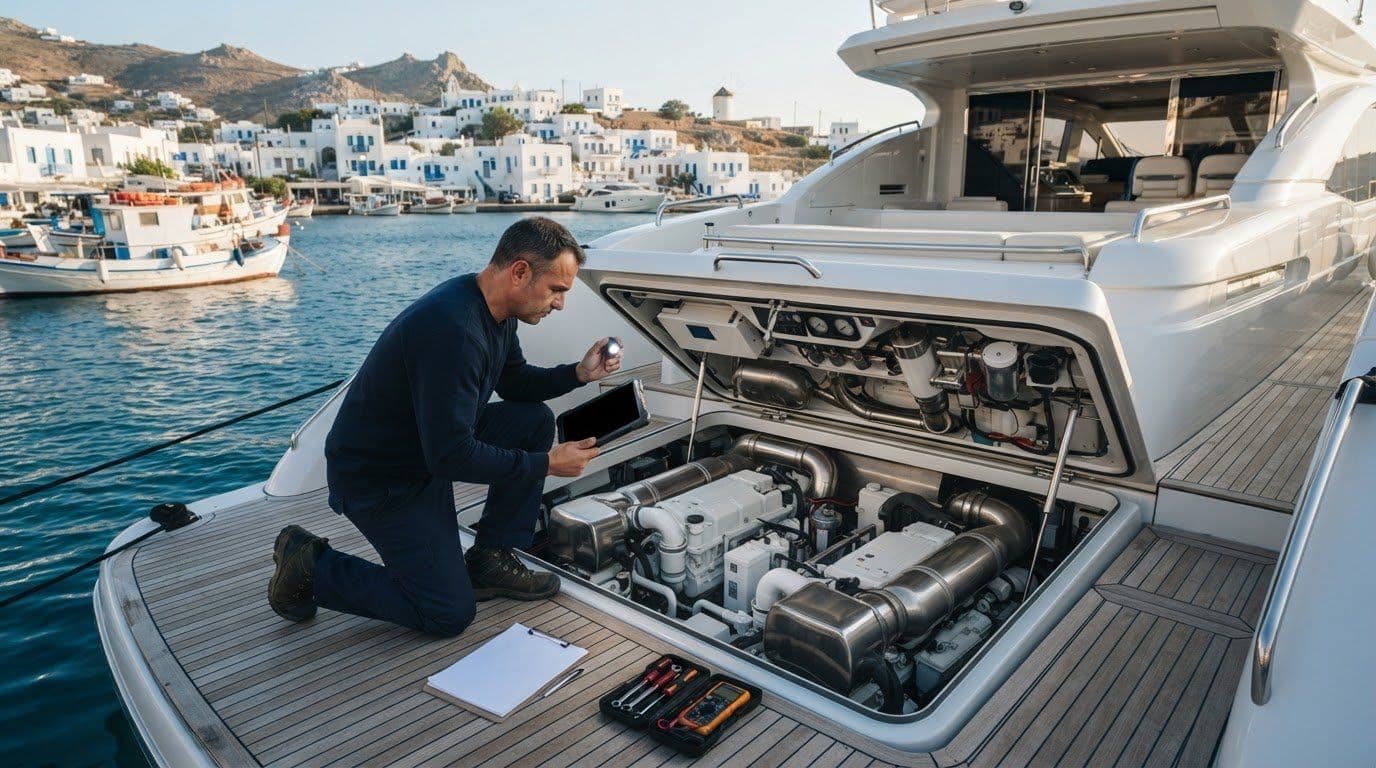
That stunning 100-foot motor yacht in the brochure looks like a floating palace, but those photos won't tell you if the air conditioning will fail during a 35°C Aegean heatwave. Marketing imagery is designed to sell a dream. It rarely reflects the mechanical reality of a vessel that has spent a long summer battling the Meltemi winds. You probably worry about the "bait and switch" of outdated photos or, worse, a mechanical failure that cuts your trip short. It's a common anxiety for anyone vetting charter yacht maintenance and condition in Greece, especially when maritime standards feel complex and opaque.
We agree that your peace of mind is non-negotiable. This guide shows you how to look past the glossy surface and use independent survey reports to verify a yacht's true health. You'll learn exactly which technical documents to request, such as the General Inspection Protocol, and how to spot red flags in machinery logs. We're providing a clear checklist to ensure your Greek charter is safe, seaworthy, and genuinely luxurious. Get ready to transform your booking process from a leap of faith into a calculated, professional decision.
Key Takeaways
- Learn why maintenance hours and engine history are more reliable indicators of a yacht's performance than its manufacturing year.
- Discover the essential role of SAMS or NAMS certified professionals in vetting charter yacht maintenance and condition in Greece to ensure an unbiased technical audit.
- Identify critical red flags like missing machinery logs or vague refit descriptions that often signal reactive rather than proactive vessel care.
- Understand the "Five-Year Rule" and the importance of documented "Winter Works" performed in Greek shipyards to survive the demanding Aegean season.
- See how elite intermediaries pre-screen the fleet to ensure every vessel meets the high operational standards of yachts like the Baglietto 100.
The Reality of Charter Yacht Maintenance in Greece
Greece offers some of the world's most beautiful cruising grounds, but it's also a demanding environment for any vessel. The combination of high salinity, relentless UV exposure, and the powerful Meltemi winds creates a high-impact setting that tests every component of a boat. For those vetting charter yacht maintenance and condition in Greece, understanding these variables is the first step toward a safe journey. A yacht that looks pristine in a harbor can reveal hidden flaws once it hits the open sea.
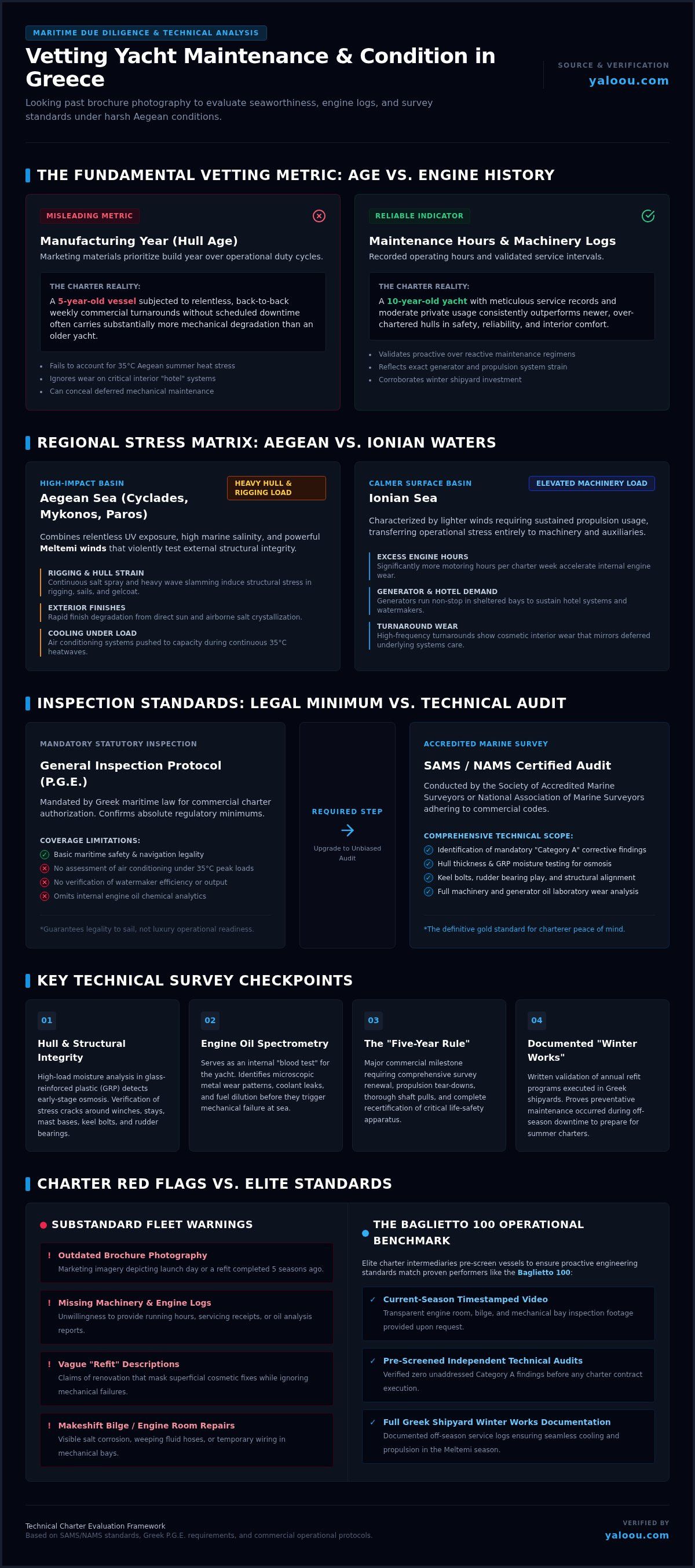
Don't let the manufacturing year fool you. In the professional charter industry, a yacht's age is often a misleading metric. A five-year-old vessel that has performed back-to-back weekly charters without a break might have more mechanical wear than a ten-year-old yacht used primarily for private trips. Focus on maintenance hours and service logs instead of the hull number. While Greek law requires a General Inspection Protocol (P.G.E.) for legal operation, this baseline check only verifies basic safety. It doesn't guarantee the "hotel" systems like air conditioning or watermakers are functioning at peak efficiency. This is why an independent marine surveyor is an invaluable asset for serious charterers.
Aegean vs. Ionian: Different Wear Patterns
The geography of your charter dictates the type of wear you should expect. In the Cyclades, including hotspots like Mykonos and Paros, the Meltemi winds put immense stress on rigging, sails, and hull integrity. Constant salt spray and heavy pounding against waves can degrade exterior finishes quickly. Conversely, Ionian charters often involve more motoring due to lighter winds. Here, engine hours and generator health are the critical metrics. High-frequency summer turnarounds also take a toll on interiors. Scuffed woodwork or tired upholstery might seem cosmetic, but they often hint at how much attention the owner pays to the invisible mechanical systems.
The "Glossy Photo" Trap
Brochures are marketing tools, not technical documents. It’s common to see photos from a yacht’s launch day or a refit that happened five seasons ago. To avoid surprises, ask for current-season, timestamped videos of the engine room and bilges. Check for signs of leaks, corrosion, or makeshift repairs. A professional broker should always provide recent photos upon request because transparency is the foundation of a high-end charter experience. Elite vessels like the Baglietto 100 maintain high standards because their maintenance is proactive, not reactive. Demand that level of clarity before you sign any contract.
Decoding Independent Survey Reports: What to Look For
Most charterers rely on photos, but sophisticated travelers demand data. An independent marine survey acts as an unbiased technical audit, stripping away marketing layers to reveal a vessel's true state. It's the gold standard for vetting charter yacht maintenance and condition in Greece. When you review these documents, look for reports signed by professionals from the Society of Accredited Marine Surveyors (SAMS) or the National Association of Marine Surveyors (NAMS). These experts follow rigorous commercial yacht safety standards to ensure the vessel isn't just pretty, but legally and structurally sound.
A comprehensive report covers everything from the thickness of the hull to the age of the fire extinguishers. Don't settle for a verbal "it's in great shape" from a booking agent. Instead, request a recent survey summary. This document provides a snapshot of the boat’s health, highlighting any "Category A" findings that require immediate attention. It’s your best defense against unexpected mechanical delays.
Hull and Structural Integrity
Greek waters, especially during the Meltemi season, put incredible strain on a hull. A professional survey report will highlight moisture readings in the glass-reinforced plastic (GRP). High moisture levels often suggest osmosis, which can compromise the hull's strength over time if left untreated. Surveyors also inspect for stress cracks in the gelcoat around high-load areas like winches, stays, and the mast base. They'll verify the condition of the keel bolts and rudder bearings. If these components show play or wear, it's a sign of deferred maintenance that could lead to steering issues in heavy seas.
Mechanical and Electrical Systems
Mechanical failure is the quickest way to ruin a vacation. A top-tier report includes an engine oil analysis. Think of this as a blood test for the yacht. It reveals internal wear patterns and potential cooling system leaks before they cause a mid-trip breakdown. Generator reliability is equally vital. In the peak Greek summer, your generator powers the HVAC system. If the generator isn't efficient, you won't have functional air conditioning while at anchor. The report should also confirm the battery bank's health and the efficiency of the charging systems to ensure silent, reliable power through the night. If you're looking for a partner who prioritizes these technical details, explore our curated Greek yachting experiences to see how we apply these standards to every booking.
Red Flags: Spotting a Substandard Yacht Before Booking
Photos of sun-drenched decks are easy to produce. Real maintenance logs are much harder to fake. When vetting charter yacht maintenance and condition in Greece, your first instinct should be to look for gaps in the paperwork. A yacht is a complex machine operating in a high-stress environment. If the manager can't produce a clear history of technical care, the vessel is likely being run on a reactive budget. This means systems break during your trip rather than during the off-season drydock. Don't accept vague claims about "pristine condition" without the logs to prove it.
One of the biggest red flags is a yacht without a permanent, year-round captain and engineer. In the Greek market, seasonal crews often lack deep knowledge of a vessel’s quirks. A permanent team treats the boat as their own, ensuring systems are maintained daily. If the crew changes every three months, the maintenance history usually vanishes with them. You also need to watch for discrepancies between provided specs and reality. If the brochure lists a brand-new tender or a specific watermaker model that isn't on the boat, it's a sign of dishonest management.
The Maintenance Log Checklist
Professionalism leaves a paper trail. When you review the logs, check if engine services are recorded at the correct hourly intervals, typically every 250 to 500 hours depending on the machinery. In the Cyclades, the standing rigging must be professionally tuned to handle the Meltemi winds; ask for the last date this was performed. Finally, verify the expiry dates on all safety equipment. Liferafts, flares, and automatic fire suppression systems must have valid, up-to-date inspection tags. If a manager ignores these life-saving details, they're certainly ignoring the engine’s cooling pumps.
Communication Red Flags
If a broker avoids technical questions, walk away. Transparency is the hallmark of a luxury service. You should be able to request a direct conversation with the captain to discuss the vessel's recent performance. Hesitation to provide insurance certificates or recent survey data is a major warning sign. The Society of Accredited Marine Surveyors sets the benchmark for these assessments. Any vessel claiming luxury status should have a report that meets these professional standards. To understand how these technical steps fit into the broader booking process, consult our Luxury Yacht Charter: The Ultimate Guide. It's your roadmap to ensuring a seamless, high-performance holiday.
Key Maintenance Milestones for Luxury Vessels
A yacht is only as reliable as its last major service. While a new boat feels like a safe bet, the "Five-Year Rule" changes the game. Once a vessel crosses the five-year mark, the need for vetting charter yacht maintenance and condition in Greece becomes critical. This is the point where major systems like standing rigging, heat exchangers, and hydraulic seals often require their first deep overhauls. If these milestones are ignored, a "luxury" charter can quickly turn into a series of technical delays.
Annual "Winter Works" are the backbone of Greek maritime reliability. Between November and March, professional crews move yachts into shipyards in Perama or Lavrio for intensive care. This isn't just about a fresh coat of paint. It involves stripping down pumps, testing electrical circuits, and ensuring the vessel is ready for the intense Aegean summer. For older yachts, look for "Zero-Hour" engine overhauls. This means the engines were completely dismantled and rebuilt to factory specifications, essentially resetting their lifespan and reliability.
Don't confuse a "refresh" with a "refit." A refresh might involve new upholstery or trendy throw pillows. A true refit addresses the invisible plumbing, wiring, and machinery that actually keep you comfortable. You can explore our premier yachts to see vessels where technical integrity is prioritized alongside aesthetic luxury. We focus on yachts that treat maintenance as a year-round commitment rather than a seasonal chore.
The Annual Haul-Out
Every commercial yacht must leave the water once a year for a hull inspection. This is the time for applying fresh antifouling and replacing sacrificial anodes. These anodes are vital; they prevent galvanic corrosion from eating away at expensive metal components like propellers and shafts. Engineers also check shaft alignment to prevent the vibrations that can ruin a quiet night at anchor. Finally, they inspect thru-hull fittings. These are the points where water enters or leaves the boat; their failure is a leading cause of water ingress and mechanical failure.
Interior and Guest Comfort Systems
Luxury is defined by the systems you don't see until they fail. The desalinator, or watermaker, requires meticulous filter changes and high-pressure pump servicing to ensure a steady supply of fresh water for showers and ice makers. Similarly, grey and black water tanks need regular sanitation and sensor calibration. There is nothing less luxurious than a malfunctioning head or a sensor that misreads tank levels in the middle of a remote bay. To ensure your next trip meets these rigorous standards, book your next Greek yachting experience with a partner who understands the technical side of luxury.
The YAL’OOU Vetting Standard: Beyond the Brochure
We don't just list boats; we curate technical excellence. At YAL’OOU, we understand that vetting charter yacht maintenance and condition in Greece requires more than a desk-side review of marketing materials. It demands physical presence and technical scrutiny. Before an elite vessel like the Baglietto 100 joins our portfolio, it undergoes a rigorous internal audit. We examine the service history of its MTU engines and the operational efficiency of its stabilizers. This ensures that the luxury experience we promise is backed by mechanical reliability.
Our local network in Athens and across the islands provides us with real-time condition updates. If a yacht faces a particularly grueling week in the Cyclades, our partners on the ground know about it before the next guest arrives. This boots-on-the-ground approach allows us to maintain a level of transparency that is rare in the industry. We believe in providing our clients with the raw data they need to feel secure, from recent engine oil analysis results to current safety certificates. Accountability is the cornerstone of our crewed yacht charter model. Because our yachts feature professional, permanent crews, there is a direct line of responsibility for every pump, sensor, and sail.
Our Relationship with Yacht Owners
We are selective about the owners we represent. We only partner with individuals who view maintenance as a non-negotiable investment rather than a seasonal expense. Our vetting process includes verifying that the onboard engineers hold current STCW certifications and possess specific technical expertise for the vessel's unique systems. The YAL’OOU Peace of Mind promise ensures that every vessel in our fleet has passed a rigorous technical screening to guarantee your safety and comfort. We don't compromise on these standards because we know that true luxury is impossible without total reliability.
Booking with Confidence
If you have specific technical concerns about a yacht’s performance or its suitability for your itinerary, we address them head-on. For our most discerning clients, we can facilitate detailed pre-charter inspections or provide direct access to the vessel's technical logs. We want you to step on board with the confidence that every detail has been checked. Your journey should be about the horizon, not the engine room. Contact our charter experts to discuss your technical requirements and let us build a safe, high-performance Greek odyssey for you.
Secure Your Aegean Odyssey
Choosing the right vessel is about more than aesthetics; it's about technical certainty. By prioritizing independent survey reports and looking past marketing brochures, you ensure your time in the Mediterranean is defined by relaxation rather than repairs. Vetting charter yacht maintenance and condition in Greece requires a professional eye, especially when navigating the high-impact environment of the Aegean summer. It's the difference between a ruined week and a seamless escape.
Our approach provides this clarity through rigorous technical pre-screening and a dedicated crewed management model that ensures year-round accountability. We leverage expert local knowledge across 20+ Greek islands to monitor every vessel in real-time. You deserve a holiday where the only thing you have to worry about is the sunset. Trust the data, verify the logs, and step on board with total confidence. The freedom of the open sea is much better when you know your yacht is in peak condition.
Browse Our Vetted Fleet of Luxury Yachts and start planning your worry-free escape today.
Frequently Asked Questions
Can I hire my own independent surveyor to check a charter yacht in Greece?
Yes, you can hire an independent surveyor in major Greek hubs like Athens or Mykonos. While brokers provide their own reports, hiring a SAMS or NAMS certified expert adds an extra layer of security. This is common for high-value, weekly crewed rentals where mechanical reliability is paramount. It ensures an unbiased look at the hull and engine health before you commit to a luxury contract in the Cyclades.
What is the most common mechanical failure on Greek charter yachts?
Generator and air conditioning failures are the most frequent issues during the peak Aegean summer. The intense heat in Paros and Mykonos forces these systems to run at maximum capacity for days. Without proactive descaling of heat exchangers and regular cooling pump checks, they can seize. High salinity in Greek waters also frequently clogs desalinator filters, which can interrupt your fresh water supply mid-trip.
How old is "too old" for a luxury yacht charter?
Age is subjective, but the "Five-Year Rule" is a standard benchmark for vetting charter yacht maintenance and condition in Greece. A ten-year-old yacht with a recent "Zero-Hour" engine overhaul and new plumbing can perform better than a three-year-old boat with neglected systems. Look for documented refits rather than just the launch date. If a vessel is over five years old, ask for specific machinery service logs.
Does a higher price always mean a better-maintained yacht?
A higher price tag doesn't always guarantee superior maintenance. Sometimes you're paying for a brand name or a prime berth in Mykonos rather than technical excellence. Some owners invest heavily in cosmetic refreshes like new cushions while ignoring the engine room. Always ask for technical proof of maintenance milestones, such as recent oil analysis or hull thickness tests, to ensure the premium price reflects the actual mechanical health.
What happens if the yacht has a mechanical failure during my charter?
Professional charter contracts, such as those used by YAL’OOU, include specific clauses for mechanical downtime. If the yacht is immobilized for more than 24 hours, you're typically entitled to a prorated refund for the lost time. In some cases, a substitute vessel of equal or higher standard may be provided. Having a permanent crew and a local network in the islands allows for faster repairs or logistics management if issues arise.
Are Greek safety standards for charter yachts as strict as the rest of the EU?
Greek maritime safety standards are among the strictest in the EU, governed by Law 4926/2022. Every commercial vessel must hold a valid General Inspection Protocol (P.G.E.) and meet specific safety equipment requirements. These regulations cover everything from liferaft capacity to fire suppression systems. While these laws ensure basic seaworthiness, independent vetting is still recommended to ensure the "hotel" systems like Wi-Fi and HVAC meet luxury expectations.
What documents should I ask to see before paying the charter deposit?
Before paying your deposit, ask for the vessel's current Safety Certificate (P.A. or P.G.E.) and the Greek Mandatory Liability Endorsement. You should also request a recent technical survey summary and the captain's professional profile. Reviewing these documents ensures the yacht is legally compliant and professionally managed. At YAL’OOU, we provide this data transparently to ensure our clients feel secure when booking high-end rentals in Athens or the Cyclades.
How can I tell if a yacht’s air conditioning is sufficient for a Greek July?
To verify if the air conditioning is sufficient for the heat in Santorini or Paros, ask for the system's total BTU (British Thermal Unit) rating. A well-maintained yacht should have a capacity that exceeds the interior volume by a safe margin. Check the last service date for the cooling water pumps and heat exchangers. If these haven't been descaled recently, the system will struggle to maintain comfortable temperatures when ambient air hits 35°C.
Disclaimer
The YAL’OOU Travel Guide is curated with care to inspire and inform discerning travelers. While every effort is made to ensure the accuracy and relevance of the information provided, all content is offered for general guidance only and may evolve over time.
Details such as local regulations, availability, pricing, and services are subject to change without prior notice. We encourage guests to seek personalized advice and confirm arrangements directly when planning their journeys.
YAL’OOU accepts no liability for any inaccuracies, omissions, or outcomes arising from the use of this information. The Travel Guide may feature recommendations, insights, and selected third-party experiences, presented solely as a source of inspiration and not as formal endorsements.
By accessing this section of our website, you acknowledge and accept this disclaimer as part of your experience with YAL’OOU.