
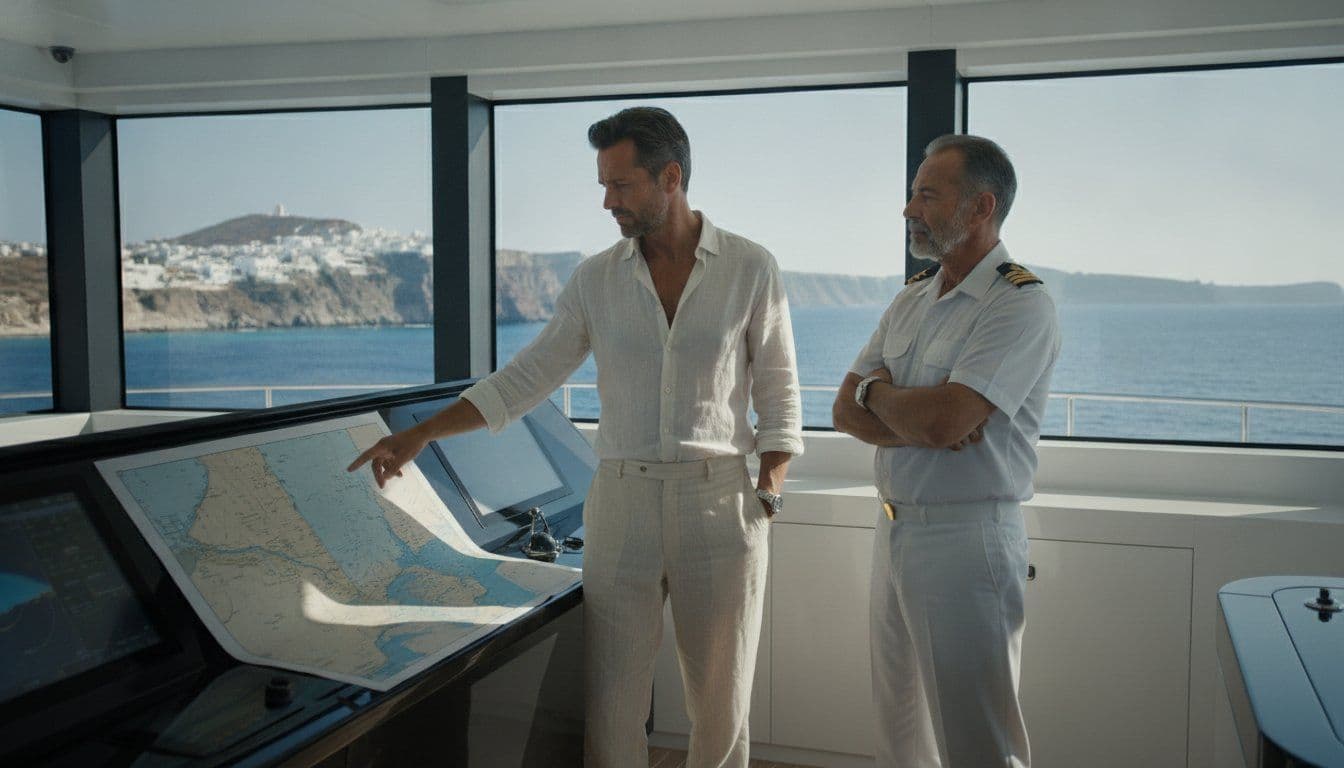
Imagine you're anchored in a turquoise cove, the Mediterranean sun is warm, and the champagne is perfectly chilled. But there's a problem. Every request you make is met with a sigh or a blunt "no" from the bridge. Instead of feeling like the master of your journey, you feel like an uninvited guest on your own charter. It's a frustrating, high-stakes situation that can quickly turn a luxury escape into an awkward ordeal. Knowing exactly what to do if you don't get along with your yacht captain is the key to saving your investment and your sanity.
We understand that a personality clash at sea is more than just a minor inconvenience. It is an emotional drain when you are supposed to be relaxing. You deserve a crew that aligns with your lifestyle and respects your vision for the trip. This guide provides a professional roadmap for handling friction without creating a scene. We will show you how to communicate your needs clearly, when to respect the captain's authority, and how to use your broker as a powerful ally. Let's get your holiday back on course.
Key Takeaways
- Identify the root cause of friction by distinguishing between simple personality differences and genuine service failures.
- Master the "Bridge Meeting" technique to address your concerns privately and professionally without disrupting the onboard atmosphere.
- Understand the boundaries of maritime law to recognize when a captain’s "veto" is a necessary safety measure rather than a service issue.
- Learn exactly what to do if you don't get along with your yacht captain by utilizing your charter broker as a discreet and effective mediator.
- Discover how expert vetting and personality profiling can ensure a perfect crew match before your luxury holiday even begins.
Understanding the Friction: Why Yacht Captain-Guest Clashes Happen
High-end yachting is a delicate dance of expectations. You arrive with a dream of total freedom; the captain arrives with a heavy checklist of maritime laws and safety protocols. This gap is where the friction begins. Most clashes aren't born from malice. Instead, they're the result of mismatched communication styles. One person expects a concierge; the other is acting as a commanding officer. When these roles don't align, the luxury experience starts to fray. A captain must balance their duty as a host with their absolute responsibility as a safety officer, a dual role that requires constant mental shifting.
The "Confined Space" effect is a real psychological factor at sea. Even on a sprawling vessel like those found in the YAL’OOU Exclusive Yachting & More fleet, the proximity is constant. On a boat, minor habits become major hurdles. If you find yourself wondering what to do if you don't get along with your yacht captain, remember that the environment itself amplifies stress. A small disagreement about a lunch spot can feel like a personal slight when you're miles from the nearest port. Living in close quarters means every interaction carries more weight than it would on land.
To better understand how professional dynamics can quickly shift on the water, watch this helpful video:
Common Triggers of Onboard Tension
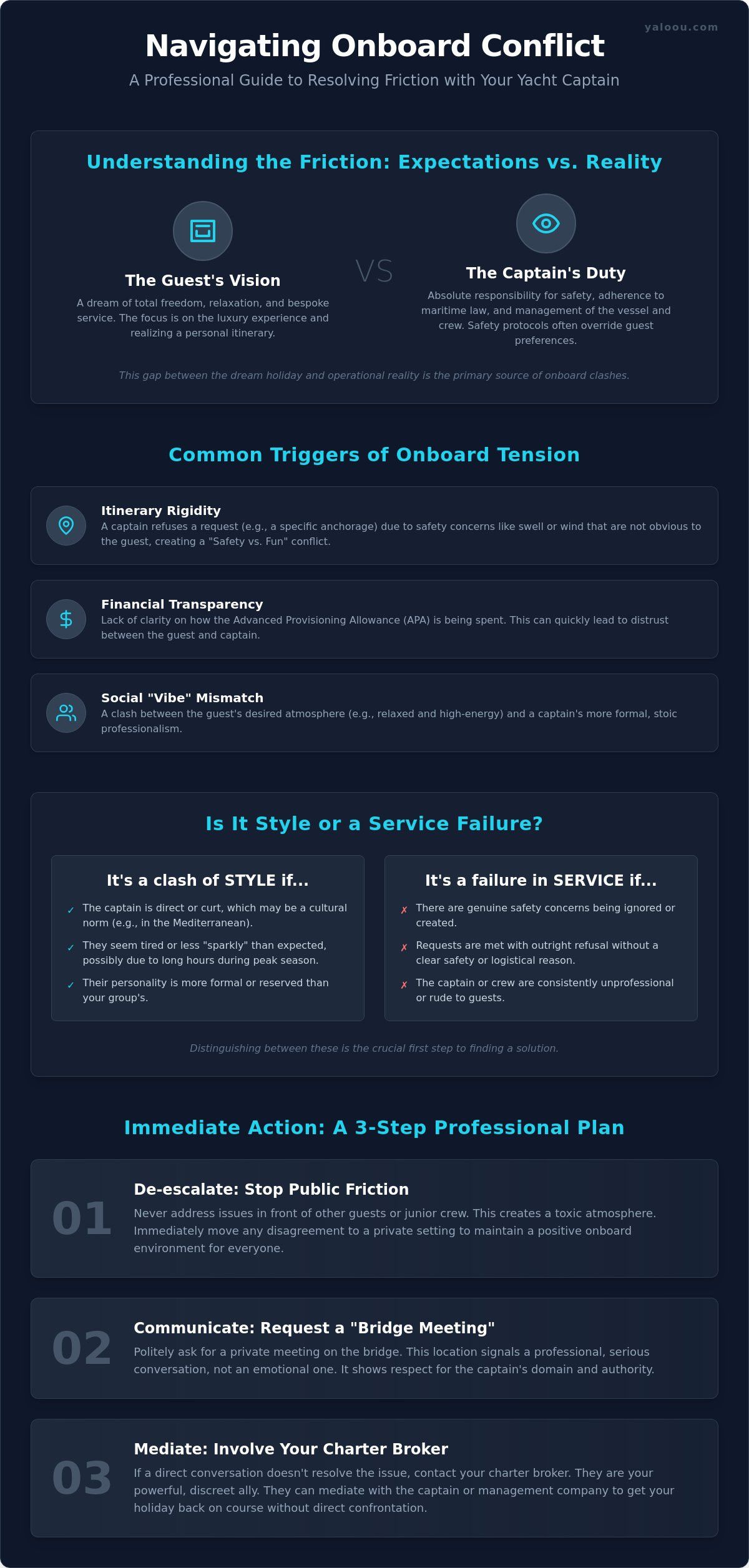
Tensions often boil down to three specific triggers. First, there's itinerary rigidity. A captain might refuse a specific landing in the Greek Islands because of a subtle shift in swell, while you see only blue skies. This creates a "Safety vs. Fun" conflict. Second, financial transparency is a frequent pain point. If the captain isn't clear about how the Advanced Provisioning Allowance (APA) is being spent, distrust grows fast. Finally, the social "vibe" matters. Some captains are naturally formal. If your group is looking for a high-energy, relaxed atmosphere, that stoic professionalism can feel like a wet blanket on your party. These mismatches in pace can quickly derail your vision for the trip.
The Difference Between Style and Substance
It's vital to distinguish between a personality you don't like and actual unprofessionalism. Mediterranean culture often prizes directness. This can come across as curt or even rude to guests used to a different service style. Using proven conflict resolution strategies helps you separate a cultural misunderstanding from a genuine failure in service. Distinguishing between a "curt" captain and one who is truly "unprofessional" is the first step toward a solution.
Crew exhaustion also plays a role in these dynamics. During the peak summer season, captains work grueling hours to maintain the vessel and manage the crew. A tired captain might lack the "sparkle" you expected, but they are still keeping you safe. Recognizing this human element can shift your perspective. It moves the conversation from frustration to a collaborative effort to improve the onboard experience for everyone involved. A little empathy for the crew's workload often opens doors to better service.
Immediate Action: How to Address Conflict Onboard Professionally
When tension spikes on a luxury charter, time is your scarcest resource. Unlike a yacht owner who can address crew issues over several months, a charterer has only a few days to salvage their holiday. You need a fast, professional resolution. If you are currently wondering what to do if you don't get along with your yacht captain, the first rule is to stop the public friction immediately. Addressing issues in front of other guests or the junior crew creates a toxic atmosphere that is hard to reverse.
Your first move should be requesting a private meeting on the bridge. This is the captain’s professional domain; it signals that you want a serious, business-like conversation rather than an emotional confrontation. Use a "Service-First" approach. Frame your concerns around the quality of the experience rather than the captain’s personality. For example, instead of saying "You are being difficult," try "I feel the current pace of our itinerary isn't matching the relaxing experience we planned." This keeps the captain’s ego intact while making your expectations clear.
The Art of the Bridge Meeting
Privacy is paramount. Never criticize a captain in front of their crew. It undermines their authority and can lead to a defensive, "fortress" mentality among the staff. Start the meeting with a positive observation to lower the stakes. "We love the yacht and the chef’s work is incredible, but we need to adjust our communication regarding the daily schedule." This balanced feedback makes the captain more receptive to change. Set a clear goal for the next 48 hours. This "test period" allows both parties to see if the adjustments are working before involving outside parties.
Effective Communication Tactics for Charterers
Clarity replaces conflict. Use "I" statements to own your feelings. Saying "I feel we are missing out on the best swimming spots" is far more effective than "You are skipping the best coves." If a request is denied, ask for the "Why" behind the "No." Often, a captain is restricted by the captain's duty of care and maritime safety regulations that aren't visible to guests. Understanding these operational constraints usually dissolves the irritation.
Document specific instances of friction. Keep a brief, private log of what was said and when. This isn't about being petty; it is about providing your broker with facts if a refund or credit is discussed later. After the meeting, send a quick recap email to your broker. This ensures there is a paper trail and keeps everyone aligned. For your next journey, choosing carefully curated yachting experiences can help ensure these professional standards are met from day one.
Safety vs. Service: Knowing When the Captain is Right
The line between a cautious captain and a difficult one is often drawn in the sand of maritime law. When deciding what to do if you don't get along with your yacht captain, you must first determine if the friction stems from a safety mandate or a service failure. Under the International Safety Management (ISM) Code, the captain has the "overriding authority" to make decisions regarding safety and pollution prevention. This isn't just a company policy. It is a legal framework that places the liability for every life on board squarely on the captain’s shoulders. Safety is absolute. Service is relative.
If your captain refuses to dock in a specific Mykonos harbor, it’s rarely a personal snub. High winds or shifting swells can turn a glamorous arrival into a dangerous hull-crushing event in seconds. In these moments, the captain is not your employee; they are a legal officer. Deferring to this authority is essential for your own protection. However, the frustration often arises when "safety" is used as a convenient shield for laziness or a lack of effort. Distinguishing between a legitimate navigation concern and a captain who simply doesn't want to lift the anchor is the key to resolving the conflict.
When to Defer to Authority
In the Cyclades, the Meltemi winds can reach speeds of 30 to 40 knots during peak summer. If the captain insists on staying in a sheltered bay rather than crossing open water, trust their judgment. Safety protocols also extend to water toys and jet skis. A captain who halts water sports because of crowded waters or deteriorating visibility is performing their legal duty. Similarly, refusing to anchor in illegal zones or marine protected areas protects both the vessel and your legal standing in foreign waters.
When the Captain is Overstepping
There is a distinct difference between safety and stubbornness. If the weather is perfect, the seas are calm, and the captain still refuses reasonable itinerary changes, you are likely facing a service issue. A captain oversteps when they fail to maintain professional discretion or ignore guest privacy. Unprofessional conduct, such as being dismissive or failing to manage the onboard crew to a high standard, is a legitimate cause for concern. If the rest of the crew seems disorganized or unhappy, it often points to a leadership failure at the top. This is the moment to move beyond a private talk and consider involving your broker for a formal intervention.
The Broker's Role: When and How to Involve Your Charter Agency
If the private conversation on the bridge didn't yield the results you expected, it's time to activate your shore-based support. Many charterers make the mistake of waiting until they've disembarked to voice their frustrations. By then, the opportunity to fix the trip has passed. Your broker is your most powerful advocate because they hold the direct relationship with the yacht owner and the management company. Knowing what to do if you don't get along with your yacht captain often involves stepping back and letting an expert mediator handle the professional friction.
A broker’s intervention is typically handled with extreme discretion to protect the onboard atmosphere. They can contact the captain or the yacht's management office to deliver a "course correction" without it feeling like a personal attack from you. This third-party perspective carries significant weight. The captain is aware that their future bookings and professional reputation in the industry depend on positive broker feedback. In extreme cases, a broker can even facilitate a crew change at the next port, though this is a complex logistical move reserved for the most serious service breaches.
Contacting Your YAL’OOU Exclusive Yachting & More Expert
Don't suffer through a tense atmosphere in silence. Call us the moment friction becomes a pattern rather than a one-off misunderstanding. We don't just book boats; we manage professional relationships. Our team has deep connections with yacht owners and can often resolve a personality clash with a single phone call. By realigning the captain's focus on your specific service preferences, we can turn the trip around in hours. You can learn about our high-touch yacht experiences to see how we prioritize guest-crew harmony from the moment you book.
The MYBA Contract and Your Rights
Most luxury charters operate under a standard MYBA contract, which is a powerful tool for guest protection. This agreement contains specific clauses regarding professional conduct and the high standard of service expected on a crewed vessel. If a captain is truly unprofessional or fails to deliver the experience promised, the contract provides a clear framework for dispute resolution. Brokers use these "Failure to Deliver" provisions to negotiate credits or partial refunds if the situation cannot be salvaged.
Financial leverage is a real asset in these situations. While the captain manages your daily costs through the APA, the broker oversees the larger charter agreement. This separation ensures you are never trapped without recourse. If you feel your holiday is at risk, reach out to your broker to activate these protections immediately. For a seamless trip where every detail is managed with precision, explore our exclusive yachting services and let us handle the professional alignment for you.
Ensuring a Perfect Match: How YAL’OOU Exclusive Yachting & More Prevents Crew Friction
Prevention is the ultimate luxury. While earlier sections of this guide detailed what to do if you don't get along with your yacht captain once the trip has begun, our primary mission is to eliminate that friction before you even step on board. We treat crew selection as a high-stakes matchmaking service. At YAL’OOU Exclusive Yachting & More, we don't just know the technical specifications of our fleet; we know the individuals behind the helm. Our vetting process involves deep dives into a captain’s professional history, leadership style, and service philosophy. This proactive approach allows us to filter out potential personality clashes during the booking phase.
We provide a continuous safety net through our dedicated concierge support. This service acts as an immediate bridge for every Greek island itinerary. If a minor irritation arises, our team is ready to step in and realign expectations instantly. You are never left to manage professional dynamics alone. We handle the background logistics so you can focus on the horizon. Trust and transparency are the foundations of our service. We believe that a well-matched crew is the most important amenity on any yacht.
Matching You with the Right Crew
Temperament is as important as technical skill. A high-energy group heading to Mykonos for a vibrant social scene needs a captain who understands that specific rhythm and can facilitate a fast-paced itinerary. Conversely, a family seeking quiet, secluded coves in the Cyclades requires a different leadership style focused on tranquility and patience. We vet for local expertise to ensure your captain is a true specialist in your chosen region. A captain who knows the hidden corners of the Saronic Gulf or the best anchorages in the Ionian provides a layer of security and local flavor that a generalist simply cannot match. Explore our curated fleet of luxury yachts to find the vessel and crew that resonate with your specific travel style.
The Power of Preparation
Preparation is the enemy of conflict. Detailed preference sheets are the foundation of a successful charter. They prevent the vast majority of onboard friction by aligning expectations weeks before embarkation. We facilitate pre-charter briefings where your specific vision meets the captain's operational reality. This ensures that when you arrive, the captain is already your biggest advocate. Every detail, from your preferred morning coffee time to your desired cruising speed, is established early. This level of detail removes the guesswork and allows the crew to provide a bespoke service from the first minute. See our top destinations for a seamless charter and start planning a journey where every professional alignment is guaranteed.
Secure Your Perfect Horizon
Your luxury holiday shouldn't be a lesson in conflict management. By understanding the delicate balance between maritime safety and high-end service, you can navigate any personality clash with professional poise. Address issues early. Use the bridge for private discussions. Never hesitate to involve your broker if the atmosphere on deck doesn't match your vision. Knowing what to do if you don't get along with your yacht captain is your ultimate backup plan for a flawless escape.
At Yaloou, we remove the guesswork. We are specialists in Mykonos and Paros luxury travel, providing expertly vetted crews for every vessel in our fleet. You're never alone on the water. Our 24/7 dedicated charter broker support ensures your peace of mind from the first anchor drop to the final sunset. We don't just offer boats; we offer the freedom to explore without compromise. Don't leave your most precious time to chance.
Plan your stress-free Greek yachting escape with Yaloou and rediscover the joy of effortless travel. The Aegean is waiting for you.
Frequently Asked Questions
Can I fire my yacht captain in the middle of a charter?
You cannot fire a captain directly because they are employed by the yacht owner or a management company, not the charterer. If the situation becomes untenable, you must contact your broker to request a formal crew change. This usually happens at the next available port and depends on the logistics of finding a qualified replacement during the busy summer season.
What happens if the captain refuses to go to the island I requested?
Safety is the only valid reason for a refusal. In Greece, the Meltemi winds can make certain routes dangerous for specific vessels. If the captain refuses a landing, they are likely protecting your safety. If you are unsure what to do if you don't get along with your yacht captain regarding these decisions, ask for a detailed weather briefing to understand the operational limits.
Should I tip a captain I didn't get along with?
Tipping is customary but performance-based. The standard gratuity in the Mediterranean is 10 to 15 percent of the charter fee, but it is meant to reward excellent service. If a captain was unprofessional or failed to meet the standards of the MYBA contract, it is acceptable to reduce the tip. Always explain your reasoning to the broker so they can address the performance issues with the crew management.
How do I complain about a yacht captain without being 'that' guest?
Knowing what to do if you don't get along with your yacht captain involves focusing on specific service failures rather than personality traits. Frame your concerns around the "onboard experience" and use the bridge meeting strategy. Professionalism is a two-way street. By keeping the conversation private and solution-oriented, you maintain your status as a respected client while ensuring your needs are met effectively.
Is it possible to switch yachts if the conflict is irreconcilable?
Switching yachts mid-charter is extremely rare due to availability and the logistics of moving provisions and guests. If there is a major breach of contract, your broker will work to find an alternative vessel or negotiate a partial refund. It's much easier to resolve crew issues on the current boat than to find a new yacht during the peak Greek summer season when most vessels are fully booked.
What is the broker's responsibility if the crew is unprofessional?
The broker acts as your legal advocate and mediator. Their responsibility is to ensure the yacht owner delivers the service level promised in your agreement. They handle the difficult conversations with management so you don't have to. If the crew fails to meet professional standards, the broker manages the formal complaint process and any resulting financial negotiations to protect your interests.
Can I request a specific captain when booking through Yaloou?
You can certainly request a specific captain if you've enjoyed their service on a previous trip. Many of our clients build long-term professional relationships with certain crews. While captains move between vessels, we do our best to match you with your preferred leader whenever the yacht's schedule and availability allow. We prioritize these personal connections to ensure a seamless experience.
What are the most common reasons for guest-captain disputes in Greece?
Disputes in the Greek Islands usually center on itinerary changes caused by the Meltemi winds. Guests want to reach Mykonos or Santorini, but the captain must prioritize safety. Other common triggers include a lack of transparency in APA spending or cultural misunderstandings regarding Mediterranean service styles. Clear communication at the start of the trip prevents most of these issues before they escalate.
Disclaimer
The YAL’OOU Travel Guide is curated with care to inspire and inform discerning travelers. While every effort is made to ensure the accuracy and relevance of the information provided, all content is offered for general guidance only and may evolve over time.
Details such as local regulations, availability, pricing, and services are subject to change without prior notice. We encourage guests to seek personalized advice and confirm arrangements directly when planning their journeys.
YAL’OOU accepts no liability for any inaccuracies, omissions, or outcomes arising from the use of this information. The Travel Guide may feature recommendations, insights, and selected third-party experiences, presented solely as a source of inspiration and not as formal endorsements.
By accessing this section of our website, you acknowledge and accept this disclaimer as part of your experience with YAL’OOU.