

You step aboard in Greece expecting the yacht shown in the listing, then notice a different cabin layout, missing equipment, or a feature that doesn’t work. It’s natural to wonder what to do if your chartered yacht is not as advertised, especially when you don’t want a disagreement to take over the first day at sea.
Not every difference has the same impact. A visual variation may be disappointing, while a change that affects safety, comfort, or a planned part of the trip needs prompt attention. Stay calm, note when you noticed the issue, and take clear photos or video where appropriate. A brief written record helps you explain the gap clearly and keep the conversation focused on practical next steps.
This guide explains how to document a discrepancy, raise it constructively with the captain or named charter contact, and discuss a proportionate response. You’ll also learn how to compare the yacht with your booking documents, organize communications, and put safety first. An early, specific conversation can help address the issue while giving the rest of your time on the water the best chance to get back on course.
Key Takeaways
- If you’re deciding what to do if your chartered yacht is not as advertised, first assess safety, identify the specific discrepancy, and tell the crew promptly.
- Compare the agreed details with what you observe. Separate verifiable facts from personal impressions, and note how each difference affects your trip.
- Raise the issue calmly with the captain or named charter contact. Explain what was agreed, what you found, what evidence you have, and what practical action you’re requesting.
- If the issue remains unresolved or the proposed fix is unclear, follow up with the named contact and keep a dated record of messages, photos, and booking documents.
- For your next Greek islands trip, put expectations in writing for vessel details, capacity, sleeping arrangements, included services, accessibility, and planned activities.
First Steps If Your Chartered Yacht Is Not as Advertised
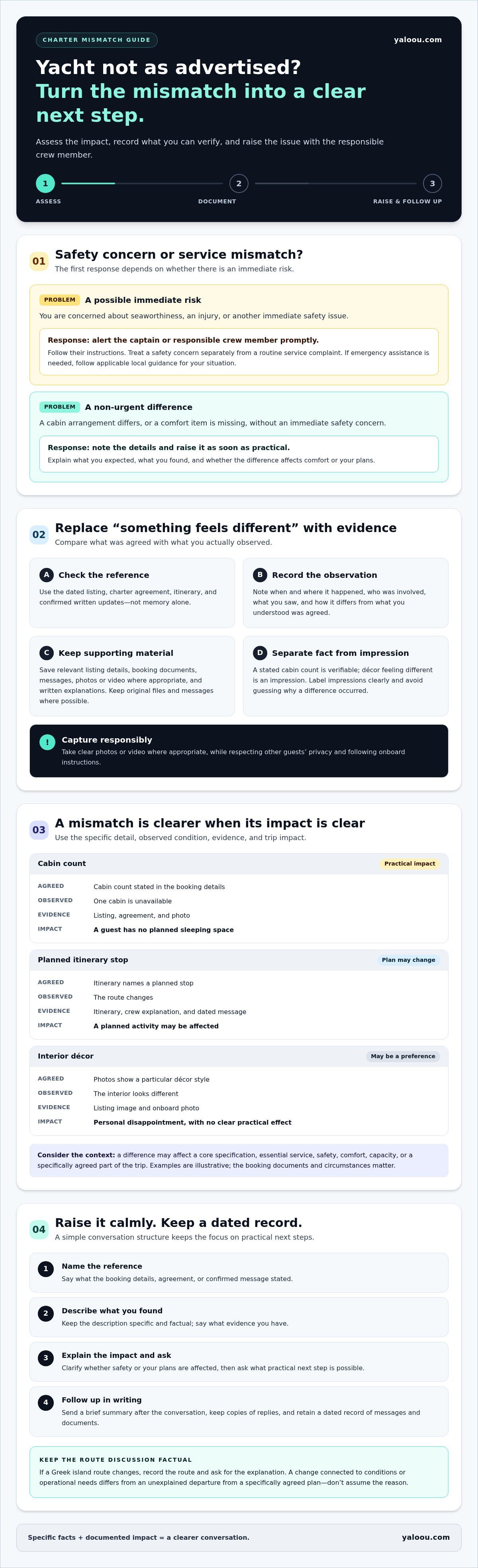
Before drawing conclusions, establish exactly what differs and whether it affects safety, comfort, a promised feature, or a planned service. If you’re considering what to do if your chartered yacht is not as advertised, follow a clear sequence: address immediate risks, record what you observe, tell the responsible crew member, then follow up in writing.
Is the issue urgent, or can it be handled after the immediate moment?
Safety comes first. If you’re concerned about seaworthiness, an injury, or another immediate risk, alert the captain or responsible crew member promptly and follow their instructions. Treat a safety concern separately from a routine service complaint. For a non-urgent issue, such as a different cabin arrangement or a missing comfort item, note the details and raise it as soon as practical. If emergency assistance is needed, follow applicable local guidance for your situation.
What details should you record straight away?
Capture the facts while they’re fresh. Note the time, location, people involved, what you observed, and how it differs from what you understood was agreed. Take clear photos or video where appropriate, while respecting other guests’ privacy and following onboard instructions. Save the listing, itinerary, charter agreement, messages, and any written explanations. Keep original files and messages where possible.
Use the agreement and confirmed communications as your reference, not memory alone. Check the exact wording and distinguish a specific commitment, such as a stated cabin count, from a personal impression, such as décor feeling different than expected. This makes it easier to explain the issue precisely without speculating about why it happened. Contract questions depend on the agreement and circumstances, so general examples are not a definitive answer about your rights.
Then tell the captain or named charter contact what you expected, what you found, and whether it affects safety or your plans. Ask what practical next step is possible. After the conversation, send a brief written summary so there’s a dated record of the issue and the response. Keep copies of any reply.
- Safety concern: alert the responsible crew member immediately.
- Non-urgent mismatch: document it and raise it promptly.
- Every discrepancy: compare it with the agreement and confirmed messages, then keep a written record.
How to compare the yacht you booked with what you received
A clear comparison turns a general sense that “something’s different” into a specific, useful account. Start with the dated listing and booking documents, then include any written updates made before departure. Not every detail carries the same weight. The agreement and confirmed communications provide important context, while the significance of a difference depends on the wording and circumstances.
Advertised or agreed detailObserved conditionEvidenceImpact on the trip
Cabin count stated in the booking details
One cabin is unavailable
Listing, agreement, photo
A guest has no planned sleeping space
Itinerary naming a planned stop
The route changes
Itinerary, crew explanation, dated message
A planned activity may be affected
Photos showing a particular décor style
The interior looks different
Listing image, onboard photo
Personal disappointment, with no clear practical effect
Keep each entry factual. A cabin count, stated capacity, or listed piece of equipment is usually easier to verify than whether the décor feels dated or the yacht seems less spacious than expected. You can record subjective impressions too, but label them as impressions rather than presenting them as objective defects.
Which differences are potentially material to the charter?
Consider whether the difference changes a core specification, an essential service, safety, comfort, capacity, or a specifically agreed part of the trip. A missing sleeping space may affect how guests can use the yacht; a different cushion colour may simply be a preference. These examples are illustrative, not a verdict. The booking documents and circumstances matter.
For a Greek island itinerary, compare the planned route with the route taken and record the explanation. A change connected to conditions or operational needs is different from an unexplained departure from a specifically agreed plan. Don’t assume the reason. Ask for it and note the response.
How can you tell a preference from a documented mismatch?
Check the exact wording and date of the listing, agreement, and later written updates. Describe what happened without exaggeration or speculation about why. Then connect the difference to a concrete impact: a sleeping arrangement no longer works, a listed amenity can’t be used, or a planned stop has changed. This gives you a grounded basis for discussing what to do if your chartered yacht is not as advertised.
For a future trip, browsing Greek yacht charter experiences can help you identify which details matter most and align expectations before departure.
How to raise the issue and compare possible remedies
Raise the concern promptly with the captain or named charter contact. A calm, specific request helps focus the conversation on a practical response and keeps the rest of the trip moving. Explain the gap without assuming anyone’s intent, then ask what can be done and when you can expect an update.
What should you say when speaking with the crew or charter contact?
Keep the conversation brief and grounded in the details you’ve recorded. You might say: “The booking information described [agreed detail]. Onboard, we found [what happened]. This affects [specific part of the trip]. Could you explain what can be done and when?” Share relevant evidence if helpful. After speaking, send a short written summary of the concern and the response, and invite the contact to correct anything you may have misunderstood.
A written follow-up creates a shared record without turning the conversation into a confrontation. If the first person you speak with isn’t responsible for resolving the issue, ask who the named charter contact is and direct your summary there. Keep safety concerns separate from routine service requests, and don’t delay raising an issue that could affect guests’ wellbeing.
How do you decide whether a proposed solution is workable?
Compare the proposed fix with the agreed expectation and the time remaining on your itinerary. Consider whether it is safe, practical, and acceptable to everyone affected. A replacement service may address a missing amenity; an itinerary adjustment may be more useful if a planned activity can no longer happen as expected. These are possibilities to discuss, not guaranteed outcomes.
Depending on the circumstances, you might ask about:
- A correction: Can the missing or non-working item be addressed onboard?
- A substitute: Is there a practical alternative that meets the same need?
- An itinerary adjustment: Could the plan change in a way that preserves a valued activity or destination?
- Written follow-up: If no immediate fix is possible, can the concern and proposed next step be recorded clearly?
Before agreeing, consider how the proposed response affects the rest of the group, planned stops, and onboard arrangements. Ask practical questions, such as “Would this be in place before we leave?” or “How would this change the remaining plan?” If you accept a temporary workaround, note what it resolves and what remains outstanding. Remedies depend on the charter agreement and the facts, so don’t assume that a discussion guarantees a refund, credit, or particular legal result.
A clear, proportionate exchange is a practical first step when deciding what to do if your chartered yacht is not as advertised. Record what was proposed, what you agreed to, and any unresolved points. If the response doesn’t address the issue, you’ll have a concise record for the next conversation.
When to escalate a yacht charter complaint in Greece
Escalation can be a measured next step, not a confrontation. Return to the named charter contact if you haven’t received a response, the discrepancy remains unresolved, or the proposed fix is unclear. Keep a dated timeline of what happened and when you raised it. Save replies, photos, the listing, the charter agreement, and relevant itinerary details together so you can refer to the same facts each time.
What if the issue remains unresolved while you are onboard?
Send the responsible contact one concise update that summarizes the discrepancy, the evidence, and your earlier attempts to resolve it. State the practical outcome you’re requesting, such as clarification or a workable adjustment, and ask when you can expect a response. Keep the tone neutral. A clear message focuses attention on the issue without making the rest of the charter revolve around the dispute.
For an immediate safety concern, don’t wait for routine complaint follow-up. Alert the captain or responsible crew member and prioritize their immediate response. If you need emergency assistance, follow applicable local guidance for your situation. Safety takes precedence over documenting a service disagreement.
What should you do after the charter ends?
Send a factual written summary promptly, setting out what differed, when you reported it, what response you received, and what remains unresolved. Keep the complete correspondence and original files, not just selected screenshots. Review the signed agreement for its complaint process, governing terms, and any stated time limits. Don’t assume a deadline or remedy is the same for every charter.
Questions about legal rights, insurance, or contractual remedies depend on the agreement and the circumstances. For advice on your specific situation, seek qualified guidance appropriate to the relevant jurisdiction. General information can help you organize the issue, but it isn’t a legal assessment or a promise of a particular outcome.
A calm, dated record gives you a clearer basis for deciding what to do if your chartered yacht is not as advertised, both during the trip and afterward. For a future Greek charter, explore Greek yacht charter experiences and align key expectations before departure.
How to reduce the chance of a charter mismatch on your next Greek islands trip
Use your experience to make the next booking clearer. Before departure, bring the key details together in writing so you and the charter team share the same understanding of the yacht, onboard arrangements, and trip plan. This won’t prevent every change, but it can make expectations easier to understand and discuss.
What should you confirm in writing before departure?
Start with the vessel particulars. Compare the yacht description and guest capacity with the charter documents, and review the YAL’OOU yacht fleet as you consider which vessel details matter to your group. Then confirm the practical arrangements that shape your time onboard:
- Sleeping and accessibility: note who will use each sleeping space and any access needs that affect comfort or movement.
- Included services: clarify which crew and guest services are part of the agreed charter.
- Itinerary: identify planned destinations, activities, and details that are priorities for your group.
- Preferences: keep important requests and final written confirmations with your booking documents.
Be precise. If a service or activity is essential to your plans, distinguish it from a preference. Also clarify which itinerary details are agreed and which may change. Greek island routes can be affected by weather or operational needs, so allow for adjustments without assuming that every change means the charter terms have been breached.
How can coordinated planning support clearer expectations?
Coordinated planning brings vessel details, route planning, crew arrangements, and guest services into the same conversation before departure. That gives you a chance to flag priorities early, whether you’re planning time around Mykonos, Paros, or another Greek destination. For more planning context, see Crewed Yacht Charter Greece: The Ultimate 2026 Luxury Guide.
YAL’OOU coordinates crewed yacht charters, tailored routes, and guest services across Greek destinations. Bringing these details together during planning can help align expectations while leaving room for practical adjustments at sea. If you’re considering what to do if your chartered yacht is not as advertised, a written record of agreed expectations also makes it easier to describe any difference accurately.
To plan a future Greek escape, explore YAL’OOU charter experiences and consider the details that matter most to your group.
Set Your Next Charter Up for a Smoother Voyage
If you’re deciding what to do if your chartered yacht is not as advertised, focus on three things: put safety first, compare the experience with the booking details, and raise concerns calmly with a clear written record. The agreement and confirmed communications provide useful context, while any remedy depends on the specific facts and terms.
For your next trip, align expectations before departure on the yacht, guest arrangements, services, and route. YAL’OOU coordinates crewed yacht charters and tailored routes in Greece, including crew coordination, guest services, and local supplier logistics. Thoughtful planning can bring these details together while leaving room for practical changes at sea.
Explore YAL’OOU’s curated yacht experiences to start shaping a Greek charter around what matters most to you. With clear expectations and attentive coordination, your next time at sea can feel relaxed, personal, and full of possibility.
Frequently Asked Questions
Can I cancel a yacht charter if the yacht is not as advertised?
Cancellation rights depend on your signed agreement, the facts, and the law that applies to your charter. Before taking action, document the mismatch, notify the named charter contact promptly, and review the contract’s terms and complaint process. Don’t assume that a discrepancy automatically allows cancellation or guarantees a refund. If you’re considering ending the charter or have a specific dispute, seek qualified advice from someone familiar with the relevant jurisdiction.
What should I do if the yacht is different from the listing?
Prioritize safety, note exactly what differs, and capture appropriate evidence, such as a dated photo of an unavailable listed feature. Raise the concern calmly with the captain or named charter contact, then follow up in writing with the agreed detail, what you observed, its impact, and the practical fix you’re requesting. If you’re deciding what to do if your chartered yacht is not as advertised, remember that the agreement and circumstances help determine how the discrepancy should be assessed.
Can I get a refund if my chartered yacht is not as described?
A refund isn’t automatic. Whether one may be available depends on the contract terms, the nature and impact of the discrepancy, and applicable rules. Preserve relevant evidence and written responses, then ask the responsible charter contact what remedies may be considered. If you’re making a specific claim, seek advice appropriate to the relevant jurisdiction. General information is not a promise of compensation or a legal assessment of your individual case.
What counts as a material difference between a yacht listing and the yacht onboard?
A difference may matter more if it affects an agreed specification, safety, guest capacity, an essential service, or a planned part of the trip. A stated cabin count is an objective detail; a preference for different décor is subjective. Compare the wording in the listing and agreement with what you observed, and note the practical impact. Whether a discrepancy is material depends on the documents and circumstances, not one universal checklist.
Who should I tell first if there is a problem with a charter yacht?
Tell the captain or named charter contact promptly, depending on the issue and onboard responsibilities. For a safety concern, prioritize immediate attention from the captain or responsible crew member. For other issues, give a calm, specific account and follow up in writing. This applies whether you’re chartering around Mykonos, Paros, Antiparos, Athens, Aegina, Poros, Spetses, Syros, Tinos, Sifnos, Serifos, Milos, Poliaigos, Kimolos, Santorini, Ios, Koufonisia, Amorgos, Crete, Corfu, or Zakinthos.
What evidence should I collect if my yacht charter is not as advertised?
Keep the listing, agreement, itinerary, dated messages, and relevant photos or video. Record when and where the discrepancy occurred, what you observed, its practical impact, and who you informed. Respect others’ privacy and follow onboard instructions when recording. Save replies and any agreed solutions, and preserve original files without editing them. Keeping the documents together makes it easier to explain the issue clearly if you need to follow up later.
Disclaimer
The YAL’OOU Travel Guide is curated with care to inspire and inform discerning travelers. While every effort is made to ensure the accuracy and relevance of the information provided, all content is offered for general guidance only and may evolve over time.
Details such as local regulations, availability, pricing, and services are subject to change without prior notice. We encourage guests to seek personalized advice and confirm arrangements directly when planning their journeys.
YAL’OOU accepts no liability for any inaccuracies, omissions, or outcomes arising from the use of this information. The Travel Guide may feature recommendations, insights, and selected third-party experiences, presented solely as a source of inspiration and not as formal endorsements.
By accessing this section of our website, you acknowledge and accept this disclaimer as part of your experience with YAL’OOU.