

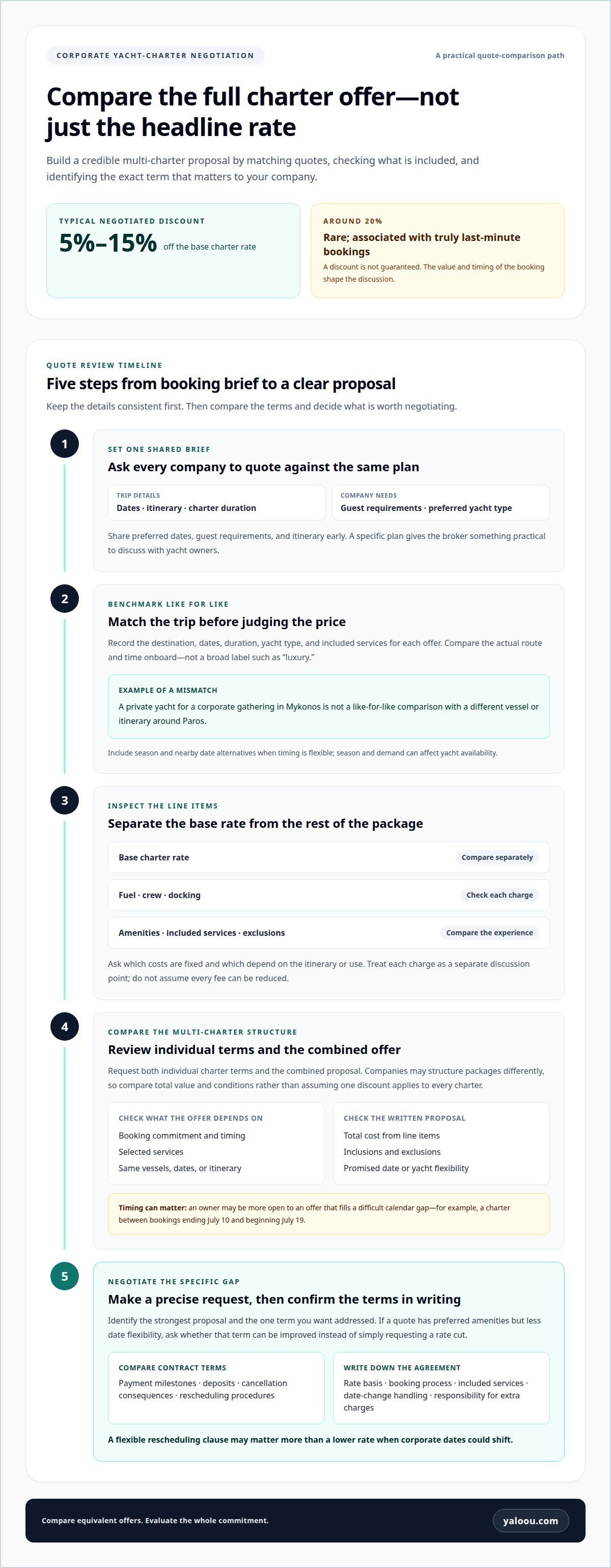
Corporate yacht-charter discounts are negotiable, but they depend on the booking. Negotiating a corporate discount for multiple yacht charters typically means discussing 5% to 15% off the base charter rate; discounts around 20% are rare and associated with truly last-minute bookings.
Booking several charters gives you a basis for discussing overall value, but a strong proposal starts with clear comparisons, not simply a request for a lower rate. Assess yacht charter quotes on a like-for-like basis, then identify which booking details may support a tailored offer. These practical steps help you weigh the full package, timing, and potential repeat business, so you can focus on what your company receives, not only the headline rate.
Key Takeaways
- Build a credible negotiation by presenting clear plans for your company’s charter needs and booking schedule.
- Assess market rates by comparing similar yachts, dates, durations, and included services.
- Compare quotes side by side so differences in what each charter includes are easy to spot.
- There’s no universal booking count for a corporate discount; the value and timing of the bookings shape the discussion.
1. The Truth About Yacht Charter Deals: Can You Really Negotiate the Price?
Yes, a yacht charter rate can be negotiable, but credibility matters. Typical negotiated discounts fall between 5% and 15% off the base charter rate; discounts around 20% are rare and associated with truly last-minute bookings. For companies negotiating a corporate discount for multiple yacht charters, a broker’s useful role is to present a clear, credible proposal, not promise a discount. Build the relationship by sharing your preferred dates, guest requirements, and itinerary early. A specific plan gives the broker something practical to discuss with yacht owners.
Compare the broker’s communication and quote detail, not just the offered rate. Ask for an itemized proposal and a clear explanation of what each charge covers. Then compare equivalent yachts, dates, and charter arrangements. A broker who understands your priorities can help shape a realistic offer; the yacht owner still has influence over the final terms. Owners may be more open to an offer that fills a difficult calendar gap. For example, a charter between bookings ending July 10 and beginning July 19 could fill an otherwise open period.
Separate fuel, crew, and docking charges from the base rate when comparing quotes. Ask which costs are fixed, which depend on the itinerary or use, and whether the overall package can be adjusted. Treat each charge as a distinct point for discussion rather than assuming every fee can be reduced.
For recurring charters, put the rate basis, booking process, payment schedule, cancellation terms, and included services in writing. Specify how date changes or itinerary adjustments will be handled. Before signing, review availability, payment commitments, cancellation exposure, and responsibility for additional charges. Confirm that the proposed corporate booking is permitted before finalizing it. Review any deadline attached to a proposed rate carefully: compare the written terms before committing, not just the discount.
2. Researching yacht charter market rates
Build a Greece-focused benchmark using quotes that match your planned trip. Record the destination, dates, charter duration, yacht type, and included services for each offer. A private yacht for a corporate gathering in Mykonos is not a like-for-like comparison with a different vessel or itinerary around Paros. Keep the details consistent, then note where each proposal differs. This gives your team a useful basis for discussion.
Season and demand can affect which yachts are available for your preferred dates. If your schedule allows, compare your planned dates with nearby alternatives and note how the options change. For a company event in Santorini, for example, keep guest requirements and charter duration consistent while comparing dates. Flexible timing can widen the shortlist, while a fixed itinerary may narrow it. Include the season in your comparison, not just the destination.
Location also shapes the itinerary. A route around Antiparos may require different planning from a charter based near Athens, so compare offers against the actual route and time onboard. Review each vessel’s description and listed amenities, then check whether the quote explains the captain, crew arrangements, and included services. These details help clarify differences between proposals without relying on a broad label such as “luxury.”
Create a comparison sheet with destinations, dates, duration, vessel details, inclusions, and contract conditions. Mark which terms match and which could change the overall experience. If your team is considering multiple Greek destinations, compare each route against the event’s priorities before weighing offers. Use those priorities to refine your shortlist and explore yacht charter experiences as you shape the itinerary.
3. Comparing quotes from multiple charter companies
Ask each company to quote against the same brief: dates, guest needs, itinerary, and preferred yacht type. Then compare what each offer includes, not just its headline rate. Quotes can differ in vessel, amenities, crew arrangements, and services, all of which affect the experience and overall commitment. Put each proposal in a shared comparison table, with one row per charter and separate columns for inclusions, exclusions, and contract terms.
For a multi-charter booking, request both individual charter terms and the combined proposal. Companies may structure volume discounts or corporate packages differently, so compare the total value and conditions rather than assuming the same discount applies to every charter. Check whether an exclusive package depends on using the same vessels, dates, or itinerary across bookings. Note any promised flexibility, such as changes to dates or yacht selection, and whether it affects the quoted terms.
There is no universal format for a volume discount. Check how each company links the proposed benefit to booking commitment, charter timing, and selected services. One company may present a combined offer, while another quotes each charter separately. For a consistent comparison, calculate the overall cost of each proposal from its written line items, then review amenity and service differences that could explain a higher rate.
Cancellation, deposit, and rescheduling rules depend on the agreement. Compare payment milestones, cancellation consequences, and change procedures for every charter, then ask for linked bookings to be addressed clearly in writing. A flexible rescheduling clause may matter more than a lower rate if corporate dates could shift. Record who can approve changes and how revised terms will be communicated.
Before choosing, identify the strongest proposal and the specific gap you want addressed. For example, if one quote includes preferred amenities but offers less date flexibility, ask whether that term can be improved rather than simply requesting a rate cut. Keep your request precise and tied to the stated offer. This gives the broker or owner a clear basis for responding.
4. How many yacht charters must a company book to qualify for a corporate discount?
A corporate discount depends on the full booking commitment, not a fixed charter count alone. Ask what the company can offer across your planned charters, taking into account confirmed dates, repeat business, suitable timing, and a clear booking plan. Present these details together so the broker or owner can assess the combined request rather than treating each charter as a separate inquiry.
Prepare a short schedule showing each charter’s preferred dates, duration, destination, guest needs, and flexibility. Then identify which details can change. For example, a company with several events might offer alternative dates or yacht preferences, creating room to match bookings with available vessels. A fixed schedule and a single yacht preference give the owner less flexibility to shape a combined proposal.
Ask for the proposed discount structure in writing. It should explain whether the terms apply to every charter or only selected bookings, and whether reservations must be made together. Compare the combined offer with separate charter quotes, including inclusions, payment timing, cancellation terms, and rescheduling conditions. A lower combined rate is not useful if its booking conditions conflict with your company’s event calendar.
Use the full booking plan to open a practical negotiation, rather than demanding an unsupported percentage. Explain your business’s likely repeat needs, preferred itinerary, and any flexibility that could help fit the owner’s calendar. If the proposal covers different event formats, specify what stays consistent and what varies. This makes the requested terms easier to assess and document in the contract.
For a company planning a corporate event at sea, connect the charter schedule to the guest experience and event requirements. Explore yacht charter experiences to shape the brief before discussing a multi-charter arrangement.
YAL’OOU Exclusive Yachting & More: Daily Yacht Charters
YAL’OOU offers Daily Yacht Charters for companies planning a focused event or a day on the water. For a longer itinerary, Weekly Crewed Yacht Rentals are another charter format to consider. Choose based on your schedule, the guest experience, and how your team wants to spend its time onboard.
Use these comparison steps to prepare a clear brief: outline your preferred dates, the experience you want, and any flexibility across your plans. This helps you assess charter options against your company’s needs and discuss the details of a potential booking. For events requiring wider coordination, YAL’OOU also offers Exclusive Event Planning.
To discuss a yacht charter for your company, contact YAL’OOU Exclusive Yachting & More or visit yaloou.com.
Turn Your Charter Plan Into a Clear Brief
Before opening discussions, align your event goals with the people approving the booking. Decide who makes the final choice, which experience matters most to your guests, and what trade-offs your company can accept. A concise internal brief keeps decisions focused and helps prevent last-minute changes from derailing the negotiation.
Treat negotiating a corporate discount for multiple yacht charters as a planning decision, not simply a request for a lower rate. Set out the experience you want, your priorities, and the approval process, then keep the agreed terms together for your team. Clear expectations help move the discussion toward a booking that fits your company’s plans.
When you’re ready to discuss a charter experience, contact YAL’OOU Exclusive Yachting & More. Start with your event goals and preferred itinerary, then take the next step with confidence.
Frequently Asked Questions
The Truth About Yacht Charter Deals: Can You Really Negotiate the Price?
Yes, charter rates can be negotiable, especially when your request presents the owner with a workable booking opportunity. Make a specific proposal that identifies dates, yacht preferences, and your group’s priorities. For a corporate event in Mykonos, a flexible schedule may create more room to discuss terms than a fixed itinerary. The owner decides whether to accept, so keep your proposed terms clear and realistic.
How Can Clear Communication Improve Your Negotiation Outcome?
Clear communication helps the broker understand what your company values and where it can be flexible. Share the event purpose, guest requirements, preferred route, and any constraints in one concise brief. For example, explain whether a Paros-based itinerary matters more than a particular onboard amenity. This makes it easier to discuss alternatives without confusion about your expectations.
How Can Overlooking Seasonality Impact Your Negotiation?
Ignoring seasonal demand can lead to a proposal that does not fit the owner’s calendar or the availability of suitable yachts. A date that works for your team may fall during a busy period, while nearby dates could open up different options. For a Greek island itinerary, compare timing as well as location. This helps your company see which parts of the plan may influence the offer.
How Can Travelers Negotiate Charter Duration and Amenities?
Start with the experience you want, then separate essential amenities from preferences. If your itinerary needs more time, ask how a longer charter changes the overall proposal and which services are included. For example, a company planning a relaxed day near Antiparos could prioritize time on the water over optional onboard extras. A clear trade-off gives the owner a specific request to consider.
What Happens If the Yacht Owner Accepts Your Offer?
Once the owner accepts, review the written booking terms before treating the arrangement as settled. Make sure the document reflects the agreed dates, itinerary, inclusions, payment schedule, cancellation terms, and any conditions tied to the offer. For a corporate booking involving several guests or events, share the final terms with the colleague responsible for approvals. Keep the accepted proposal and contract together for reference.
What Discounts Do Yacht Charter Companies Offer for Repeat or Multiple Bookings?
Negotiated discounts are typically 5% to 15% off the base charter rate, while discounts around 20% are rare and associated with truly last-minute bookings. Repeat or multiple reservations don’t create an automatic entitlement or a universal discount threshold. For bookings around Mykonos or Paros, present the planned charters together and ask how the owner would structure the overall offer.
Disclaimer
The YAL’OOU Travel Guide is curated with care to inspire and inform discerning travelers. While every effort is made to ensure the accuracy and relevance of the information provided, all content is offered for general guidance only and may evolve over time.
Details such as local regulations, availability, pricing, and services are subject to change without prior notice. We encourage guests to seek personalized advice and confirm arrangements directly when planning their journeys.
YAL’OOU accepts no liability for any inaccuracies, omissions, or outcomes arising from the use of this information. The Travel Guide may feature recommendations, insights, and selected third-party experiences, presented solely as a source of inspiration and not as formal endorsements.
By accessing this section of our website, you acknowledge and accept this disclaimer as part of your experience with YAL’OOU.