
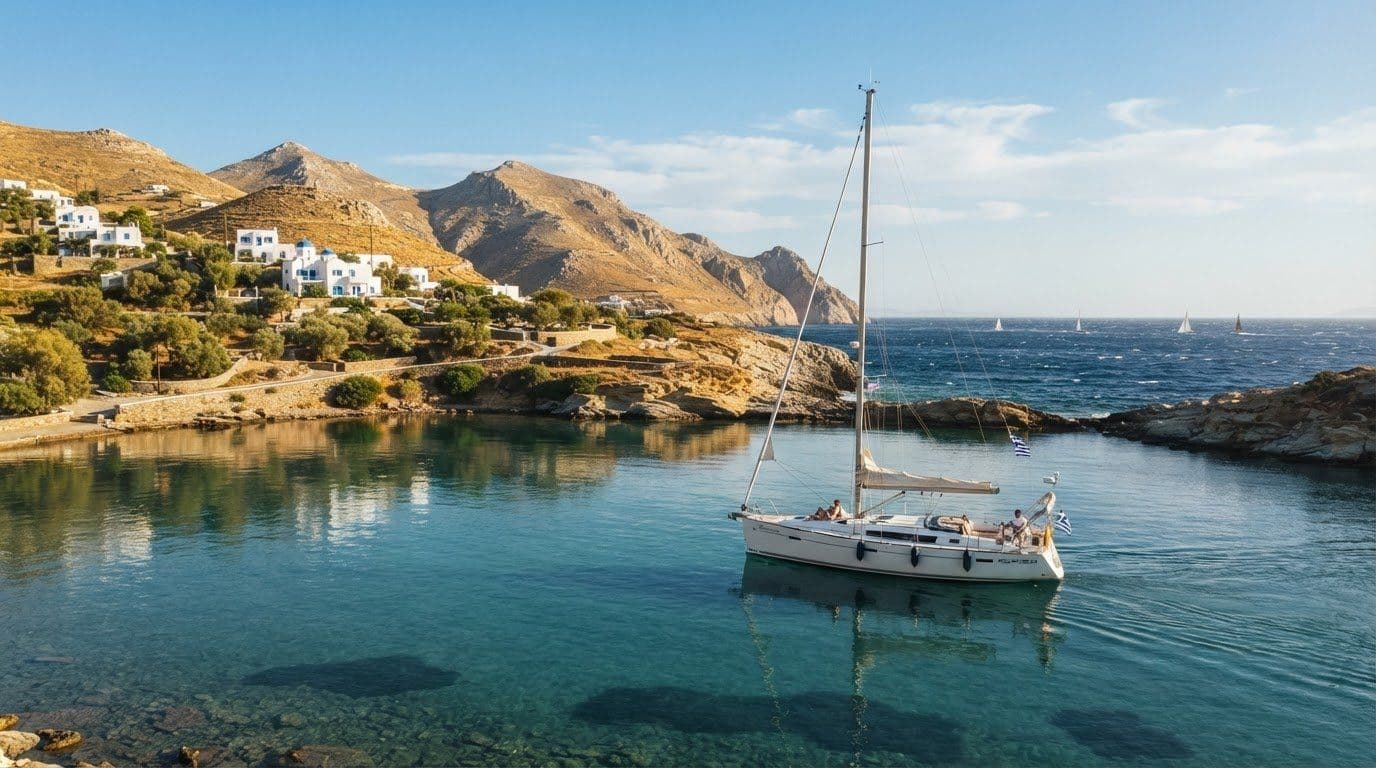
The Cyclades’ open position in the Aegean is part of their appeal, but it also exposes sailing routes to summer winds. If calmer summer sailing is your priority, avoiding the Meltemi winds in the Cyclades may mean considering the Ionian Sea or Saronic Gulf instead. The Meltemi is strongest and most persistent in July and August.
If you’re drawn to the Cyclades, you don’t have to rule them out. Understand how the Meltemi affects conditions, when it is most likely to shape a trip, and how the region compares with other Greek sailing areas.
This guide explains what the Meltemi is and why the Cyclades feel its effects, then compares sailing there with the Ionian and Saronic Gulf. You’ll get a clearer sense of which destination best suits the summer voyage you have in mind.
Key Takeaways
- Learn how the Meltemi’s seasonal timing and daily rhythm can shape your sailing plans.
- Compare the Ionian and Saronic Gulf to see which better fits your preferred summer sailing conditions.
- Find out which Cyclades islands are more exposed and why island geography matters.
- Understand how flexible routing can help you adapt your plans when winds strengthen.
Can you still enjoy the Cyclades during Meltemi season?
Sailors can enjoy the Cyclades during Meltemi season, but conditions may reshape a sailing holiday. The wind is most persistent in July and August, making a flexible route more practical than a fixed island-hopping plan.
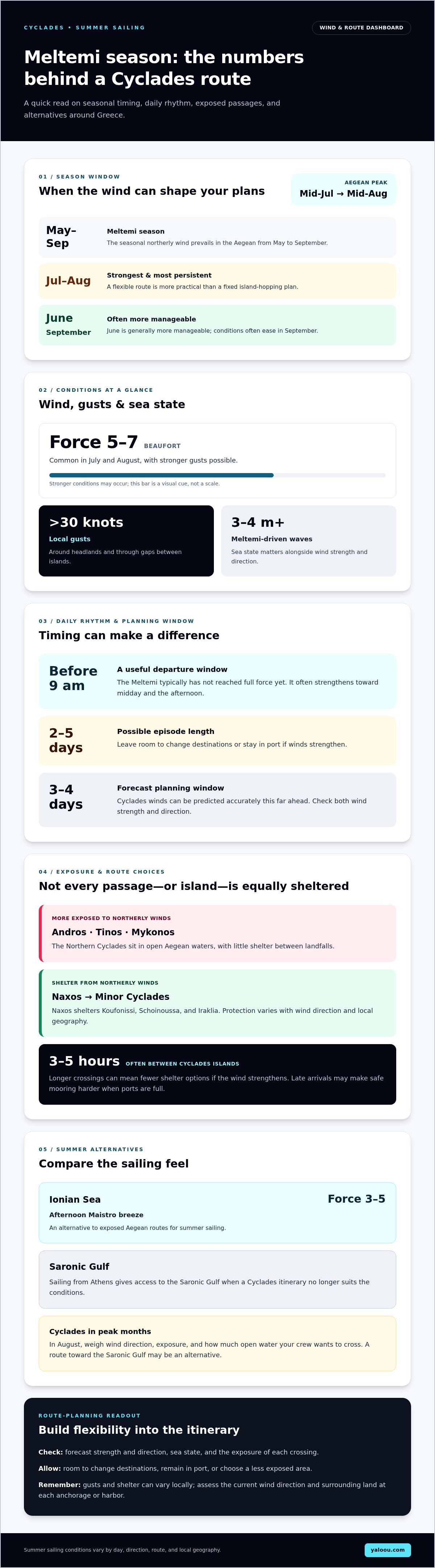
The Meltemi can occur from mid-May to mid-September, with its Aegean peak from mid-July to mid-August. June is generally more manageable, while conditions often ease in September. In July and August, winds commonly reach force 5 to 7 on the Beaufort scale, with stronger gusts possible. Open-water exposure and the route’s direction affect how demanding a passage feels.
During the day, the wind often strengthens toward midday and the afternoon. Early morning departures can make passages more comfortable because the Meltemi typically hasn’t reached full force before 9 am. Episodes may last 2-5 days, so sailors benefit from leaving room to change destinations or stay in port. A route toward the Saronic Gulf can also be an alternative when exposed Aegean sailing no longer suits the conditions.
Are there local travel rules or port advisories during strong Meltemi winds? Port conditions and operational notices vary by island and day, so follow harbor instructions and adapt your plans to the conditions. Strong winds can make docking more difficult, especially when gusts affect maneuvering inside a marina.
How often are Cyclades ferries delayed or canceled during strong Meltemi winds? There is no fixed daily pattern. High-speed ferries and hydrofoils are often the first services canceled on particularly windy days, while larger ferries may be delayed. The impact depends on conditions and the route.
A catamaran also requires careful consideration in strong Cyclades winds, which can make sailing more challenging than on a monohull. If avoiding the Meltemi winds in the Cyclades is your priority, another sailing area during the peak months may suit your plans better.
Alternative sailing areas in the Ionian and Saronic Gulf
For summer sailing, the Ionian Sea and Saronic Gulf offer alternatives to exposed Aegean routes. The Ionian’s afternoon Maistro breeze is usually force 3-5, while sailing from Athens gives access to the Saronic Gulf when the Meltemi makes a Cyclades itinerary unsuitable. In August, the choice can come down to wind direction, exposure, and how much open water your crew wants to cross.
Which Cyclades islands are most sheltered from the Meltemi? Naxos shelters the Minor Cyclades islands of Koufonissi, Schoinoussa, and Iraklia from northerly winds. These islands can offer a more protected route than exposed passages, but shelter varies with wind direction and local geography.
Which Cyclades beaches and harbors offer protection from northerly Meltemi winds? Southern-coast beaches are generally more sheltered from northerly winds. When considering an anchorage or harbor, assess its exposure to the current wind direction and surrounding land rather than assuming every side of an island offers equal protection.
Distance matters, too. Cyclades island-to-island passages often take 3-5 hours, and longer crossings can leave fewer shelter options if the wind strengthens. Late arrivals can also make safe mooring harder when ports are full. A skipper should weigh the crew’s experience, sea state, and route length before committing; a cooler temperature doesn’t make an exposed passage less demanding.
How can travelers check Meltemi forecasts and wind speeds before a trip? Review forecasts for both wind strength and direction, then use the outlook to shape the route. Cyclades winds can be predicted accurately 3-4 days ahead, giving sailors a useful planning window.
What wind speeds and sea conditions make ferry travel risky in the Cyclades? There isn’t one universal wind-speed threshold. Strong Meltemi conditions can cancel high-speed ferries and hydrofoils, while larger ferries may be delayed; rough seas and route exposure also affect travel. For a more flexible island experience, explore Greek island sailing experiences when comparing regions and routes.
What is the meltemi wind?
The Meltemi is a dry summer wind that shapes sailing across the Aegean. Its direction, island exposure, and sea state determine which Cyclades routes feel most demanding.
Wind Direction and Formation
The Meltemi, also called the Etesian, is a seasonal northerly wind driven by summer pressure patterns over the region. In the Cyclades, it blows from the north or northwest, though conditions can vary across Greece. It prevails in the Aegean from May to September. For sailors planning a charter, understanding the wind’s direction helps explain why one route leg feels exposed while another is more sheltered.
Exposure is especially notable around the Northern Cyclades islands of Andros, Tinos, and Mykonos, where winds are stronger. The islands sit in open Aegean waters, so north or northwest winds may encounter little shelter between landfalls. The Dodecanese and other Greek islands also have local wind patterns, but the Cyclades’ open passages make forecast direction especially important when choosing a route.
Wind Funnels and Sea State
Wind funnels form when air accelerates around headlands and through gaps between islands. In the Cyclades, gusts around these features can rise above 30 knots, even when broader conditions seem less intense. That local variation matters: a passage between islands may feel rougher than an exposed forecast area suggests.
Meltemi-driven waves in the Cyclades can reach 3-4 meters or more, making route planning about sea state as well as wind speed. Sailors should base routes on forecast strength and direction, avoid relying on straight rhumb-line passages, and allow room to change plans. Rather than treating the islands as equal stepping stones, map exposed crossings and potential shelter before departure. Those who prefer a gentler summer sailing experience may compare the Cyclades with less exposed Greek sailing areas before choosing their destination.
Why Cyclades islands are exposed to the Meltemi
The Cyclades sit in the open Aegean, directly in the path of northerly summer winds. Unlike a coastline sheltered by a continuous land barrier, these scattered islands leave broad stretches of water exposed. Wind can cross open sea before reaching a harbor or beach, building waves along the way. This geography helps explain why the same weather can feel different between island groups.
Island spacing matters. The Cyclades form a chain, not a solid wall, so wind passes through channels between landfalls. Gusts can intensify around headlands and narrow gaps, while exposed passages offer less protection. Northern Cyclades islands such as Andros, Tinos, and Mykonos are especially affected. A route that looks short on a chart may still cross open water with limited shelter.
July and August bring the strongest, most persistent Meltemi conditions. During this peak, consider both the forecast and each route’s exposure. A sheltered bay may offer a respite, but it does not make every nearby crossing sheltered. Assess each leg separately, including wind direction, open-water distance, and available harbors. A flexible holiday plan makes it easier to adapt when conditions make a planned destination less comfortable.
This exposure also distinguishes the Cyclades from the Ionian Sea, where summer afternoon Maistro winds are usually force 3-5. The Ionian can suit travelers who prefer gentler sailing conditions, while the Aegean’s open routes demand more attention to wind and sea state. Neither region is sheltered everywhere; local coastlines and route choices still matter. In the Cyclades, map the gaps between islands, not just the islands themselves.
That’s the central takeaway: the Cyclades’ beauty and exposure come from the same open-sea setting. Choose routes around the forecast, keep alternatives in mind, and explore Greek island experiences as you shape a holiday that fits your preferred conditions.
YAL’OOU Exclusive Yachting & More: Daily Yacht Charters
YAL’OOU Exclusive Yachting & More offers Daily Yacht Charters for travelers who want to experience the Greek islands by yacht. If the Meltemi forecast makes a multi-island sailing plan feel too exposed, a day charter can be a way to focus your time on a shorter outing rather than planning a longer route.
For a longer escape, Weekly Crewed Yacht Rentals offer a different format. The right choice depends on how much time you have and the kind of sailing experience you want, alongside the weather and route conditions. YAL’OOU also offers High-End Villa Rentals and VIP Ground Transfers to complement an island stay.
To plan a Greek island escape around your preferred pace and the conditions, contact YAL’OOU or visit yaloou.com.
Choose the Sailing Style That Fits Your Trip
Let your preferred pace guide the next decision. If you want a focused day on the water, consider a daily yacht charter; for a longer escape, a weekly crewed yacht rental offers a different way to experience the islands. A high-end villa rental can suit a trip centered on time ashore. The best fit depends on how you want to spend your days, not simply which islands appear on a map.
For travelers avoiding the Meltemi winds in the Cyclades, keep the plan responsive to conditions and your crew’s comfort. YAL’OOU Exclusive Yachting & More offers daily yacht charters, weekly crewed yacht rentals, and high-end villa rentals to support different styles of Greek island travel.
Share your preferred pace and island plans with YAL’OOU as you shape your trip. Explore YAL’OOU experiences, and take the next step toward a Greek island escape that feels right for you.
Frequently Asked Questions
When does it blow?
The Meltemi blows across the Aegean in summer, commonly from May through September, with the strongest and most persistent conditions in July and August. If your trip falls near the season’s edges, treat the month as context, not a promise of calm. Wind strength and direction can change how comfortable a particular sailing leg feels, so consider the day’s forecast alongside your dates.
How strong can the Meltemi be?
It typically blows at force 5-7 on the Beaufort scale, with gusts occasionally reaching force 8-10. Over open Aegean water, winds commonly reach 15-25 knots. Separate sustained wind from gusts when weighing a route: one reading doesn’t describe every passage. An exposed crossing and a sheltered anchorage can feel very different, so consider the yacht, crew, and sea state together.
Is the Aegean more difficult than the Ionian?
In summer, the Aegean is generally more demanding for average holiday crews because of stronger wind exposure and challenging conditions. In the Ionian, afternoon Maistro winds are usually force 3-5. That comparison can help match a destination to your crew’s experience and preferred pace. The Ionian isn’t uniformly calm, and local exposure still matters, but it offers an alternative to open Aegean routes.
Is the Meltemi dangerous?
Strong Meltemi conditions can make sailing and docking difficult, and exposed passages can become challenging and risky. The practical concern is how wind, waves, route length, and crew experience combine on a given leg. A plan relying on a long, exposed crossing has less flexibility than one with nearby shelter. Leave room to adjust the itinerary instead of treating every planned departure as fixed.
Mapping the Calm: Which Greek Archipelagos are the Least Windy?
The Ionian Islands and the Argo-Saronic area are alternatives to exposed Aegean routes for travelers seeking easier summer sailing. Neither is uniformly wind-free: local coastlines and wind direction still shape conditions. For a practical comparison, consider how much open water each route crosses and how readily the itinerary can change. That may matter more to your trip than choosing an archipelago by reputation alone.
The Arch-Nemesis of the Aegean: What is the Meltemi?
The Meltemi, also called the Etesian wind, is a dry seasonal northerly that blows over the Aegean in summer. In the Cyclades, it usually comes from the north or northwest, and its effect depends on whether a route is exposed to that direction. When comparing destinations, look beyond the island name: a passage between islands may have very different conditions from a nearby sheltered bay.
Disclaimer
The YAL’OOU Travel Guide is curated with care to inspire and inform discerning travelers. While every effort is made to ensure the accuracy and relevance of the information provided, all content is offered for general guidance only and may evolve over time.
Details such as local regulations, availability, pricing, and services are subject to change without prior notice. We encourage guests to seek personalized advice and confirm arrangements directly when planning their journeys.
YAL’OOU accepts no liability for any inaccuracies, omissions, or outcomes arising from the use of this information. The Travel Guide may feature recommendations, insights, and selected third-party experiences, presented solely as a source of inspiration and not as formal endorsements.
By accessing this section of our website, you acknowledge and accept this disclaimer as part of your experience with YAL’OOU.