
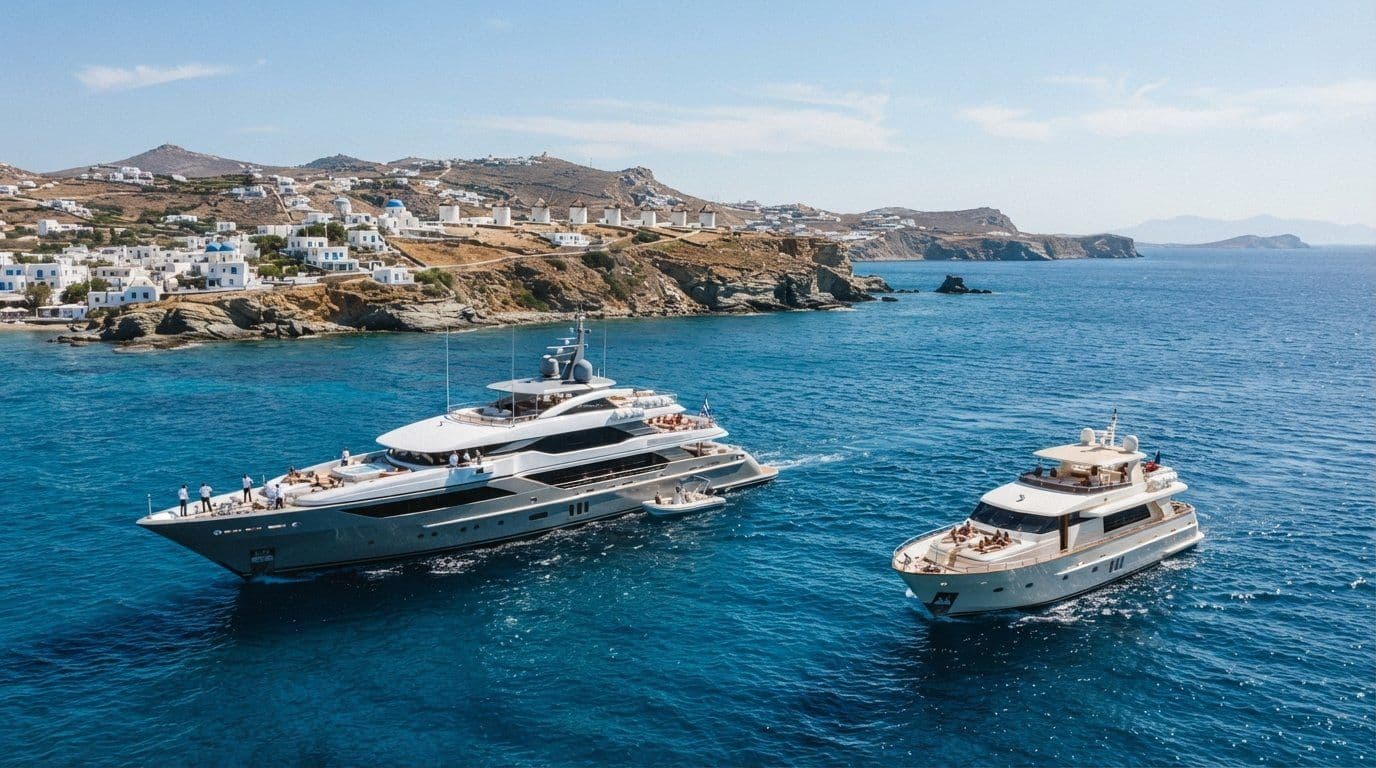
The biggest name isn’t automatically the best fit for a Greek yacht charter. For travelers weighing a boutique Aegean yacht agency vs international superyacht houses, the choice comes down to fleet access, company location, and yachts suited to the group and itinerary. Most yachts are limited by law to 12 guests, while a 64-metre yacht is listed as an exception certified to carry more.
It’s easy to focus on brand recognition, but practical details shape the experience on board and across the islands. A boutique Aegean yacht agency vs international superyacht houses comparison should also consider yacht length, guest capacity, crew scale, and operating regions.
This guide explains how boutique agencies and international firms can differ, how to assess a yacht proposal, and why regional knowledge matters. Use these criteria to compare charter options for a Greek island trip and decide which arrangement suits your plans.
Key Takeaways
- Compare the range of yachts available, not just an agency’s size, to find vessels that fit your group and itinerary.
- Learn how a company’s base and local representation can shape its knowledge of Greek cruising.
- Use operating regions to assess whether a charter fits the route you have in mind.
- See how charter brokerage services differ from the practical support that can accompany a trip.
- Explore when a daily yacht charter or a weekly crewed rental may suit your plans.
Fleet size, yacht lengths, and guest capacity
A charter agency’s fleet list may include yachts it represents rather than owns. Focus on the options that suit your group and trip: ask about cabin layout, guest arrangements, crew, and the proposed cruising area. A broader international network may have more listings, while a boutique Aegean agency may focus on Greek island itineraries. What matters is whether the available yacht and route fit your plans.
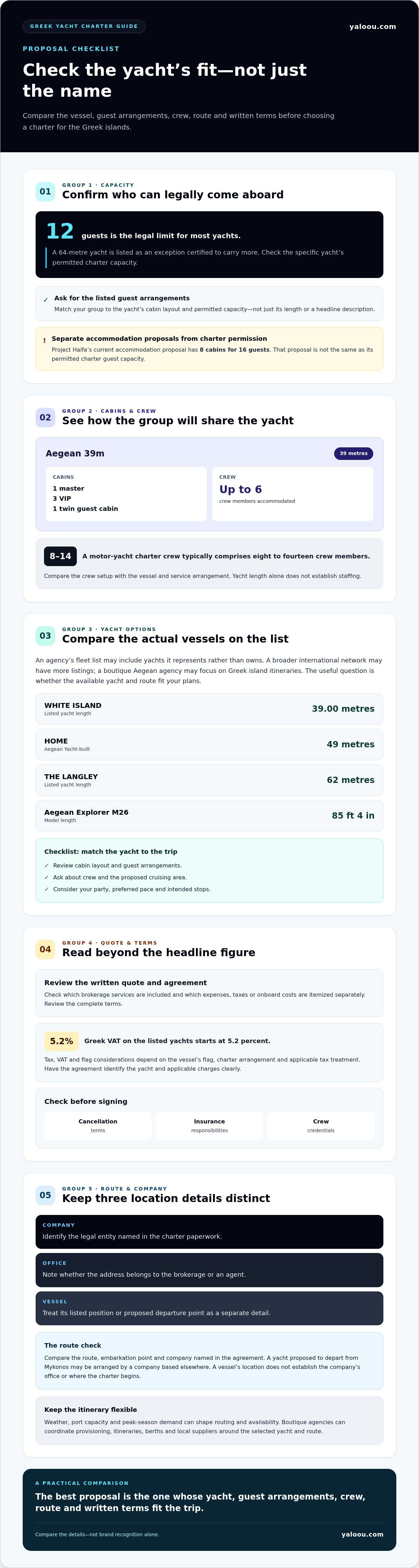
Length alone doesn’t determine how comfortably a group fits. Most yachts are limited by law to 12 guests, with a 64-metre yacht listed as an exception certified for more. Guest capacity should be checked against the yacht’s listed arrangements and permitted charter capacity. Compare that with Project Haifa, whose current accommodation proposal has eight cabins for 16 guests. The proposal is not the same as a charter’s permitted guest capacity.
To see how yacht design shapes an Aegean itinerary, watch Greek Islands Sailing: The Ultimate Charter Guide from NauticEd - International Sailing & Powerboating.
Cabins clarify how guests share space. The Aegean 39m has one master cabin, three VIP cabins, and one twin guest cabin. It can accommodate up to six crew members. By comparison, a motor-yacht charter crew typically comprises eight to fourteen crew members. Match the crew setup to the vessel and service arrangement, rather than assuming yacht length alone predicts staffing.
Length examples show the range behind “superyacht.” WHITE ISLAND is listed at 39.00 metres, while Aegean Yacht-built HOME is 49 metres and THE LANGLEY is 62 metres. The Aegean Explorer M26 model is 85 feet 4 inches long. Ask how each candidate’s dimensions and cabin plan fit your party, preferred pace, and intended stops.
Compare agency fees through the written quote and charter agreement. Check which brokerage services are included and which expenses, taxes, or onboard costs are itemized separately. Review the complete terms rather than relying on a headline figure.
For Greek licensing, tax, VAT, and flag considerations, the relevant details depend on the vessel’s flag, charter arrangement, and applicable tax treatment. Greek VAT on the listed yachts starts at 5.2 percent. Have the agreement identify the yacht and the applicable charges clearly.
Booking typically moves from defining dates and guest needs to selecting a yacht, reviewing its proposal, and signing the agreement. Check the contract’s cancellation terms, insurance responsibilities, and crew credentials before signing. Weather, port capacity, and peak-season demand can shape routing and availability, so itinerary flexibility matters. Boutique agencies can coordinate provisioning, itineraries, berths, and local suppliers around the selected yacht and route.
Company type and location
A yacht’s location, a brokerage’s office, and a company’s legal base are separate details. A yacht proposed for departure from Athens, Mykonos, or Paros is not necessarily built or managed by a company based there. Keep these facts distinct when comparing boutique Aegean agencies with international houses. A vessel’s listed location describes its position, not necessarily the company’s office or your charter’s starting point.
A yacht builder and a charter broker have different roles. The builder creates the vessel; the broker or agency connects clients with yachts available for charter. A listing may name the builder, but that does not identify the booking agency or the company arranging the charter. Read each offer carefully to distinguish the yacht’s background from the company handling your enquiry.
A company’s structure can shape how a charter is arranged. A local agency may focus on Aegean routes, while an international brokerage may connect clients with a wider network. Neither description alone establishes service quality, yacht ownership, or local presence. Review the contracting company’s details and identify who will handle your enquiry. That makes clear who is arranging the booking.
Location matters when it relates to your route and departure point. A Greek office may offer a different connection to local ports than a brokerage coordinating remotely, while an international house may also work through local representation. Distinguish a staffed office from an agent or a yacht’s proposed departure point: each describes a different connection to Greece.
- Company: identify the legal entity named in the charter paperwork.
- Office: note whether the address belongs to the brokerage or an agent.
- Vessel: treat its listed position or departure point as a separate detail.
Use three details to compare firms: the route, the embarkation point, and the company named in the agreement. A yacht proposed for departure from Mykonos, for example, may be arranged by a company based elsewhere. The departure point does not establish where the agency has an office. Check how the route, embarkation, and booking company fit together instead of relying on a map pin or brand name.
If your priority is planning time on the water around Greece, explore Aegean yacht experiences as one way to shape the trip around your preferred pace and stops.
Aegean Yacht's DONNA DEL MARE is listed in Dubrovnik-Neretva, Croatia. This identifies the vessel’s stated location, but does not establish the company’s legal base, office, or where a charter would begin. Treat it as a vessel detail when reviewing an offer, then consider the contracting company and proposed embarkation point separately. The distinction remains useful even when a yacht’s name or brokerage identity suggests a particular region. Check how the listing fits the route and booking arrangement before drawing conclusions about where the company operates.
Operating regions
A charter company’s operating region describes where it arranges trips, not simply where its office is located. A boutique Aegean agency may concentrate on Greek island routes, while an international superyacht house may work across several cruising areas. The boutique Aegean yacht agency vs international superyacht houses comparison is most useful when you match regional reach to your route. Compare the advertised area with your embarkation point, destinations, and return plan.
For a Greek itinerary, name the islands and regions you want to visit. The Cyclades, Saronic Gulf, Ionian Islands, and Dodecanese offer distinct route possibilities. A Cyclades trip differs from one linking Saronic destinations. Ask the agency to map your intended stops against the yacht’s starting point and the time available. This gives the proposed route meaning beyond a broad “Greece” label.
A wider international network may help when your plans extend beyond the Aegean or include multiple cruising regions. A locally focused firm may bring close familiarity with Greek routes and suppliers. These are differences in scope, not automatic measures of service. Ask how the proposed yacht, itinerary, and departure point work together for your trip.
Use these steps to compare regional fit:
- Name your route: list the Greek islands or regions that matter most.
- Set your start and finish: make the embarkation and return points explicit.
- Match the yacht to the plan: check that the proposed vessel is suitable for the route and schedule.
- Clarify regional coverage: establish which destinations the agency will arrange within the charter.
A Cyclades-focused holiday calls for a proposal built around those islands, rather than a generic Mediterranean itinerary. If you want to combine Greek destinations with another cruising region, explain that at the outset. The agency can then shape a route around the full plan instead of treating each destination as a separate request.
Regional knowledge matters after the itinerary is drafted, too. Port access, weather, and seasonal demand can affect the order of stops and the pace of a journey. A considered route leaves room for alternatives if conditions change. Ask for the intended route and the reasoning behind it, including how the plan could adapt.
Choose a partner whose regional reach matches your priorities. In the boutique Aegean yacht agency vs international superyacht houses decision, focus on the route each can arrange, not the label alone. For a Greek island escape, local Aegean knowledge may be central. If your itinerary spans several regions, an international network may be more relevant. Judge the proposal by its route, departure point, and fit with your plans.
What services does a boutique Aegean yacht agency provide compared with an international superyacht brokerage?
Both types of company can arrange yacht charters, but their service models may differ. A boutique Aegean agency may focus on matching a yacht, itinerary, and guest preferences to a Greek island trip. An international brokerage may connect clients with a wider selection of yachts and coordinate through a broader network. These are useful starting points, not guarantees about an individual firm.
For a week in the Cyclades, the discussion might begin with your departure point, preferred pace, and time ashore. The agency can then present yacht options and help shape an itinerary. A brokerage working across multiple regions may be useful if your trip includes destinations beyond Greece or calls for comparisons across cruising areas.
Look at the work covered, not just the company label. A charter arrangement can involve several distinct tasks:
- Finding a yacht: matching the vessel to the group, travel dates, and preferred style of cruising.
- Planning the route: proposing Greek stops and an order that fits the trip’s priorities.
- Coordinating details: bringing together the charter terms, guest preferences, and practical arrangements.
- Personalizing the stay: organizing requested onboard experiences, such as dining preferences.
Responsibilities may be shared among the brokerage, yacht crew, and other service providers. Before booking, establish who handles each arrangement. For example, ask who plans the itinerary, receives provisioning preferences, and communicates changes. A clear division of responsibilities makes the experience easier to manage.
Compare proposals using the same brief. Give each agency your preferred dates, group details, embarkation point, and must-see destinations. Then assess how directly each proposal addresses them. A useful response explains why a yacht suits your plans, what the route prioritizes, and which arrangements fall outside the charter booking.
Contract terms matter as much as the service description. YAL’OOU states that it writes every charter using the MYBA form of agreement. Read the agreement for the named parties, payment schedule, cancellation provisions, and treatment of expenses. Make sure the written terms reflect your discussions about the yacht and itinerary.
A boutique agency may suit you if your priority is a focused Greek itinerary and attention to destination-specific preferences. An international brokerage may be a better fit for a search spanning regions or requiring a wider yacht comparison. Choose based on the proposal, responsibilities, and route, rather than assuming one company structure guarantees more personal service.
A boutique agency can shape a Greek itinerary around guest priorities and coordinate practical details. Provisioning preferences and onboard requests may involve the agency, crew, or other providers. Clarify who receives and manages each request before booking.
Which international superyacht houses have offices or agents in Greece and the Aegean?
An international yacht house may serve Greek charter clients through its own office, a local agent, or a team based elsewhere. These arrangements differ: an office is part of the company, while an agent represents it locally. A yacht listed in Greece does not prove its brokerage has a Greek office. Check how the company’s stated presence relates to the people handling your charter.
For a practical comparison, identify the booking company and the Greek contact’s role. A contact may coordinate your enquiry without being part of the contracting brokerage. This distinction matters when your plans involve a Greek departure, island stops, or changes during the trip. A clear explanation connects the company, its representative, and the charter arrangement.
Use this checklist to assess a house’s Aegean presence:
- Identify the office: distinguish a company office from an independent local representative.
- Establish the relationship: find out which organization the local contact represents.
- Review the paperwork: identify the legal entity named in the charter agreement.
- Connect the contact to the route: clarify who coordinates arrangements for your Greek itinerary.
A brand’s international reach may help when searching across several cruising regions. Local representation can provide a direct point of contact for a Greek itinerary. Neither fact alone tells you how much support you will receive. Compare the proposal, the company named in the agreement, and the person responsible for communicating arrangements.
If a brokerage proposes a yacht for an Aegean trip, ask who coordinates departure details and communicates itinerary updates. Keep the answer with your booking documents. If the contact changes during the process, clarify which organization remains responsible. This record helps keep communications connected to the right company and charter.
Office locations alone do not provide a useful ranking of international houses. A listed office, a local agent, and a yacht available for charter each describe a different connection to Greece. Instead, compare firms that can present a suitable vessel and explain their role in your booking. That creates a more meaningful shortlist than brand recognition alone.
Once you know what kind of support you want, shape your Greek trip around its route and pace. Explore Greek yacht experiences with YAL’OOU Exclusive Yachting & More and start outlining the time on the water that suits you.
Budget comparisons also need to separate the base charter price from the funds set aside for expenses. Standard industry guidelines typically estimate the Advanced Provisioning Allowance (APA) at 30 to 40 percent of the base price for a motor-yacht charter in Greece. Treat that estimate as a planning guide, then ask how the chosen yacht’s expenses are handled and what the booking documents specify. A clear breakdown can help you compare proposals without mistaking the weekly rate for the full trip cost.
These financial frameworks can help frame an initial comparison, but the vessel, itinerary, and terms in an individual proposal still matter. Ask your contact to confirm the applicable rate and explain which costs fall outside the base price before you decide how a particular house fits your plans.
YAL’OOU Exclusive Yachting & More: Daily Yacht Charters
YAL’OOU Exclusive Yachting & More offers Daily Yacht Charters for exploring the Greek coast and islands on a day trip. Choose this format when you want time on the water without a week-long charter. For a longer journey, Weekly Crewed Yacht Rentals offer another way to explore. YAL’OOU also offers High-End Villa Rentals and VIP Ground Transfers for a broader Greek holiday.
Start by deciding how much of your trip you want to spend at sea, then match the charter format to your itinerary. A focused day on the water suits a shorter visit; a weekly rental gives the journey more room to unfold.
To discuss your plans, contact YAL’OOU Exclusive Yachting & More or visit yaloou.com.
Make Your Next Greek Charter Feel Like Your Own
Turn your preferences into a clear trip brief. Note the experience you want, how you would like to spend your time, and whether your plans center on the water or include a stay ashore. This makes the boutique Aegean yacht agency vs international superyacht houses comparison practical, with your trip rather than a company label guiding the decision.
YAL’OOU Exclusive Yachting & More offers Daily Yacht Charters, Weekly Crewed Yacht Rentals, and High-End Villa Rentals. These options offer different ways to experience Greece, from a day at sea to a longer stay. Choose the format that fits your plans, then explore the details at your own pace.
Explore YAL’OOU’s yacht experiences and take the next step toward a Greek escape that feels right for you.
Frequently Asked Questions
How do boutique agencies compare with large brokerages in local knowledge, yacht inventory, and global reach?
Boutique agencies often focus on local itinerary planning, while large brokerages may connect you with a broader international yacht network. For a Mykonos-to-Paros trip, compare how each proposal handles your preferred stops and embarkation details, not just the number of listings. If your plans extend beyond Greece, a brokerage with wider regional reach may simplify the search. The right fit depends on your route and priorities.
Disclaimer
The YAL’OOU Travel Guide is curated with care to inspire and inform discerning travelers. While every effort is made to ensure the accuracy and relevance of the information provided, all content is offered for general guidance only and may evolve over time.
Details such as local regulations, availability, pricing, and services are subject to change without prior notice. We encourage guests to seek personalized advice and confirm arrangements directly when planning their journeys.
YAL’OOU accepts no liability for any inaccuracies, omissions, or outcomes arising from the use of this information. The Travel Guide may feature recommendations, insights, and selected third-party experiences, presented solely as a source of inspiration and not as formal endorsements.
By accessing this section of our website, you acknowledge and accept this disclaimer as part of your experience with YAL’OOU.