
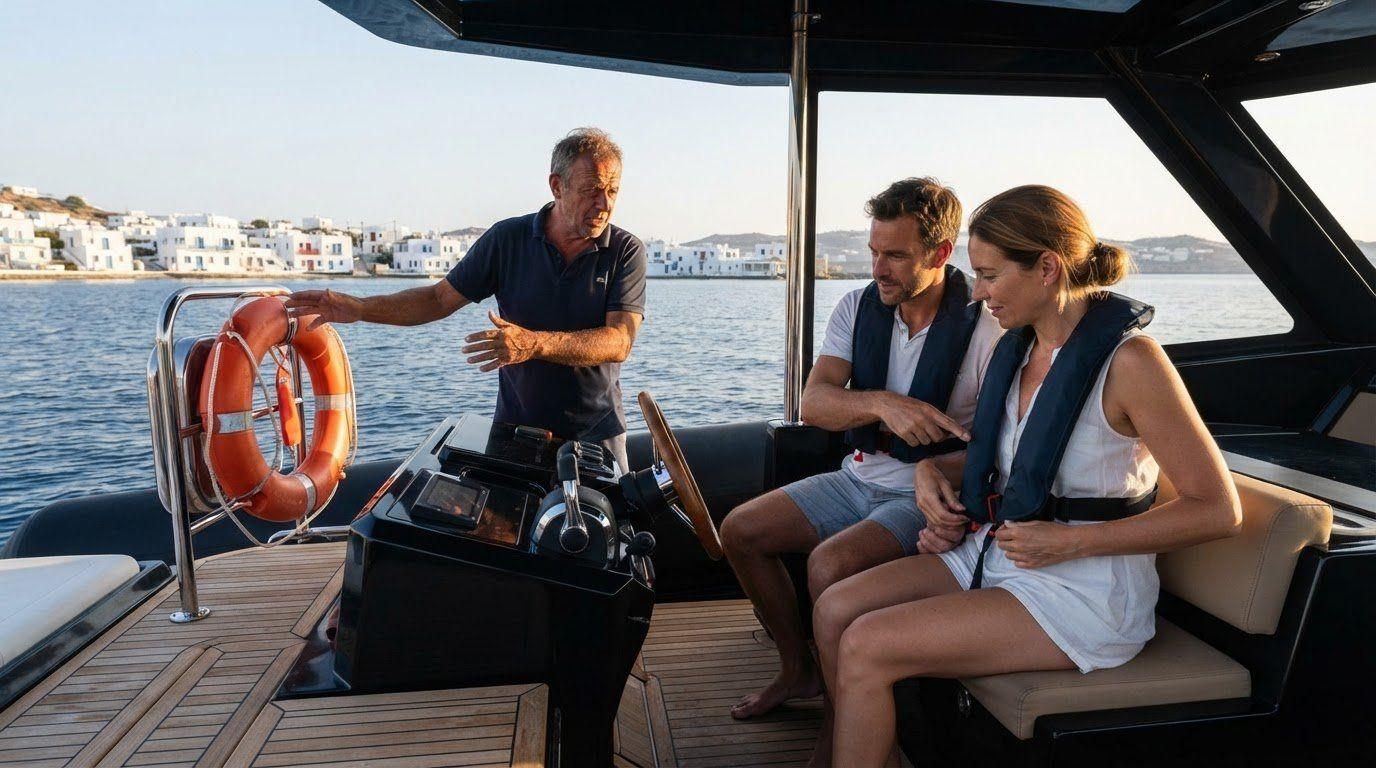
On a crewed yacht in Greece, the captain and crew are responsible for the vessel and guests’ safety on board. The captain leads navigation and route planning, so crewed yacht charter safety standards in Greece start with clear responsibilities, a safety briefing and decisions based on conditions at sea.
It’s natural to want the freedom of an island-hopping trip without taking on the skipper’s role. On a skippered charter, travelers typically don’t need a sailing licence themselves; the operator handles vessel-side charter compliance.
This guide explains the crew’s responsibilities, how Greek charter licensing works and which sailing qualifications may be accepted for bareboat charters. It also covers how captains discuss itineraries with guests and adapt routes and anchorages to the weather, so you can plan with confidence while leaving navigation to the professional crew.
Key Takeaways
- Know what the captain and crew manage onboard, and why a clear safety briefing matters before departure.
- Understand how vessel-side charter paperwork is handled and what licensing typically means for guests on a skippered trip.
- Learn which sailing qualifications may support a bareboat charter and why operators assess experience alongside certificates.
- See how weather, wind exposure and anchorage options shape a captain’s route and itinerary decisions.
Crew responsibility for onboard security and safety
On a crewed Greek yacht, the crew is responsible for the vessel and guests’ safety on board. A clear briefing helps guests understand their role during the trip.
Crew Roles and Vessel Operation
The captain operates the yacht and manages navigation; other crew members support the vessel and guest service. A typical crew on a 20-to-30-metre yacht includes a captain, chef and at least one deckhand. Yachts measuring 35 metres and above may carry expanded crews, including a chief stewardess, engineer and additional deckhands.
Cabin count helps explain guest capacity, but it doesn’t determine crew size by itself. For example, FLO is listed with five cabins and two crew members; a five-cabin yacht can host 10 passengers plus crew. These details help guests understand the setup aboard a motor yacht sailing Mediterranean waters, including the Saronic region.
Passenger and Child Safety Rules
Greek yachts are generally limited to a maximum of 12 guests, and capacity limits don’t distinguish between adults and children. Cabin and berth capacity may set a lower practical limit: a five-cabin yacht can accommodate 10 passengers plus crew. Children count toward the guest total, so age doesn’t create an extra place onboard.
Keep children within the crew’s designated safe areas, especially while the yacht is moving or guests are boarding. The captain’s directions apply to every passenger, whatever their age or experience.
Emergency Procedures and Medical Facilities
Before departure, find out where the life jackets are and how the crew expects you to respond in an emergency. The U.S. Government Publishing Office says pilots and passengers should have life jackets and know what to do in an emergency.
A first-aid kit, radio, fire extinguishers and life jackets are examples of equipment included in a safety recommendation for yacht trips. The crew should explain how to raise an alarm, where first-aid supplies are kept and how it will respond to a medical incident. Onboard first aid supports an immediate response; the crew can coordinate further assistance when needed.
Guest Preparation and Safety Briefings
Attend the safety briefing before departure and familiarize yourself with the yacht’s equipment and procedures. Ask the skipper to demonstrate how to use a life jacket and explain where to gather in an emergency.
Pay attention to instructions for moving around the deck, entering or leaving the water and following crew directions. Conditions and daily plans can change during the season, so listen for updates from the captain and follow the crew’s guidance throughout the trip.
Greek charter licences and e-Permits
On a skippered charter, guests typically don’t need a sailing licence; the operator handles vessel-side compliance. Understanding crewed yacht charter safety standards in Greece also means knowing how charter paperwork, local navigation rules and sea conditions can shape a trip.
The Greek charter code requires charter yachts to carry an emergency tiller. Weather and sea conditions can affect routes, while wildfire concerns may inform discussions about shore access and itinerary choices.
Marine Regulations and Port Authority Checks
Greek marine regulations cover vessel compliance and navigation, while documentation checks by port authorities help establish that charter paperwork is in order. Operators may carry out checks associated with Greek port authorities and handle permits required for charters in Greek waters.
Guests should understand local speed limits, anchoring rules and maritime traffic regulations. These matter on island itineraries, whether a route passes a busy marina or heads through the Ionian. Greece’s crewed yacht charter safety standards also depend on following the relevant rules along the planned route.
Yacht Inspections and Certification
The operator is responsible for vessel-side compliance, including ensuring the yacht’s paperwork is in order and handling permits required for Greek waters. This is separate from a guest’s sailing qualification: travelers on skippered charters typically don’t apply for the Greek charter licence themselves.
Documentation checks associated with Greek port authorities may form part of the operator’s process. The Greek charter code requires charter yachts to carry an emergency tiller, and the RCD also requires emergency tillers on wheel-steered boats. This is a specific equipment requirement, not a complete inventory of onboard safety gear.
The Meltemi is a strong northerly wind that shapes Cyclades sailing from mid-June through August. Late April through October is identified as the best charter period in Greece, though captains adapt routes to conditions. For wildfire concerns, discuss shore access when shaping your itinerary. Explore Greek island experiences as you plan.
Accepted sailing qualifications
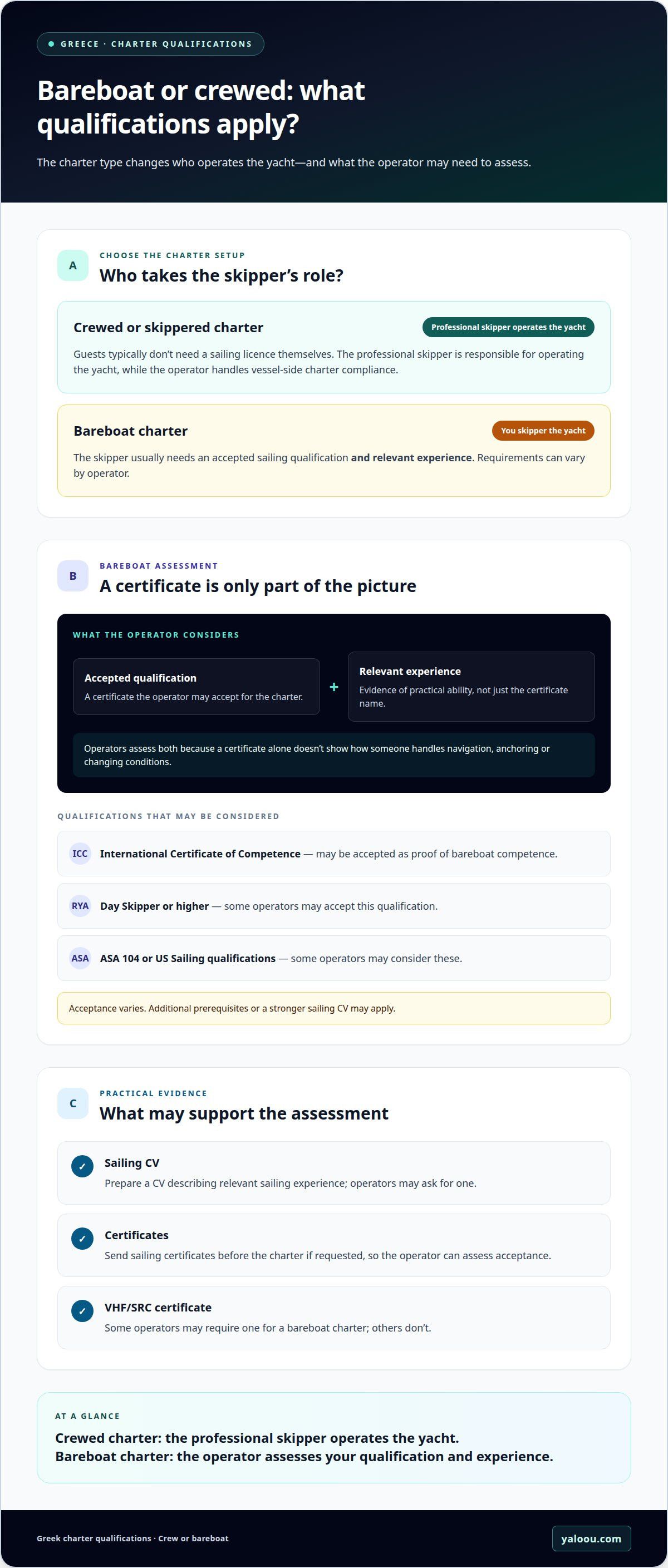
For bareboat charters in Greece, the skipper usually needs an accepted sailing qualification and relevant experience. Operators assess both, because a certificate alone doesn’t show how someone handles navigation, anchoring or changing conditions. On a crewed charter, travelers typically don’t need a sailing licence themselves; the professional skipper takes responsibility for operating the yacht.
Accepted credentials can vary by operator. An International Certificate of Competence (ICC) may be accepted as proof of bareboat competence. Some operators may accept an RYA Day Skipper qualification or higher, while others may consider ASA 104 or US Sailing qualifications. Additional prerequisites or a stronger sailing CV may apply.
- Send sailing certificates before the charter if requested, so the operator can assess acceptance.
- Prepare a sailing CV describing relevant experience; operators may ask for one.
- Some operators may require a VHF/SRC certificate for a bareboat charter, while others don’t.
Expect the assessment to consider practical skills, not just the name of a certificate. Bareboat skippers are expected to demonstrate navigation, pilotage, position awareness and sailing-plan preparation. Safe anchoring and mooring also matter, particularly on itineraries that include unfamiliar harbours or bays.
A co-skipper on a Greek yacht charter must be over 18 years old. An International Certificate of Competence, International Proficiency Certificate or similar home-country qualification is described as required to charter a yacht in Greece. For bareboat sailing, share the relevant documents early, allowing time for the operator’s review before departure.
The planned vessel and route help frame the experience assessment. A catamaran itinerary around Mykonos, for example, still calls for sound position awareness and safe anchoring. A beautiful route with charming island stops doesn’t replace the skipper’s responsibility to navigate and moor safely. Match qualification evidence to the sailing experience you’ll bring aboard.
Captain-led route and anchorage planning
On a crewed yacht in Greece, the captain navigates and plans the route. The itinerary is discussed with guests, then adjusted if the weather makes another plan more suitable. That flexibility matters across the Cyclades and the Aegean, where wind exposure can shape open-water crossings and overnight stops.
The Meltemi is a strong northerly wind that defines Cyclades sailing from mid-June through August. In July and August, it is described as blowing from the north at Force 4 to 7 in the Aegean. Those conditions affect when a captain plans exposed passages and which island shores offer shelter for an overnight anchorage.
For Aegean charters in July and August, captains plan open-water crossings for the morning, before the wind builds. They can also use island lee shores for overnight anchorage. This links the day’s passage with a more sheltered place to stop, rather than treating each island visit as a fixed appointment. A luxury itinerary can remain enjoyable while its sequence adapts to conditions.
Yacht design also changes which anchorages are practical. A catamaran drawing 1.2 metres can anchor in bays that a monohull drawing 2.8 metres cannot access. Draft affects access, so two yachts may need different stops even on the same route. The captain weighs that vessel constraint alongside wind and the planned itinerary when selecting suitable bays.
Discuss preferred islands and priorities with the captain before departure, then stay open to route changes as conditions evolve. A beautiful stop may need to give way to a more suitable anchorage or crossing plan. To shape your Greek island itinerary, begin with the places and experiences that matter most to your group.
YAL’OOU Exclusive Yachting & More: Daily Yacht Charters
YAL’OOU Exclusive Yachting & More helps turn safety-aware planning into a Greek island charter tailored to your trip. Choose Daily Yacht Charters for a focused itinerary on the water, or Weekly Crewed Yacht Rentals for a longer journey with a professional crew. With Mykonos and Paros among its areas of focus, YAL’OOU coordinates yacht and trip logistics around your preferences.
When choosing between a day charter and a longer voyage, consider how much time you want underway and how many island stops your plans allow. Share your preferred destinations and travel priorities so the charter can be shaped around the experience you have in mind.
For a Greek yacht charter shaped around your plans, contact YAL’OOU Exclusive Yachting & More.
Plan a Greek Escape That Fits Your Priorities
Focus your next decision on the kind of trip you want, not just the places on a map. Decide whether you’re planning a focused day at sea or a longer island journey, then share your preferred pace, destinations and priorities when shaping the experience. Understanding crewed yacht charter safety standards in Greece can help you plan with realistic expectations and enjoy the journey with confidence.
YAL’OOU Exclusive Yachting & More can shape the yacht experience around your plans. If your stay in Greece also includes time ashore, High-End Villa Rentals can complement the trip. Keep the planning personal: choose the experiences that matter to your group and leave room for the captain’s decisions at sea.
Explore experiences and contact YAL’OOU Exclusive Yachting & More to start planning your Greek escape.
Frequently Asked Questions
What safety regulations apply to crewed yacht charters in Greece?
Greek charter yachts generally carry no more than 12 guests, and the charter code requires an emergency tiller. Guests should also follow local speed limits, anchoring rules and maritime traffic regulations. For example, an anchoring decision needs to account for the rules at that location, not just the planned stop. The captain’s safety briefing explains how onboard procedures apply during the trip.
What licenses and certifications must Greek charter yachts and crews have?
For a crewed charter, travelers typically don’t need a sailing licence, and the operator handles vessel-side charter compliance and required permits. Bareboat bookings are different: operators usually assess the skipper’s accepted sailing qualification and experience. An ICC may be accepted, while some operators may accept RYA Day Skipper or higher, or ASA 104 and US Sailing qualifications. Acceptance varies by operator.
What safety qualifications should a Greek charter yacht captain and crew hold?
For bareboat sailing, the skipper needs an accepted qualification and relevant experience; operators may review certificates and a sailing CV before departure. Practical competence matters too, including navigation, position awareness, pilotage, safe anchoring and mooring. Some operators may require a VHF/SRC certificate. On a crewed charter, the captain navigates and operates the vessel while guests follow the crew’s onboard instructions.
How do Greek yacht charter safety standards compare with EU and international standards?
Both the Greek charter code and the EU Recreational Craft Directive specify an equipment requirement: wheel-steered boats need an emergency tiller. This is a narrow comparison, not proof that every Greek charter rule matches every EU or international standard. An ICC concerns a skipper’s competence for bareboat sailing; it’s distinct from vessel equipment and charter-permit requirements.
How can travelers verify a Greek crewed yacht charter company's safety record and insurance?
Review the charter documents and insurance wording separately: yacht insurance doesn’t, by itself, establish a company’s safety record. The charter package includes insurance for the yacht, but the documents determine which vessel is insured and the policy’s scope. For safety history, look for specific, documented inspection or incident information rather than treating insurance or general promotional claims as evidence of past performance.
Disclaimer
The YAL’OOU Travel Guide is curated with care to inspire and inform discerning travelers. While every effort is made to ensure the accuracy and relevance of the information provided, all content is offered for general guidance only and may evolve over time.
Details such as local regulations, availability, pricing, and services are subject to change without prior notice. We encourage guests to seek personalized advice and confirm arrangements directly when planning their journeys.
YAL’OOU accepts no liability for any inaccuracies, omissions, or outcomes arising from the use of this information. The Travel Guide may feature recommendations, insights, and selected third-party experiences, presented solely as a source of inspiration and not as formal endorsements.
By accessing this section of our website, you acknowledge and accept this disclaimer as part of your experience with YAL’OOU.