

A lower quote doesn’t necessarily mean better value. When comparing booking through a local Greek agency vs American yacht brokerages, look beyond the headline charter fee: assess the yacht recommendations, the broker’s knowledge of the Greek islands, and which costs fall outside the base price. Comparing the same details is the clearest way to understand what each offer includes before you commit.
It’s reasonable to want clear costs and local knowledge without sacrificing responsive service. A broker’s location matters less than the quality of the comparison, the clarity of the contract, and how well they explain the charter details.
This guide explains how to assess broker experience and yacht recommendations, understand APA, VAT, and crew gratuity, and compare the full booking picture. It also outlines when a Greek-focused agency may suit your plans and when a global brokerage may be a better fit, so you can make an informed choice and focus on the trip ahead.
Key Takeaways
- Compare at least two agencies on the quality of their yacht recommendations and the clarity of their service, not just the headline quote.
- Use professional association membership and relevant charter experience as useful signals when assessing a broker’s expertise.
- Compare Greek-focused agencies with global brokerages by matching their strengths to your yacht size, itinerary, and support needs.
- Build a realistic charter budget by separating the base fee from APA, VAT, and discretionary crew gratuity.
- Read the contract and fee structure carefully so you understand what each quote covers before choosing a broker.
Broker qualifications and industry expertise
For a Greek yacht charter, the signed contract is the central record of the booking terms. Before signing, read the clauses covering payment, cancellation, complaints, governing law, and dispute resolution. They set out the agreed process if a disagreement arises. Keep the completed contract, payment records, and written broker communications together for easy reference.
Professional membership can offer a useful indication of background, but the association’s criteria matter. CYBA states that active membership requires four years of full-time experience as a crewed-yacht charter broker. MYBA’s stated requirements include two years of trading for a firm and two years of experience for an individual. These are different measures, so consider the broker’s own experience in relation to the charter you need.
Familiarity with the Greek market is another practical factor. The Greek Yachting Association, or GYA, is a professional organisation associated with yacht charter brokers. Some trade associations also require members to attend seminars and yacht shows to maintain market knowledge. Ask how the broker’s recent professional learning informs yacht recommendations, route planning, and explanations of contract terms. A useful answer connects that experience to your plans.
Membership alone is not a complete measure of expertise. A yacht charter broker may belong to more than one professional association, and no membership label tells you how well they know a particular yacht. Look for specific answers about the vessel, proposed itinerary, and services described in the contract. For example, compare how well each recommendation suits your group’s preferred pace and onboard priorities.
Distinguish charter experience from experience buying and selling yachts. The Yacht Brokers Association of America says buying or selling a boat takes expertise, time, and industry knowledge. That applies to yacht transactions, but does not by itself demonstrate skill in arranging a Greek charter. Check that the broker can explain the charter process, present suitable options, and clarify the agreement you would sign.
Use a simple qualification check before choosing a broker:
- Match their experience to crewed charter work, not only yacht sales.
- Note relevant association memberships and what each represents.
- Ask for a clear explanation of the recommended yacht and contract terms.
- Compare the answer with your itinerary and vacation priorities.
A capable broker makes decisions easier by connecting experience to specific details, not broad claims. Comparing yacht options for the same dates and reviewing a contract for the charter period can make the process clearer. Consider how each option fits your plans, then check that the contract reflects the agreed yacht and terms. Specific answers and clear records give you a stronger basis for booking.
Your main safeguards are the protections and procedures set out in the signed contract, including its complaint, governing-law, and dispute-resolution terms. If a disagreement arises, follow the process those clauses establish and retain the contract, payment records, and written broker communications to support your position.
Comparing service from multiple agencies
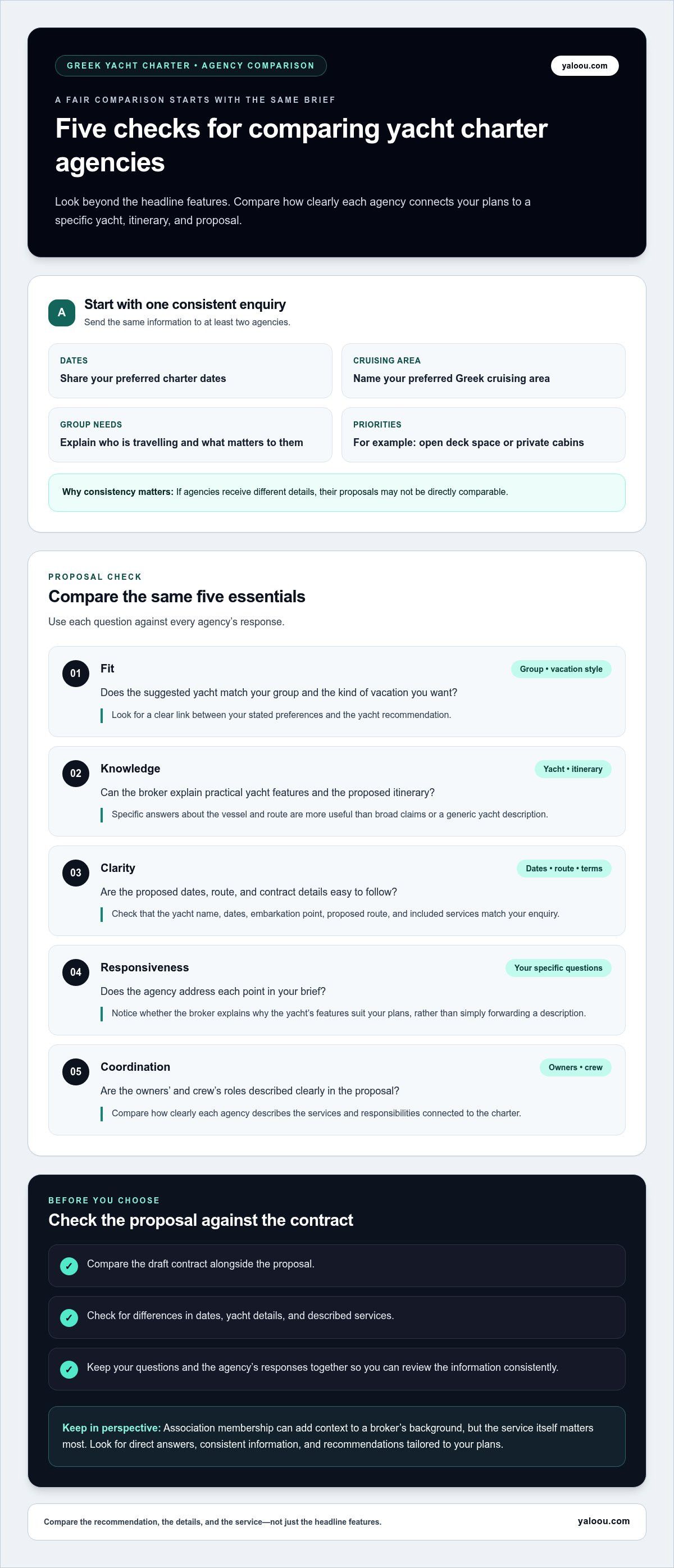
Send the same enquiry to at least two yacht charter agencies to compare their service and knowledge of the yachts they recommend. Keep your brief consistent: include your dates, preferred Greek cruising area, group needs, and priorities. If agencies receive different details, their proposals may not be directly comparable.
Focus on the recommendation, not just the yacht’s headline features. A luxury yacht may look impressive, but what matters is how its layout, onboard setup, and itinerary suit your group. For example, tell each agency whether open deck space or private cabins matter most. Then compare how clearly each broker connects those preferences to a specific yacht.
Review each proposal for details that shape the experience. Check that the yacht name, dates, embarkation point, proposed route, and included services match your enquiry. Notice whether the broker explains why the features suit your plans, rather than simply forwarding a description. A clear response helps you assess how well the agency understands your priorities and the Greek charter context.
Use a shared comparison checklist so each response answers the same points:
- Fit: Does the suggested yacht match your group and vacation style?
- Knowledge: Can the broker explain the yacht’s practical features and itinerary?
- Clarity: Are the proposed dates, route, and contract details easy to follow?
- Responsiveness: Does the agency address each specific point in your brief?
- Coordination: Are the owners’ and crew’s roles described clearly in the proposal?
Association membership can add context to a broker’s professional background, but the service itself matters most. For example, an agency that explains how an international yacht’s onboard features suit your route gives you more useful detail than a generic vessel summary. Look for direct answers, consistent information, and recommendations tailored to your plans.
Before choosing, compare the entire booking process. Read each draft contract alongside its proposal and note any differences in dates, yacht details, or described services. Keep your questions and the responses together. This helps you identify gaps early and see which agency provides the clearest path from enquiry to charter.
As you refine your plans, browse Greek yacht experiences for ideas that can help shape the priorities you share with an agency.
Greek agency versus US-headquartered global brokerage
A broker’s location alone doesn’t determine value. Compare the written charter terms, yacht fit, and itinerary support, then decide whether Greek-market focus or global reach better suits your plans.
Prices and Commission Structures
Greek agencies and U.S. brokers may present fees differently, so compare the total written charter cost and how brokerage or management fees are shown. Don’t assume the broker’s location determines the final amount. Check whether each quote clearly sets out the same yacht, dates, and services.
Read the contract alongside the quote. Separate the base charter fee from additional charges, and note whether each charge is included, itemised separately, or payable under another contract term. Comparing like with like helps you assess value without assuming a lower headline figure is better.
Also compare insurance responsibilities and cancellation terms in the agreement. A clear explanation of what the contract covers is more useful than a general claim that a proposal is comprehensive.
Availability, Itineraries, and Service Quality
Compare availability against the same dates and trip requirements. For a Greek charter, a broker can present yacht options for your dates and prepare a contract for the charter period. This lets you compare actual options rather than broad fleet descriptions.
Then compare itinerary knowledge and service details. Ask whether each route reflects your preferred pace, embarkation point, and destination priorities. A Greek-focused agency may bring local context to island routes, while a global brokerage may offer broader access to international yacht options. The strongest proposal explains why its yacht and itinerary suit your plans.
Service quality is visible in the response itself. Note whether the charter broker answers each question, explains the yacht’s features, and keeps the proposed dates and contract details consistent. These practical details help distinguish useful guidance from a polished but generic yacht charter pitch.
Regulations, Licenses, and Charter Rules
Greek law caps the number of guests on a charter yacht at twelve, regardless of the yacht’s size. For U.S. travelers, confirm that your group fits this limit and that the guest count appears consistently in the booking details and contract.
When planning around sailing licences, distinguish a crewed charter from a bareboat arrangement. The key question is who operates the yacht: the crew or the charterer. Consider licensing responsibilities as part of that distinction, rather than assuming U.S. brokers and Greek agencies follow different rules because of their location.
The MYBA Charter Agreement is the standard form for large plus-expenses yacht charters. Review its payment and responsibility clauses, including how insurance is addressed. Clear contract language helps you understand the charter structure before committing, whether you book through a local or global broker.
APA, VAT, and crew gratuity
Separate the base charter price from APA, VAT, and crew gratuity before comparing Greek yacht listings. These items work differently: APA covers onboard expenses, VAT is a tax, and gratuity is a discretionary tip. For a catamaran charter in Greece, APA is typically 25 to 35 percent of the base charter price. Your itinerary and onboard choices shape how that allowance is used.
APA, or advance provisioning allowance, is paid before the charter to cover expenses incurred during the trip. Depending on the charter arrangement, provisioning and fuel may be handled through this allowance. Treat APA as a working budget, not part of the yacht’s base price or a fixed fee. Ask the broker to explain how expenses are recorded and how any remaining balance or amount due is settled.
VAT needs separate attention. Greek crewed yacht charter VAT rates shown on current rate cards range from 5.2 to 12 percent, with a stated statutory ceiling of 13 percent. The rate cards show 5.2, 6.5, 7.8 or 12 percent. Short hires and bareboat charters in Greece are subject to 24 percent VAT. Compare like with like: a crewed charter and a bareboat charter can have different VAT treatment.
Crew gratuity is customary at 10 to 15 percent of the base charter price on a Greek crewed yacht charter, but it remains discretionary. It is distinct from APA and VAT, so don’t treat it as an automatic tax or as onboard spending. Include it as a separate planning line if you intend to tip the crew. That keeps your estimate transparent without confusing a customary amount with a contractual charge.
Use this sequence to review a quote for a luxury yacht, superyacht, or catamaran:
- Identify the base charter price and the VAT rate shown.
- Record APA separately, including its stated percentage and accounting terms.
- Keep discretionary crew gratuity outside mandatory taxes and contract charges.
- Compare the same charter type, region, dates, and itinerary across listings.
Check every figure against the contract, not just the broker’s summary. A clear quote should distinguish the base price, APA, VAT, and gratuity. If proposals show different VAT rates, compare the charter type and stated rate rather than assuming the difference is due to broker location. For a catamaran, the typical APA range can serve as a planning reference, while actual onboard spending depends on the charter expenses and choices.
What fees do American yacht brokerages charge for Greece yacht charters?
American yacht brokerages typically calculate charter brokerage or management fees as a share of the base charter cost. Because charter pricing depends on the service offered, compare how each quote presents its fee, what cost it is based on, and whether it appears separately or within the quoted total.
Broker location alone doesn’t explain the fee structure. A Greek agency and a U.S.-based brokerage may present the same charter costs differently, so focus on the written breakdown. Ask whether the brokerage fee is calculated against the base charter price, and distinguish it from APA, VAT, and discretionary gratuity. These are separate budget lines, not interchangeable labels.
For a practical comparison, use proposals for the same yacht, dates, itinerary, and included services. If one quote shows a separate brokerage fee while another gives a combined total, request an itemised comparison in the same format. This helps show whether the difference comes from fee presentation, charter terms, or yacht selection.
Review these details in each quote and contract:
- Fee basis: Identify whether the calculation refers to the base charter cost.
- Presentation: Note whether the fee appears separately or within a combined quote.
- Other costs: Keep APA, VAT, and crew gratuity distinct from brokerage fees.
- Contract match: Compare the written fee terms with the proposal’s total.
A Greek yacht charter’s price depends on the yacht, dates, itinerary, and included services, and is provided after a quote request. The base charter cost is the starting point for comparing brokerage fees. Don’t compare a headline total from one brokerage with an itemised proposal from another. First align the charter details, then compare the fee basis and overall cost structure.
Fee transparency is more useful than assumptions about American or Greek business practices. A clear explanation identifies the basis for the fee and separates it from other charter expenses. If a proposal uses broad labels, read the contract definitions alongside the quote. This gives you a clearer picture of what the brokerage fee covers and how the total is calculated.
For a Greece charter, start your comparison with the experience you want, then assess the matching yacht and terms. Explore Greek yacht charter experiences to shape your plans and prepare a more focused enquiry.
YAL’OOU Exclusive Yachting & More: Daily Yacht Charters
YAL’OOU Exclusive Yachting & More offers Daily Yacht Charters and Weekly Crewed Yacht Rentals for travelers planning time on the water in Greece. Choose a daily charter for a shorter yacht experience, or explore a weekly crewed rental for a longer escape. The right format depends on how much time you want to spend cruising and the trip you have in mind.
After comparing quotes, contract terms, and separate charter costs, use those priorities to guide your yacht selection. A clear idea of your preferred duration and experience helps focus the next step, whether you’re planning a day on the water or a crewed week.
To discuss a Greek yacht charter, contact YAL’OOU Exclusive Yachting & More with your plans.
Shape Your Greek Escape Around the Experience
The choice between booking through a local Greek agency and American yacht brokerages matters most when it helps shape a trip around the way you want to travel. Start with the experience you’re seeking: a relaxed day on the water, a longer crewed escape, or time ashore in a private villa. Those priorities can guide your next conversation and help make the experience personal from the outset.
YAL’OOU Exclusive Yachting & More offers Daily Yacht Charters, Weekly Crewed Yacht Rentals, and High-End Villa Rentals. Share your preferred pace, travel style, and plans for time in Greece. A thoughtful starting brief helps turn inspiration into a trip that feels like yours.
Explore yacht experiences and contact YAL’OOU Exclusive Yachting & More to start planning your Greek getaway. Your next memorable escape can begin with a clear idea of what you want from it.
Frequently Asked Questions
How can you know if you’re being over-charged?
Compare written quotes for the same yacht, dates, charter type, and services. Separate the base charter price from brokerage fees, APA, VAT, and discretionary gratuity. For yacht charter brokerage or management, the typical range is 15% to 20% of the base charter cost. A higher total isn’t automatically an overcharge if the proposals differ; compare each line and contract term before judging value.
How do I find a US & international yacht broker?
Search professional yacht-charter associations and compare brokers who handle Greek itineraries. CYBA active membership requires four years of full-time crewed-yacht charter-broker experience; MYBA’s requirements include two years of firm trading and two years of individual experience. A broker may belong to more than one association. YBAA is another professional body associated with yacht sales, though buying or selling experience alone doesn’t establish charter expertise.
How does the booking actually run, from the first email to the gangway?
Start with an enquiry that describes your dates, group, preferred Greek region, and priorities. The broker can then present suitable yacht options and explain the proposed itinerary and terms. Once you select an option, review the contract, payment schedule, and cost breakdown before signing. Keep the signed agreement and payment records together. Before departure, use the final written arrangements to confirm where to embark and what the charter includes.
What are the typical costs and fees when booking a yacht charter through a Greek agency?
Budget for the base charter price plus applicable VAT, any APA, and discretionary crew gratuity. A catamaran’s APA in Greece is typically 25% to 35% of its base charter price. Crew gratuity is customary at 10% to 15% of the base price, but remains discretionary. Compare itemized quotes for the same yacht and charter dates; the agency’s location alone doesn’t establish whether its total is competitive.
How can I verify a Greek yacht charter agency or an American yacht brokerage is licensed and reputable?
Match the business name on the proposal with the contracting party named in the charter agreement. Review the contract’s payment, cancellation, and complaint terms, and retain written communications and receipts. Professional membership can provide context: CYBA and MYBA have stated experience or firm-trading criteria, while the Greek Yachting Association is a professional organisation associated with charter brokers. Treat membership as one credential, not a substitute for clear contract terms.
How do VAT, APA, fuel, skipper, and other extras affect the total charter price in Greece?
They can change the final amount beyond the base price, so compare how each item appears in the quote. Greek crewed-charter rate cards show VAT rates of 5.2%, 6.5%, 7.8%, or 12%, with a stated statutory ceiling of 13%. Short hires and bareboat charters are subject to 24% VAT. APA covers onboard expenses under the charter arrangement; the contract should show how fuel, skipper costs, and other extras are treated.
What are the pros and cons of booking directly with a local Greek agency versus through a U.S. broker?
Booking through a Greek agency can make communication about a Greek itinerary more direct, while a U.S. broker may make the booking process more familiar for American travelers. Neither option guarantees a lower total or better service. When comparing booking through a local Greek agency vs American yacht brokerages, consider who coordinates the booking, how clearly each explains the contract, and whether the recommended yacht suits your trip. Let your priorities guide the choice.
How do communication, time zones, language, and on-the-ground support differ between Greek agencies and American brokers?
A Greek-based contact may offer direct context on local ports and itinerary details, while a U.S. broker may make early planning more convenient for travelers based in America. Communication ultimately depends on the people handling your booking, not simply their location. Keep key decisions in writing, including changes to dates, route, or services. That record helps maintain a clear handoff from booking discussions to embarkation in Greece.
Disclaimer
The YAL’OOU Travel Guide is curated with care to inspire and inform discerning travelers. While every effort is made to ensure the accuracy and relevance of the information provided, all content is offered for general guidance only and may evolve over time.
Details such as local regulations, availability, pricing, and services are subject to change without prior notice. We encourage guests to seek personalized advice and confirm arrangements directly when planning their journeys.
YAL’OOU accepts no liability for any inaccuracies, omissions, or outcomes arising from the use of this information. The Travel Guide may feature recommendations, insights, and selected third-party experiences, presented solely as a source of inspiration and not as formal endorsements.
By accessing this section of our website, you acknowledge and accept this disclaimer as part of your experience with YAL’OOU.