

Credentials can look impressive, but they don’t prove an agent understands the realities of planning luxury travel in Greece. The clearest red flags when choosing a luxury travel agent are limited first-hand destination knowledge, vague answers about planning and support, and unclear payment terms. Prioritise practical experience and transparent communication over polished claims.
It’s natural to want reassurance before trusting someone with a complex trip. A good advisor listens to your priorities, explains relevant trade-offs, and shows how the itinerary will work in practice, from transfers and timing to what happens when plans change.
This guide explains how to assess destination experience and credentials, spot gaps in emergency support, and understand fees, deposits, and cancellation terms before booking. Use these signals to make a confident choice and set expectations for a smoother Greek escape.
Key Takeaways
- Look for clear post-booking communication and a practical plan for handling disruptions, not vague promises of support.
- Weigh first-hand knowledge of Greece and thoughtful itinerary planning more heavily than impressive-sounding credentials alone.
- Review professional affiliations and recognition as supporting evidence, then consider whether the advisor’s expertise fits your travel style.
- Before paying, understand the written terms, full cost breakdown, and payment process; pressure or unclear explanations deserve caution.
1. Post-booking support and emergency availability
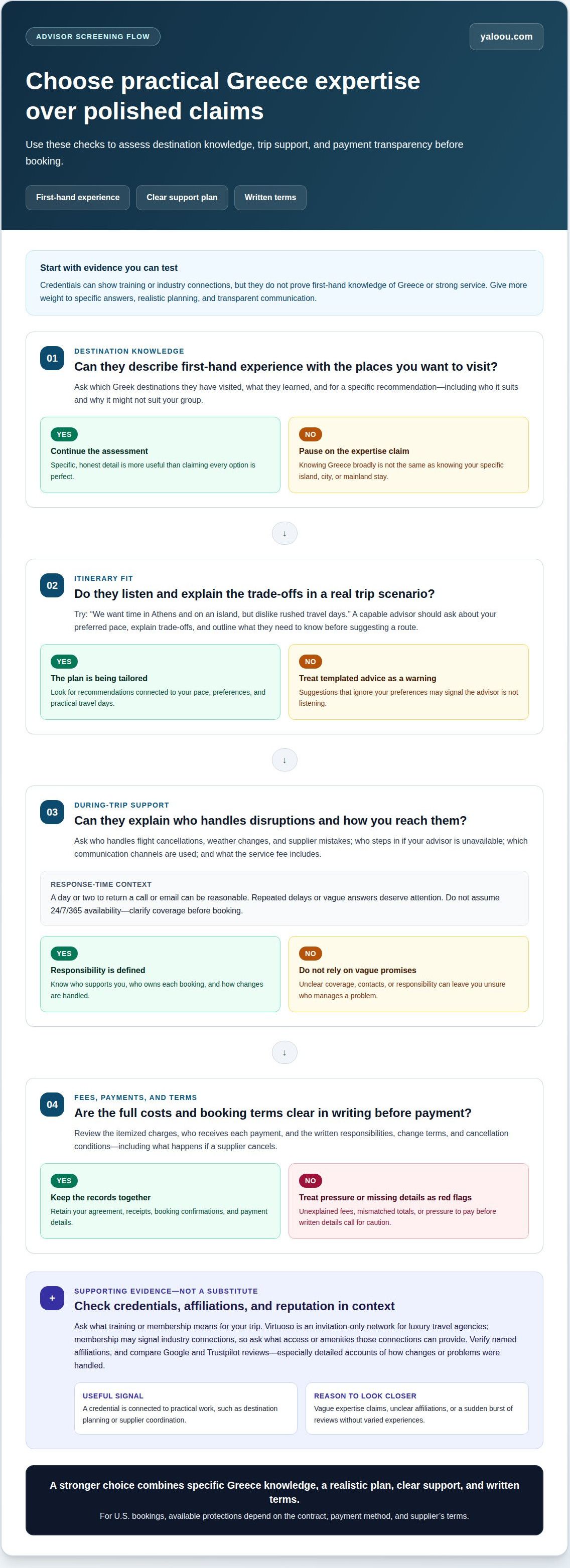
Test responsiveness before paying: send a specific itinerary question by email, then note how clearly the agency replies. A day or two to return a call or email can be reasonable, but repeated delays or a vague contact form may signal weak support. Ask who handles flight cancellations, weather changes, and supplier mistakes, and how to reach that person during travel. Don’t assume an advisor is available 24/7/365; clarify coverage, communication channels, and what the service fee includes.
An independent luxury travel agent may offer direct access to one advisor, while an agency may provide a broader staff network or supplier relationships. Booking directly connects you with the supplier, but leaves you to manage separate reservations. Ask who is responsible for each booking, who steps in if your advisor is unavailable, and how private requests or itinerary changes are handled.
For U.S. bookings, available protections depend on the contract, payment method, and supplier’s terms. Keep your agreement, receipts, and booking confirmations, and understand your payment provider’s dispute process. An agreement that omits responsibilities, change terms, or cancellation conditions is a warning sign. So is a policy that leaves unclear what happens if a supplier cancels.
Before hiring an advisor, ask: “What does your fee cover? Who supports me during the trip? How do you handle changes, supplier errors, and cancellations?” Request written terms before authorizing payment. A booking fee disclosed only after payment, or added without explanation, signals poor transparency. Ask for an itemized statement and a receipt showing each charge and its recipient.
Clear booking tools and records should make your itinerary, payment status, and supplier confirmations easy to follow. Disorganized records, mismatched totals, or pressure to pay before receiving written details call for caution. Promises of guaranteed upgrades or exclusive access are also red flags unless the advisor explains the supplier arrangement and its conditions. Ask what is confirmed, what is only requested, and what alternatives suit your plans if access changes.
2. Credentials vs Experience: What Matters More?
A certificate can show completed training, but it can’t prove an advisor knows Greece first-hand. Give more weight to relevant destination experience, clear explanations, and recommendations tailored to your travel style. Ask which Greek destinations they’ve visited and what they learned there. A useful answer includes practical detail, such as how they’d adapt a plan for travelers who prefer quiet evenings to busy nightlife.
Test their knowledge with a real itinerary scenario. You might say, “We want time in Athens and on an island, but dislike rushed travel days.” A capable advisor should explain the trade-offs, ask about your preferred pace, and outline what they need to know before recommending a route. Templated suggestions that ignore your preferences suggest the advisor isn’t listening.
Ask about first-hand experience with the specific destination, not just Greece as a whole. Someone familiar with Athens may have different insights from someone who knows a smaller island or a mainland stay. Request an example of a recommended place, who it suits, and one reason it might not suit your group. Honest limits are more useful than claims that every option is perfect.
Ask how the advisor handles travel rules without expecting them to recite every requirement from memory. Find out what rules could affect your proposed trip, how they identify relevant details, and when they verify them. The answer should describe a clear process. Confident guesses or dismissing your question as “nothing to worry about” are reasons to pause.
Finally, compare their suggested experiences with your priorities, then ask what each adds to the trip. Explore Greece travel experiences for ideas to discuss with an advisor. Experience matters most when it helps turn your vision into a realistic, well-paced plan.
3. Editorial recognition and professional credentials
Editorial recognition can help you assess an advisor’s reputation, but it doesn’t replace evidence of useful service. Treat awards and media mentions as a starting point, then look for specific examples of planning skill and client support. Virtuoso, for example, is an invitation-only network for luxury travel agencies. Membership may signal industry connections, but ask what access or amenities those connections can provide for your vacation, including hotel benefits.
Ask the advisor to name relevant professional training, accreditations, or network memberships and explain how each applies to your trip. A credible answer connects a credential to practical work, such as destination planning or supplier coordination. Be cautious of vague claims like “certified luxury expert” without a clear issuing organization or explanation. A credential offered for purchase with little meaningful assessment is a warning sign, not proof of expertise.
Check affiliations by looking up the named organization and confirming the agency’s membership through its public member information or a written explanation. Compare reviews on Google and Trustpilot, paying attention to detailed accounts of how the advisor handled changes or problems. A sudden burst of reviews, evidence of incentivized reviews, or exclusively glowing feedback without varied customer experiences can be red flags.
A track record matters most when it resembles your own trip. Ask for examples involving Greece, your preferred pace, and the experiences you value. Notice whether the answers are specific, consistent, and professional. A delay alone doesn’t prove poor service, but repeated unanswered questions or evasive explanations before booking deserve attention. Red flags when choosing a luxury travel agent include using credentials as a substitute for relevant experience, unclear affiliations, and claims of exclusive access without a concrete explanation. Compare the advisor’s stated process with the details in your written proposal before committing.
4. Cash payment demands and secure card processing
Cash isn’t automatically improper, but pressure to pay in cash without a receipt deserves scrutiny. Before sending money, ask who receives each payment: the advisor, agency, or supplier. Request an itemized invoice showing the booking components, payment schedule, and cancellation terms. A demand to transfer funds to an unrelated person, or a refusal to document payment, is a serious warning sign.
For card payments, confirm the business name shown at checkout and obtain written confirmation afterward. Don’t send card numbers or security codes through ordinary email or messaging. Use the payment process provided by the agency, and contact your card issuer if a charge looks unfamiliar. Keep the invoice, booking confirmation, and relevant messages together so you can trace each transaction during your trip.
Ask the advisor to explain how supplier payments and their own fees appear in the final accounting. Travel agents are mostly paid directly by travel suppliers, while some charge additional fees for their work. The agency should disclose its fees before booking, not after payment. Compare the quote with the invoice and ask about any difference before authorizing another charge.
Passports and payment details need careful handling. Ask why passport information is needed, how it will be shared with suppliers, and how to provide it securely. Share only the requested information through the stated process, and avoid sending full card details in a message. Clear answers help you assess the advisor’s approach to sensitive information.
Before committing, match every charge to a service, supplier, or disclosed advisor fee. If an invoice bundles costs without explanation, pause and request an itemized version. You can also explore Greece travel experiences while shaping your plans, then compare the proposed itinerary with its written costs. Transparent payment practices help clients understand what they’re paying for and who is responsible for each part.
YAL’OOU Exclusive Yachting & More: Daily Yacht Charters
YAL’OOU Exclusive Yachting & More offers Daily Yacht Charters for travelers who want to experience Greece from the water. For more time aboard, Weekly Crewed Yacht Rentals offer another way to shape your stay. Pair a yacht experience with a High-End Villa Rental or VIP Ground Transfers to connect time on the water with accommodation and travel on land.
Choose the option that fits your itinerary and the kind of holiday you want. A day at sea can be the focal point of a wider Greek escape, while a weekly rental suits plans centered on an extended yacht stay. Explore YAL’OOU’s options and choose what best complements your journey.
For details, contact YAL’OOU Exclusive Yachting & More or visit yaloou.com.
Make your next step a confident one
Before you commit, turn your priorities into a short decision filter. Decide what matters most on your Greece trip, such as a slower pace, time on the water, or a carefully planned stay. Compare each proposal with those priorities, not just its polished presentation. Red flags when choosing a luxury travel agent are easier to spot when you know what you need the advisor to deliver.
Keep your written proposal and payment terms together, and make sure the trip still feels right after you’ve reviewed them. If you’re shaping a Greek escape around distinctive experiences, YAL’OOU Exclusive Yachting & More can be a natural next step. Explore Greece experiences and consider what belongs in your itinerary.
Choose with care, then leave room for the moments that make the journey yours.
Frequently Asked Questions
Credentials vs Experience: What Matters More?
Relevant experience in Greece usually tells you more about an advisor’s practical judgment, while credentials can show structured training. Ask how they’d adapt a proposed island itinerary for a traveler who wants fewer transfers and more time ashore. A useful answer explains the trade-offs behind the recommendation. Treat credentials as supporting evidence, not a substitute for destination knowledge or thoughtful planning.
What makes a travel agency genuinely “luxury”?
A luxury agency shapes a trip around your preferences instead of simply assembling premium bookings. For a Greek itinerary, that could mean balancing time in Athens with a slower island stay, then coordinating the details that make each transition feel considered. Look for recommendations that reflect your pace, privacy preferences, and interests. An expensive-looking itinerary alone doesn’t demonstrate personalized service.
What credentials should a luxury travel agent have in the United States?
There isn’t one credential that proves an advisor is right for every luxury trip. Ask for the exact name of any training, accreditation, or professional affiliation, then find out what it represents. Virtuoso, for example, is an invitation-only luxury travel network, but membership alone doesn’t establish an advisor’s first-hand knowledge of Greece. Weigh credentials alongside relevant experience and clear, practical answers.
What fees and commissions do luxury travel agents charge, and what should be disclosed upfront?
Travel agents are mostly paid by travel suppliers, and some charge additional fees for their work. Ask how the advisor is compensated, which charges appear on your invoice, and whether a separate planning fee applies. Get the complete cost breakdown before authorizing payment. The amount and structure can differ by booking, so focus on clear terms rather than assuming there is one standard fee.
How can I tell whether an agent is recommending trips based on commissions rather than my needs?
Look for recommendations tied to your stated priorities, not just repeated enthusiasm for one supplier or type of booking. Ask why a particular hotel or experience suits your itinerary, then request an alternative with a different pace or setting. An advisor who explains the trade-offs and listens to your response makes it easier to judge whether the plan serves your needs.
Disclaimer
The YAL’OOU Travel Guide is curated with care to inspire and inform discerning travelers. While every effort is made to ensure the accuracy and relevance of the information provided, all content is offered for general guidance only and may evolve over time.
Details such as local regulations, availability, pricing, and services are subject to change without prior notice. We encourage guests to seek personalized advice and confirm arrangements directly when planning their journeys.
YAL’OOU accepts no liability for any inaccuracies, omissions, or outcomes arising from the use of this information. The Travel Guide may feature recommendations, insights, and selected third-party experiences, presented solely as a source of inspiration and not as formal endorsements.
By accessing this section of our website, you acknowledge and accept this disclaimer as part of your experience with YAL’OOU.