
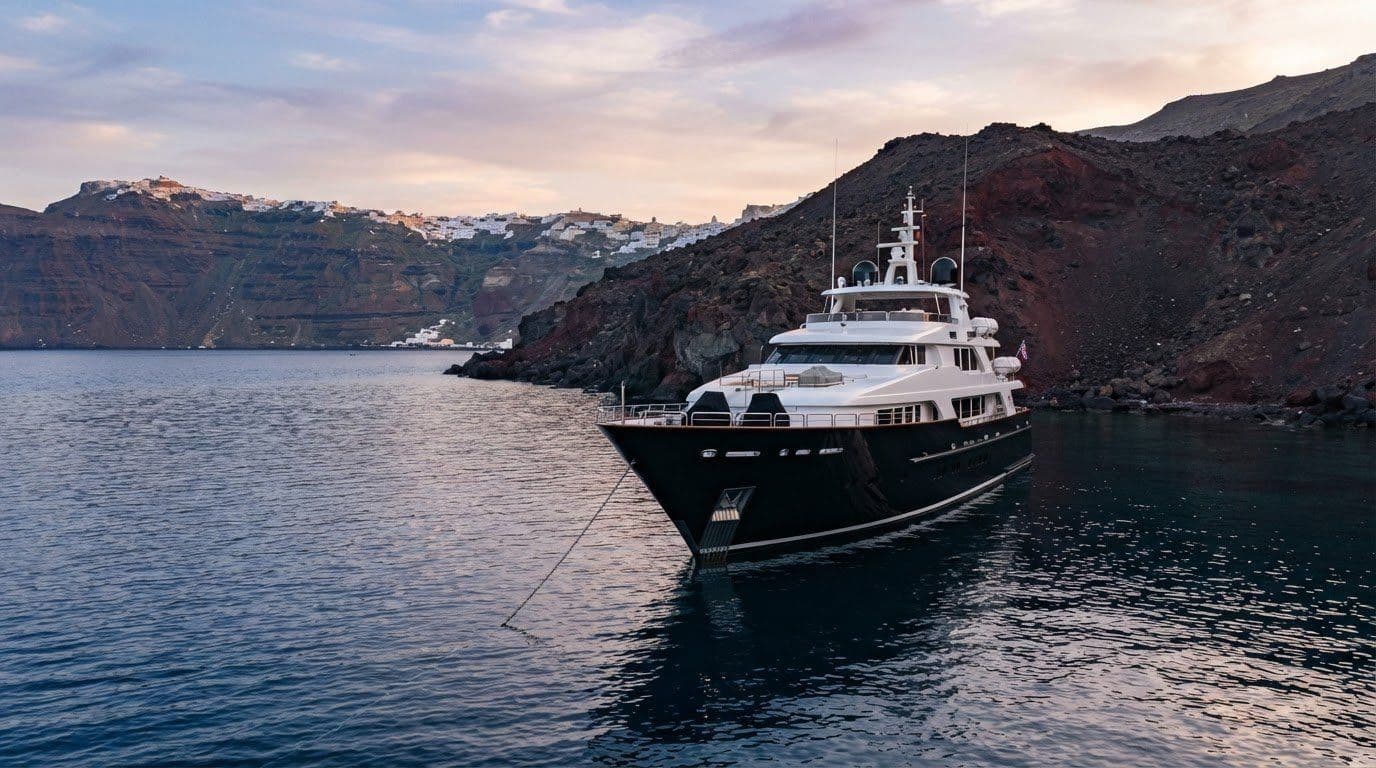
Overnight yacht mooring in Santorini can depend on finding shelter that suits the wind. For sheltered bays in Santorini for calm yacht mooring overnight, consider the Armenis inlet, the southeast cove at Nea Kameni, or Ag Nikolaos quay on Thirasia. Each offers a different type of shelter and mooring.
It’s natural to look for a protected spot before settling in for the night. But Santorini’s dramatic caldera doesn’t mean every anchorage is sheltered: deep water, exposed coastlines, and summer northerlies can change which locations are suitable.
This guide explains how the main anchorages fare, where yachts can find shelter from the Meltemi, and what to consider when choosing an overnight stop. Wind direction, gusts, and the lack of a full-service marina matter as much as the bay itself. Use these details to plan a more comfortable stop and recognise when moving on is the wiser choice.
Key Takeaways
- Match your overnight stop to wind direction and the type of shelter available, from a cove to a quay or mooring buoy.
- Allow for gusts as well as the forecast wind: Cyclades conditions can strengthen after several windy days.
- Learn when the Meltemi is most influential and why it can make exposed crossings and anchorages less comfortable.
- Plan around Santorini’s lack of a full-service yacht marina, including the practical limits of its harbors and mooring options.
Which Santorini anchorages are sheltered from the meltemi, the summer north wind?
For sheltered bays in Santorini for calm yacht mooring overnight, compare the south-coast anchorages with options near Nea Kameni and Thirasia. Santorini has no full-service yacht marina, so depth, wind exposure, and room to swing vary by location.
Sheltered South-Coast Anchorages
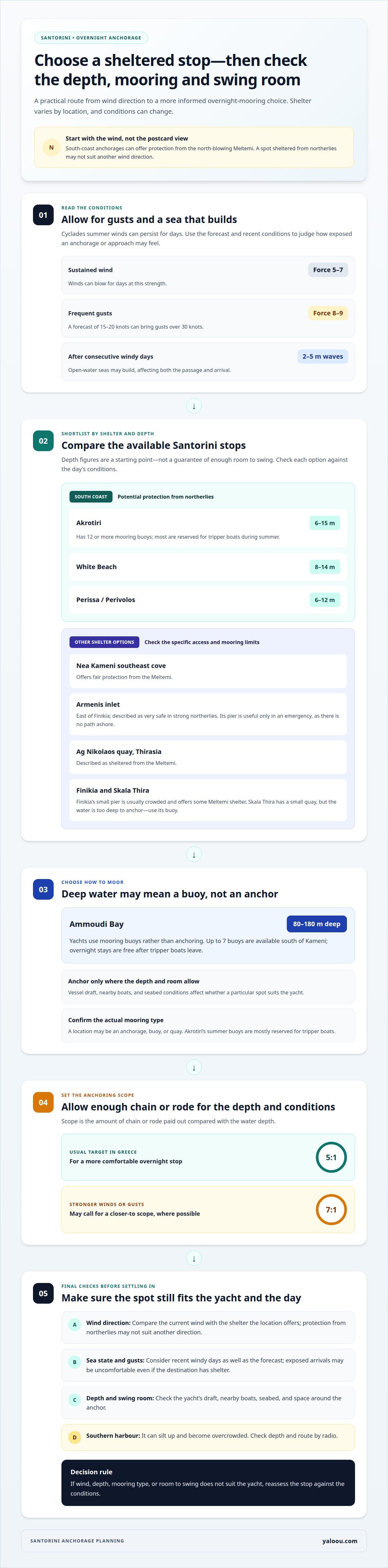
South-coast anchorages can offer protection from the north-blowing meltemi, but each has different depths and space. Akrotiri typically has 6-15 metres of water, White Beach 8-14 metres, and Perissa/Perivolos 6-12 metres. Akrotiri has 12 or more mooring buoys, though most are reserved for tripper boats during summer. These are options to assess against the day’s conditions, not interchangeable berths.
For sheltered bays in Santorini for calm yacht mooring overnight, Nea Kameni’s southeast cove offers fair protection from the Meltemi. The Armenis inlet, east of Finikia, is described as very safe in strong northerlies, but its pier is useful only in an emergency because there’s no path ashore.
Overnight Anchorage Considerations
Overnight anchoring means allowing for depth, wind shifts, and the yacht’s swing room around its anchor. In Greece, a 5:1 scope-to-depth ratio is usually a better target for a more comfortable overnight stop; stronger winds or gusts may call for closer to 7:1 where possible. Scope is the amount of chain or rode paid out compared with water depth.
Caldera conditions differ sharply. Ammoudi Bay is 80-180 metres deep, so yachts use mooring buoys rather than anchoring. Up to 7 buoys are available south of Kameni, with overnight stays free after tripper boats leave.
Comparing Anchorage Space and Depth
Depth figures help compare anchorages, but don’t show the full room available for a yacht to swing. The south-coast ranges run from 6-12 metres at Perissa/Perivolos to 8-14 metres at White Beach, while Akrotiri reaches 15 metres. Vessel draft, nearby boats, and the seabed affect whether a particular spot suits the yacht.
Skala Thira has a small quay, but the water is too deep to anchor, so yachts should use its buoy. At Finikia, the small pier is usually crowded and offers some shelter from the Meltemi. Ag Nikolaos quay on Thirasia is also described as sheltered from the Meltemi.
Local Conditions and Anchorage Restrictions
Compare the current wind direction and sea state with the shelter each location offers: a spot protected from northerlies may not suit another wind direction. Depth and access matter too. Santorini’s southern harbour can silt up and become overcrowded, so sailors should check depth and route by radio.
Check whether the intended stop is a buoy, quay, or anchorage. Akrotiri’s summer buoys are mostly reserved for tripper boats.
Cyclades summer wind strength and gusts
Summer wind in the Cyclades can shape every leg of a cruise, not just the overnight stop. Sustained winds and gusts affect departure choices and passage comfort, and may mean changing an island-hopping plan. Build flexibility into the route before setting out.
Winds can blow for days at Force 5-7 on the Beaufort scale, with frequent gusts reaching Force 8-9. A forecast of 15-20 knots can bring gusts over 30 knots. After consecutive windy days, seas may build to waves of 2-5 metres. On days with Force 6-plus winds, crews are advised to stay put or motor-sail in shelter instead of pressing on through exposed water.
From Santorini, Ios is 25 nautical miles away, Naxos 55, Paros 60, and Mykonos 80. These are distances from Santorini, not successive passage lengths. Treat each as a possible itinerary branch, then plan the day’s sailing around the wind and the yacht’s route. A charter that leaves room to adjust stops can better accommodate changing conditions.
Wind exposure changes how a destination feels. Open crossings may become demanding after several windy days, while a sheltered stop can give the crew time to wait for conditions to ease. On Santorini, cliffs frame the caldera; Finikia has a small pier and a couple of tavernas ashore. Treat shore visits as flexible plans, not reasons to arrive late at an exposed anchorage.
Keep alternatives in mind: shorten a passage, pause in shelter, or change the next island stop. For a tailored Cyclades sailing experience, plan around both the wind and the places you want to visit. A flexible route helps make a summer charter more comfortable without treating a forecast as a promise of calm conditions.
The Meltemi and summer sailing conditions
The Meltemi shapes summer sailing across the Aegean, and its strength varies through the season. Its timing matters when planning passages around Santorini and the other Cyclades islands.
Meltemi Effects on Greek Cruising
The Meltemi is a dry northerly wind that can influence Greek cruising for several days. It may begin in May, usually stirs later in June, and is strongest in July and August. In the Cyclades, June conditions tend to reach Force 4-6. These seasonal shifts affect passage comfort and make a flexible itinerary more practical than a fixed sequence of island stops.
In the Aegean, the Meltemi typically blows at 20 to 25 knots during summer and can be stronger in the Cyclades. It can make open crossings lively, so a yacht’s route and shelter options matter. Greece also experiences the Sirocco, another wind that can affect cruising conditions.
Wind-Driven Wave Conditions
Meltemi-driven waves build when strong winds persist across open water. After several consecutive windy days, Cyclades seas can become rough, with waves reaching 2-5 metres. That sea state can make an exposed passage uncomfortable and complicate arrival at an anchorage, even when the destination itself offers shelter.
A planned crossing toward Santorini, for example, may feel very different after days of northerly wind than during a calmer spell. Both the duration of the wind and the route’s exposure matter. A sheltered overnight stop can offer a pause, but it won’t make an open approach calm.
The broader sailing season in Greece runs from April through October, with average temperatures of 70-80 degrees Fahrenheit. The Meltemi eases into September and generally by mid-October, as low-pressure systems become more frequent in the Cyclades. This seasonal pattern helps frame when northerly winds are more likely to shape a route.
When planning a yacht charter, build flexibility around the weather rather than assuming a departure date means easy sailing. Leave room to change the order of island stops or remain in shelter when conditions make a crossing uncomfortable. Santorini’s dramatic caldera is a striking destination, but arrival conditions still matter.
Santorini’s lack of a full-service yacht marina
Santorini has no full-service yacht marina, so an overnight anchorage won’t automatically provide fuel, water, and shore access together. Treat refuelling as a route-planning need rather than assuming it’s available at your chosen anchorage. Check locally whether water is available at Skala Thira before relying on it.
Skala Thira has a small quay, but yachts should use its buoy because the water is too deep to anchor. The port may also ask visiting boats to leave when it’s crowded, so it isn’t a guaranteed base for a longer stop. Provisions are available from the main town, reached from Skala by donkey or funicular.
Vlychada Marina is another named option, with alongside depths of 5-8 metres for yachts up to 60 metres long. These figures describe depth and vessel length, not the full range of services available there. Monolithos is a poor substitute for a sheltered harbor: it’s very shallow and exposed from the northeast through the south.
This affects how you plan a night ashore. A buoy or quay may solve the mooring question without providing every service a yacht needs. Finikia has a small pier and a couple of tavernas, but the pier is usually crowded. Armenis, east of Finikia, can offer shelter in strong northerlies; its pier is described as useful only in an emergency, with no path ashore.
For Santorini’s famous volcanic scenery, plan the anchorage and shore stop as separate parts of the visit. The island’s dramatic cliffs don’t mean every harbor provides marina-style support. An overnight stay may work best as one stop within a wider Cyclades itinerary, rather than as a fixed base. Explore yacht experiences around the Greek islands when shaping a route that balances sheltered mooring with time ashore.
YAL’OOU Exclusive Yachting & More: Daily Yacht Charters
YAL’OOU Exclusive Yachting & More offers Daily Yacht Charters and Weekly Crewed Yacht Rentals for exploring the Greek islands. Choose a daily charter for a shorter escape, or a weekly crewed rental when your plans call for a broader island itinerary. A crewed yacht experience can make it easier to adapt your route around changing summer conditions and the overnight mooring options discussed above.
If Santorini is part of your plans, consider how its anchorages fit into the wider journey rather than treating the island as a full-service marina stop. The right charter format depends on the pace and style of trip you have in mind.
Contact YAL’OOU Exclusive Yachting & More to discuss your Greek island yacht plans.
Shape Your Santorini Stop Around the Journey
Make the overnight stop part of a journey that suits your pace, rather than a fixed point the rest of the route must serve. Planning for sheltered bays in Santorini for calm yacht mooring overnight works best when you decide what matters most: a quiet evening aboard, time ashore, or room to adjust plans as conditions change. That choice can make a brief island visit a more considered sailing experience.
Before setting your itinerary, picture how you want the day to end and what you want to carry into the next morning. Keep the route open to thoughtful changes, and let the passage become part of the experience, not just the distance between destinations.
Start planning your Greek island journey with YAL’OOU Exclusive Yachting & More, and take the next step toward a Santorini escape shaped around you.
YAL’OOU Exclusive Yachting & More for Santorini Planning
YAL’OOU Exclusive Yachting & More offers Daily Yacht Charters and Weekly Crewed Yacht Rentals for travellers planning time on the water around Santorini. Once you’ve considered sheltered bays and overnight mooring, contact the team to discuss yacht arrangements for your itinerary.
Beyond the yacht, YAL’OOU also offers High-End Villa Rentals, VIP Ground Transfers, Private Chef Services, and Exclusive Event Planning.
Frequently Asked Questions
What is the holding like at Santorini?
Holding varies by anchorage, and depth alone doesn’t indicate how well an anchor will bite. Santorini’s south-coast options have different depth ranges, while the caldera’s deep water often calls for a buoy instead of anchoring. Assess each location individually: the yacht’s draft, available room, seabed conditions, and the day’s wind all affect its suitability for an overnight stay.
Where can a yacht anchor at Santorini?
Yachts can consider Akrotiri, White Beach, and Perissa/Perivolos on Santorini’s south coast, or the southeast cove at Nea Kameni. At Skala Thira, use the small quay’s buoy because the water is too deep to anchor. Oia also has an old mooring buoy, but keep the ferry dock beside it unobstructed. These options differ in access and mooring setup.
How sheltered are Vlychada, Ammoudi, and other Santorini anchorages from prevailing winds?
Vlychada Marina offers alongside depths of 5-8 metres for yachts up to 60 metres long, but those figures don’t establish wind protection. Ammoudi Bay’s 80-180-metre depths make mooring buoys the practical option rather than anchoring. For northerlies, Armenis is described as very safe, while Finikia’s small pier provides some shelter. Shelter depends on wind direction and the exact berth.
What are the seabed types and holding conditions in Santorini's sheltered bays?
Depth ranges alone don’t identify seabed composition, so they can’t establish anchor holding for every bay. Compare the intended spot with current chart information and what’s visible as the yacht approaches, then assess whether the anchor is set before relying on it overnight. For example, Akrotiri’s 6-15-metre range describes water depth, not a uniform seabed or guaranteed holding across the anchorage.
Are overnight yacht anchoring or mooring permits required in Santorini?
For an overnight stop, distinguish anchoring from taking a buoy or using a quay, as conditions vary by site. Akrotiri’s buoys are mostly reserved for tripper boats during summer, while at Skala Thira yachts are directed to a buoy because the water is too deep to anchor. Follow the instructions for the specific mooring or harbour, and don’t assume an available buoy is open for overnight use.
Which Santorini bays are safest during meltemi winds and swell?
No single bay is safest for every wind direction or swell. In northerly conditions, Armenis is described as very safe, and Ag Nikolaos quay on Thirasia as sheltered from the Meltemi. Finikia offers some protection, while Nea Kameni’s southeast cove provides fair shelter from the Meltemi. Compare the forecast direction with each site’s exposure, and don’t treat a description of shelter as protection from every sea state.
Disclaimer
The YAL’OOU Travel Guide is curated with care to inspire and inform discerning travelers. While every effort is made to ensure the accuracy and relevance of the information provided, all content is offered for general guidance only and may evolve over time.
Details such as local regulations, availability, pricing, and services are subject to change without prior notice. We encourage guests to seek personalized advice and confirm arrangements directly when planning their journeys.
YAL’OOU accepts no liability for any inaccuracies, omissions, or outcomes arising from the use of this information. The Travel Guide may feature recommendations, insights, and selected third-party experiences, presented solely as a source of inspiration and not as formal endorsements.
By accessing this section of our website, you acknowledge and accept this disclaimer as part of your experience with YAL’OOU.