

Could protecting your skin leave a mark on the teak beneath your feet? On a Greek yacht, sunscreen and skincare product restrictions on yacht teak decking can be confusing, especially when advice about mineral, chemical, oily, and spray formulas does not always agree.
Sun protection matters, and caring for the deck does not mean going without it. Some sunscreen ingredients, including avobenzone, are commonly associated with yellow or brown marks on marine surfaces. Other formulas may transfer residue, while oils and lotions can leave a film. The result depends on the product and surface, so a label alone cannot tell you whether a product will mark a particular deck.
This guide explains how products can transfer, which application formats need extra care around teak, and how to follow a practical routine on board. You will also learn what to do if product reaches the deck and why the crew’s instructions should guide any cleanup. A few thoughtful habits can help you protect your skin and respect the vessel while enjoying an unhurried yacht experience among the Greek islands.
Key Takeaways
- Understand sunscreen and skincare product restrictions on yacht teak decking by considering how product can transfer, rather than assuming every formula will damage the wood.
- Compare lotions, sticks, sprays, oil-rich products, and tinted skincare by how easily you can control application and avoid contact with deck surfaces.
- Build a simple pre-deck routine that limits unnecessary product transfer while keeping sun protection part of your day.
- Follow the crew’s onboard guidance and enjoy your Greek yacht experience with care for shared surfaces.
Sunscreen and skincare on yacht teak decking: what is the real concern?
Can sunscreen, body lotion, or another personal-care product transfer onto a teak deck? Yes. Product on your hands or skin can reach a surface when you sit down, lean on a rail, or walk across the deck. That possibility is a reason to take care, not proof that every product will stain or harm every teak surface.
The practical concern is residue or visible marking. The outcome may depend on the formula, how much product reaches the wood, the deck’s condition and finish, exposure to sun and moisture, and how the surface is maintained. A mark should not automatically be described as permanent damage. Without reliable evidence about a specific product and surface, avoid assuming that one ingredient will inevitably cause lasting staining. That is the useful distinction behind sunscreen and skincare product restrictions on yacht teak decking: general precautions can reduce transfer, while onboard instructions should reflect the vessel.
Why teak decking needs considerate day-to-day care
Teak is valued for its properties in marine settings; its characteristics and history of shipbuilding use are outlined in Teak wood properties and marine use. On a yacht, an exposed deck may face strong sun, salt, moisture, and regular foot traffic. These conditions make thoughtful everyday care worthwhile, but teak surfaces are not all finished or maintained in the same way.
Deck maintenance and guest habits are connected, but they are different responsibilities. Crew members manage the surface according to the vessel’s care practices. Guests can help by limiting unnecessary product transfer and following directions on board. Not every yacht has teak decking, and its finish and condition can vary, so one care rule will not suit every boat.
What “restrictions” means for guests
Here, a product-transfer precaution means that skincare may leave residue or a mark if it reaches a particular surface. The likelihood depends on the formula and the condition of the surface. It is not a universal product ban. General teak-care guidance alone does not establish that sunscreen or skincare is prohibited on every yacht.
Follow vessel-specific instructions from the crew, who can account for the yacht’s surfaces and care routine. If there is no special direction, use products thoughtfully: apply them away from teak where practical, limit unnecessary contact with deck surfaces, and give them time to settle before lounging or walking across the deck. These habits complement proper maintenance; they do not replace it.
Most important, do not compromise sun protection to protect a surface. Choose and apply sunscreen according to its label and your needs, then be mindful of where product could transfer. This balanced approach supports comfortable time outdoors and considerate care for the shared yacht environment.
How sunscreen and skincare ingredients may interact with yacht teak
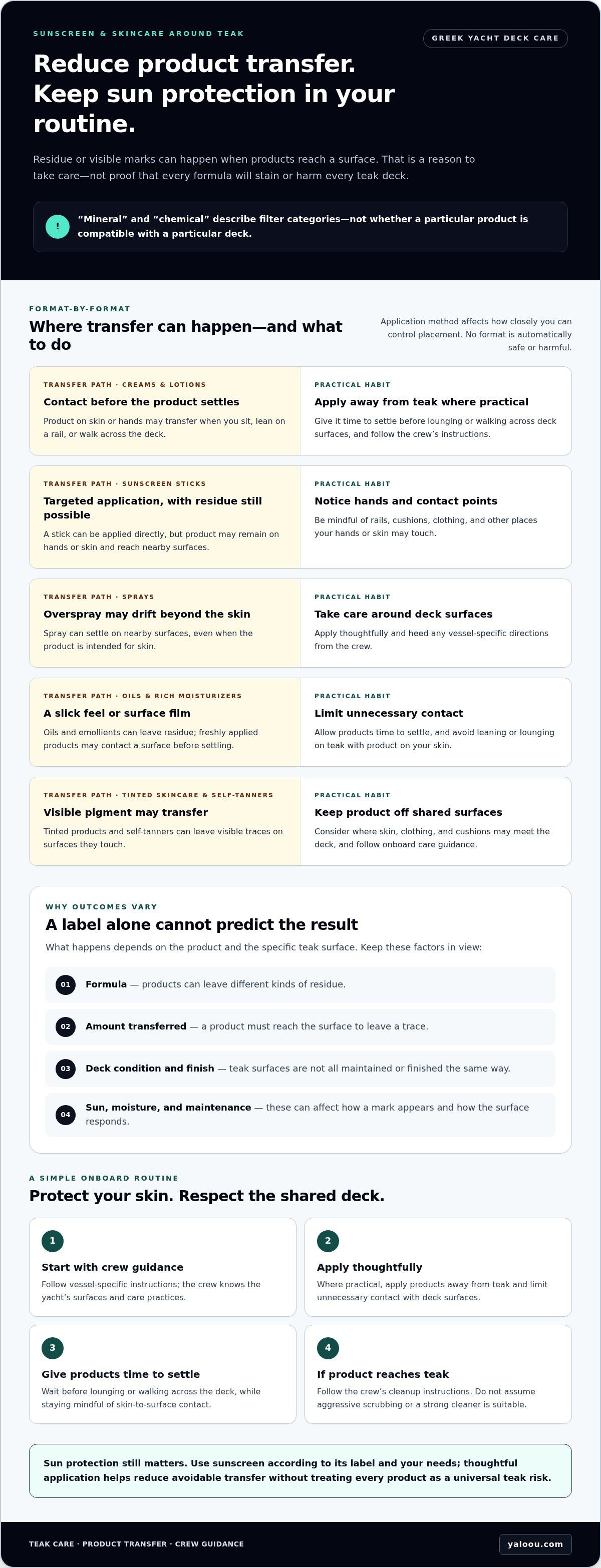
A product can reach teak without being poured onto it. Lotion on a hand may transfer to a rail; cream on a thigh may leave a trace on a seat or deck when you stand. Oils and emollients can feel slick or leave a surface film, while tinted products may transfer visible pigment. These are possible ways residue can reach a surface, not proof that a product will permanently stain wood.
Application method matters, too. A spray can drift beyond the skin and settle on nearby surfaces, while lotion or a stick is generally applied more directly. This affects how carefully you can control placement, not whether a format is automatically safe or harmful. Mineral filters such as zinc oxide and titanium dioxide, and chemical UV filters, are ingredient categories, not reliable indicators of teak compatibility on their own. Product-specific claims need credible technical evidence.
Why sunscreen formulas shouldn’t be treated as interchangeable
Compare formats by how they are applied and where residue could go. Creams and lotions can transfer through contact before they settle. Sticks allow targeted application, but product may remain on hands or skin. Sprays can create overspray, and a formula’s base may include ingredients beyond its UV filters. The words “mineral” and “chemical” do not establish how a particular product will behave on a particular deck.
There is no sound basis for labelling a sunscreen universally teak-safe or teak-damaging. Avoid choosing or rejecting a product based on a single ingredient name alone. If a claim identifies a specific filter as a cause of teak staining, look for reliable testing or technical documentation that relates to the product and surface in question.
Skincare products beyond sunscreen
Body oils, rich moisturizers, self-tanners, and tinted skincare can also transfer. Freshly applied or incompletely absorbed products may be more likely to contact a surface than products that have had time to settle, but the result still depends on the formula and the deck’s condition. Hands, feet, clothing, cushions, and rails can all become contact points.
Teak is not one uniform surface. Age, wear, finish, and previous maintenance may influence how a mark appears and how it responds to cleaning. Sun and moisture add further variables. A trace that wipes away from one maintained surface may look different on another. Prompt, appropriate cleaning may help address residue, but do not assume that aggressive scrubbing or a strong cleaner is suitable. Follow the crew’s care instructions.
For practical sunscreen and skincare product restrictions on yacht teak decking, separate what you can observe from what you might assume. A greasy feel or visible transfer is evidence of residue; a claim of permanent chemical damage requires stronger evidence. Keep applying sun protection as directed. Apply carefully, give products time to settle, and limit contact with deck surfaces where practical. These considerate habits fit naturally into a private Greek yacht experience. Explore YAL’OOU’s Greek yacht experiences as you plan time on the water.
Comparing sunscreen choices for teak-conscious yacht guests
Choosing sunscreen for a day on the water involves two separate questions: does it suit your skin and sun-protection needs, and how can you apply it thoughtfully around deck surfaces? No product format or ingredient label answers both. The comparison below describes possible transfer pathways, not tested teak-staining outcomes. Any residue risk depends on the formula, how you apply it, and whether it contacts the surface.
Product typeApplication controlPossible deck-contact considerationPractical use
Lotion or cream
Usually applied directly by hand
If product remains on skin or hands, contact could transfer residue.
Apply carefully away from teak where practical; let it settle before sitting or walking on the deck.
Stick
Targeted application, though hands may still touch product
Transfer is possible if freshly applied skin or hands touch a surface.
Useful for controlled application; follow the product directions.
Spray
Can be harder to confine to the intended area
If airborne product drifts onto nearby surfaces, it could leave residue.
Use only as directed and avoid spraying near teak or other deck surfaces.
Oil-rich products
Varies by format
If an oily film reaches a surface, it may feel slick or leave residue.
Handle thoughtfully and avoid direct contact with deck surfaces where practical.
Tinted skincare
Varies by format
If pigment transfers through contact, it may leave a visible mark.
Allow it to settle and take care around cushions, seating, and decking.
How to read product labels without assuming teak compatibility
Active ingredients provide UV protection; the format and other ingredients affect how a product applies. “Mineral” describes filters such as zinc oxide or titanium dioxide, while “water-resistant” describes a sunscreen label claim, not its interaction with teak. Neither label establishes deck compatibility. Follow the sunscreen’s directions and your dermatologist’s advice for personal skin needs. A teak-care question is separate from a medical or sun-protection decision.
A practical comparison by application format
Formats applied directly, such as lotions and sticks, can make it easier to control where product goes. Transfer is still possible if freshly treated skin touches a surface. Sprays may drift beyond the intended area, depending on how and where they are used. Oils and tinted formulas are not automatically unsuitable; consider the possibility of a surface film or pigment transfer. Formula and application matter more than a single label.
These are cautious observations about application and contact, not evidence that one category will stain teak. Do not infer sunscreen and skincare product restrictions on yacht teak decking from a mineral, water-resistant, or oil-free label alone. This comparison is not a ranking of stain risk. Keep sun protection appropriate for your needs, apply it as directed, and follow any crew instructions for the vessel’s surfaces.
A simple routine for using skincare around teak decking
A little planning makes skincare easier to manage on board. Keep your sun-protection routine intact, apply products with care, and let the crew guide any response if something reaches the deck. These steps help reduce avoidable transfer without asking you to guess how a particular surface should be treated.
Before stepping onto teak
Apply sunscreen in a suitable area away from teak where practical. Use sprays carefully to limit drift, and give lotions, oils, or other skincare time to settle before lounging or walking across the deck. Keep following product directions and any personal medical advice; deck-conscious habits should complement, never replace, the sun protection you need.
- Choose a suitable place to apply. Move away from teak and nearby surfaces where practical, especially when using a spray. Avoid spraying toward the deck, cushions, or rails.
- Apply as directed. Follow the amount and reapplication guidance on the product label. Do not reduce sun protection simply to avoid possible transfer.
- Allow products to settle. Before stepping onto or sitting against teak, give skincare time to absorb. If your hands or skin still feel visibly wet or oily, avoid touching the surface until they feel settled.
- Take care during the day. Repeat the same mindful routine after reapplying. Be aware of contact points such as hands, feet, and legs, particularly before sitting or leaning on deck surfaces.
If a product transfers onto the deck
If you notice a drip, smear, or overspray, tell the crew promptly. Do not scrub it, rinse it, or apply a household or improvised cleaner unless the crew directs you to do so. Different surfaces and finishes may need different care, and the crew can choose an appropriate response. Pointing out what happened promptly gives them useful context, including which product was involved and where it landed.
A calm response is more helpful than trying to remove a mark yourself. The right approach to sunscreen and skincare product restrictions on yacht teak decking is straightforward: use products thoughtfully, respect vessel-specific instructions, and follow the crew’s guidance on deck care. General advice cannot replace the onboard routine for a particular yacht.
Considerate guest habits help keep a shared yacht experience comfortable for everyone. As you plan time on the water in Greece, explore YAL’OOU’s private yacht experiences and enjoy the islands with care for the vessel and the people on board.
Enjoy a Greek yacht experience while respecting teak and crew guidance
A day on the water is meant to feel relaxed, whether you are taking in the coastline near Mykonos or enjoying the quieter pace around Paros. Thoughtful skincare habits can support that experience without making deck care a source of worry. Apply products with care, stay mindful of shared surfaces, and let the crew guide you on the vessel’s own routines.
Not every yacht has teak decking, and surfaces and care protocols can differ from vessel to vessel. General guidance about sunscreen and skincare product restrictions on yacht teak decking should not be treated as a universal onboard rule. Crew instructions take precedence. They are the most relevant guide to where products may be applied, how to handle a spill, and what care is appropriate for the surfaces on board.
What guests can expect from a considerate onboard routine
Clear communication is practical courtesy, not a reason to feel anxious. If you are unsure where to apply a product, ask a crew member. If something drips or transfers, mention it promptly rather than trying to remove it yourself. A quick, calm conversation gives the crew useful information and lets them direct the next step according to the vessel’s care routine.
Guests also share responsibility for keeping the onboard environment comfortable. Use sunscreen as directed and follow personal medical advice, while taking reasonable care to limit unnecessary product contact with deck surfaces, seating, and rails. These small choices respect both the yacht and the people who care for it, without asking anyone to compromise skin protection or enjoy the day less.
Plan a private experience across the Greek islands
From the energy of Mykonos to the distinctive charm of Paros, a private yacht experience offers a personal way to spend time along the Greek coast. Make space for the moments that matter: a refreshing swim stop, a view of the shoreline, or simply time together at sea. On board, attentive guest habits and straightforward communication help everyone settle into the experience.
YAL’OOU’s wider Greek setting includes Mykonos, Paros, Antiparos, Athens, Aegina, Poros, Spetses, Syros, Tinos, Sifnos, Serifos, Milos, Poliaigos, Kimolos, Santorini, Ios, Koufonisia, Amorgos, Crete, Corfu, and Zakynthos. For any yacht experience, follow the crew’s directions for that vessel and enjoy the day with confidence. Discover YAL’OOU’s Greek yacht experiences and find inspiration for your time among the islands.
Make room for a more thoughtful day at sea
Let care for the vessel become part of the ease of your time on the water, not a distraction from it. The principles behind sunscreen and skincare product restrictions on yacht teak decking come down to thoughtful choices and clear communication with the crew, so you can feel at ease while enjoying the day.
As you plan your Greek escape, consider what kind of experience would let you slow down and enjoy the islands at your own pace. YAL’OOU curates private yacht experiences across Greek destinations, with a personal approach rooted in unhurried Greek hospitality.
Explore YAL’OOU’s private yacht experiences and start imagining a day at sea that feels personal from the first moment to the last.
Frequently Asked Questions
Can sunscreen stain yacht teak decking?
Yes, sunscreen can transfer to teak, but a visible mark is not inevitable. What happens depends on the product, how much reaches the surface, the teak’s condition, and its care. A small smear after reapplying sunscreen, for example, may look different from repeated contact with a surface. If you spot a mark during a charter, tell the crew rather than testing a cleaning method yourself.
Are mineral sunscreens safer for teak than chemical sunscreens?
Not necessarily. “Mineral” and “chemical” describe sunscreen filter categories, but neither label proves that a formula is compatible with teak. Products also differ in their other ingredients and texture. Choose sunscreen for your skin and follow its directions, as well as any dermatologist’s guidance. For a Greek yacht day near Mykonos or Paros, handle the product thoughtfully and follow the crew’s instructions for onboard surfaces.
Can I use spray sunscreen on a yacht?
The practical issue is often controlling where the spray goes, not a blanket rule against using it. In a breeze or near other people, product may drift beyond the intended area. Apply it in a suitable spot and follow the label’s directions. If you are unsure where to spray on board, ask the crew before applying it near seating, rails, or deck surfaces.
Should I wait before walking on teak after applying sunscreen?
Yes, let sunscreen settle before making direct contact with teak, but do not rely on a universal waiting time. Formulas differ, so follow the directions on your product rather than guessing how many minutes to wait. If your skin still feels visibly wet or oily, take extra care before stepping onto the deck. Follow any vessel-specific advice, especially after reapplying during the day.
What should I do if skincare product gets on yacht teak?
Tell a crew member promptly and identify the product if you can. For example, mention whether it was sunscreen, body oil, or tinted moisturizer, and point out where it landed. Do not scrub the spot or use household cleaner; an improvised treatment could be unsuitable for that surface. The crew can decide what response fits the yacht’s teak and care routine.
Do teak-care rules differ from one yacht to another?
Yes. A yacht’s surfaces, finish, condition, and maintenance practices can vary, and not every yacht has teak decking. General sunscreen and skincare product restrictions on yacht teak decking should not be treated as a universal ban or a substitute for onboard directions. Follow the crew’s guidance for where to apply products and what to do if something spills.
Disclaimer
The YAL’OOU Travel Guide is curated with care to inspire and inform discerning travelers. While every effort is made to ensure the accuracy and relevance of the information provided, all content is offered for general guidance only and may evolve over time.
Details such as local regulations, availability, pricing, and services are subject to change without prior notice. We encourage guests to seek personalized advice and confirm arrangements directly when planning their journeys.
YAL’OOU accepts no liability for any inaccuracies, omissions, or outcomes arising from the use of this information. The Travel Guide may feature recommendations, insights, and selected third-party experiences, presented solely as a source of inspiration and not as formal endorsements.
By accessing this section of our website, you acknowledge and accept this disclaimer as part of your experience with YAL’OOU.