
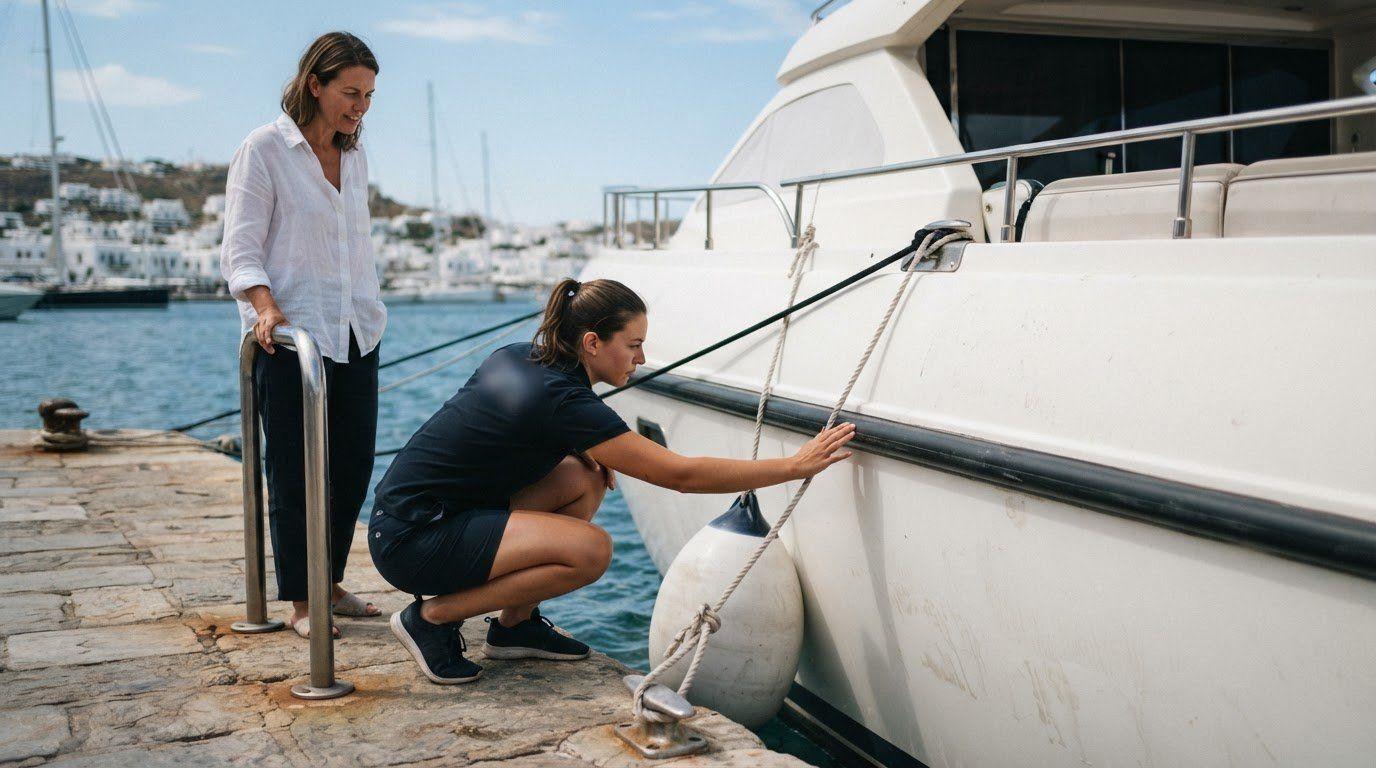
The yacht charter security deposit hold and release protocol in Greece centres on the return inspection. Depending on the yacht, the deposit may be taken as a card pre-authorisation or paid in cash. It is refundable after checkout if there is no damage. The deposit provides security against damage beyond normal wear and tear, so the handover matters as much as the final day at sea.
It’s understandable to worry that a card hold could linger or that a waiver means no deposit is required. These options work differently: a pre-authorisation reserves funds rather than charging them, while a waiver changes the terms of your financial exposure. The release timing depends on the charter agreement and checkout process.
This guide explains how deposits are held, what can affect their release, and how a damage waiver differs from deposit insurance. It also covers what to document before departure and which agreement terms to understand, so you can set sail with a clearer picture of the process.
Key Takeaways
- Understand whether the deposit is a card pre-authorisation or a cash payment, and how that affects access to your funds.
- Know which return-inspection findings can affect a refund and why clear records of the yacht’s condition matter.
- Read the agreement’s deposit and damage terms closely so you can distinguish a waiver from insurance.
- Learn what can influence release timing and how to plan your charter with fewer payment surprises.
Card payment and refundable-deposit conditions
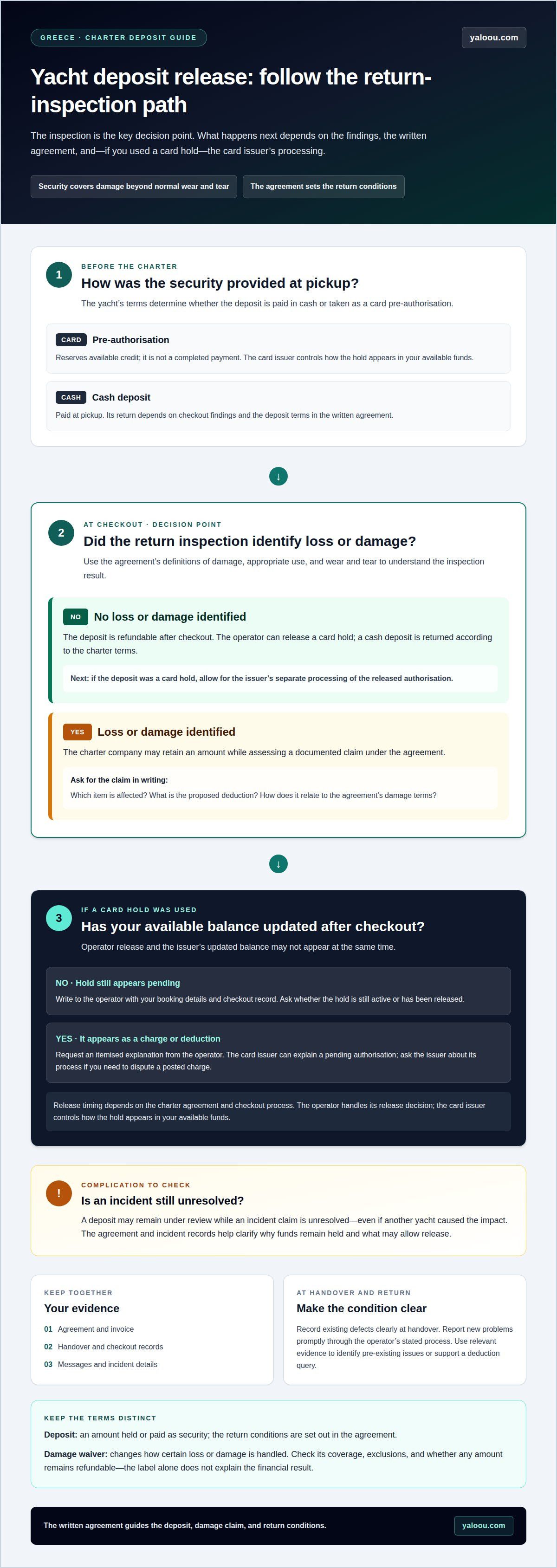
In Greece, the yacht’s terms determine whether you pay the security deposit by card or in cash at pickup. Its return depends on the checkout and the damage terms in the written agreement.
Deposit Payment at Yacht Pickup
At pickup, you provide the agreed security before the charter begins. Depending on the yacht, the operator may take cash or place a card pre-authorisation. A pre-authorisation reserves available credit rather than completing a payment. Knowing which method applies helps you distinguish a pending hold from a charge on your statement.
Consumer and Contract Rules for Deposits
For deposits and refunds, focus on the amount, return conditions, and definitions of appropriate use and wear and tear. The rental agreement should set these out clearly. They explain what the deposit covers and how its return is assessed after checkout. Read them alongside the payment conditions: a booking payment and a refundable security deposit serve different purposes.
Charter invoices and card payments are in euros. If your card uses another currency, your card issuer sets the exchange rate. Bank transfers go to the Greek or EU account printed on the invoice. To pay through a card payment link, you need the booking number and payment amount. Card approval confirms the booking instantly.
Catamaran booking schedules can specify 50% at reservation, with the remaining 50% due 28 days before the charter or at least 30 days before embarkation. Departures within 60 days may require full payment at booking. Follow the schedule in your agreement and invoice, since the stated deadlines differ.
Unreleased Holds and Disputed Deductions
An unreleased hold is a card pre-authorisation that continues to restrict available funds after checkout. Contact the charter operator in writing with your booking details and checkout record. Ask whether the hold was released or converted into a charge, and request an itemised explanation for any deduction. The distinction matters: your card issuer can explain a pending authorisation, while the operator can clarify its actions.
If you dispute a deduction, identify the specific item and include relevant handover or return evidence. Keep the agreement, invoice, messages, and checkout documentation together. Ask the operator to link each deduction to the agreement’s damage terms. If the issue remains unresolved, contact your card issuer about its process for disputing a posted charge.
Charter operator deposit and waiver examples
Charter terms may pair a refundable deposit with an optional damage waiver. The waiver changes how certain loss or damage is handled, while the deposit remains a separate part of the charter arrangement. Read both terms together, especially if the yacht includes equipment such as an outboard.
For example, a damage waiver may cover loss or damage while the boat is in the charterer’s care. Some waiver packages also have a smaller refundable deposit than the standard option. The two are not interchangeable: the waiver sets out damage coverage, while the deposit is an amount held or paid as security.
The same principle applies to catamarans and monohulls. A missing item, damaged fitting, or reported onboard problem may be treated differently under the operator’s terms. Ask for any proposed deduction to identify the affected item and explain how it relates to the charter conditions. An itemised explanation makes it easier to assess whether a charge reflects damage or a pre-existing issue.
Evidence can make a practical difference. Record existing defects clearly at handover and report new problems promptly through the operator’s stated process.
Before choosing a waiver, compare its coverage and exclusions with the deposit terms. Check whether it applies to particular equipment, accidental damage, or loss, and whether any amount remains refundable. The label alone does not explain the financial result; the written conditions do.
For a charter built around time on the water, explore Greek yacht charter experiences and consider how the operator’s deposit and waiver terms fit your plans.
How yacht charter security deposits are held
A card hold reserves funds against possible damage; it is not a completed payment. The charter company requests the pre-authorisation, and the card issuer controls how it appears in your available funds. After checkout, the operator can release the hold or retain funds while resolving a documented claim. Knowing who handles each stage helps explain why the operator’s release and your bank’s updated balance may not appear at the same time.
The yacht’s return inspection is the key decision point. If the vessel comes back without loss or damage, the deposit is refundable after checkout. If damage is identified, the charter company may retain an amount while assessing the claim under the agreement. If the hold remains after the inspection, ask for the claimed damage and its basis in writing.
An unresolved incident can complicate release. For example, a charterer may remain responsible for damage caused by another yacht until that yacht’s owner compensates the charter company. The deposit may remain under review even if the charterer did not cause the impact. The agreement and incident records help clarify why funds remain held and what would allow the operator to release them.
The presence of a skipper or crew does not, by itself, establish a separate deposit rule for bareboat and crewed charters. The agreement sets the deposit amount, return conditions, and responsibility for damage. For a bareboat charter, it identifies the charterer’s obligations; for a crewed charter, it should still explain how damage claims and the deposit are handled. Read these terms before booking.
For either format, separate the process into three steps: inspection, operator release, and issuer processing. If the hold remains, ask the charter company whether it is still active or has become a charge. Then ask your card issuer how it will reflect the operator’s release. This is central to the yacht charter security deposit hold and release protocol in Greece: the operator addresses the claim, while the issuer updates the card account.
How insurance & damage waivers affect deposits in Greece
A yacht charter security deposit normally covers the yacht’s insurance excess, the portion assigned to the owner under the insurance arrangement. A damage waiver and third-party deposit insurance affect different parts of that exposure. Neither term alone tells you whether the card hold will be smaller or when funds will be released.
A waiver purchased at the charter base may limit the charterer’s liability for specified loss or damage while the yacht is in their care. Some waiver packages pair that coverage with a smaller refundable deposit. The waiver itself is usually non-refundable, so compare its written coverage, exclusions, and remaining deposit obligation with the standard terms. A waiver does not automatically mean there will be no hold.
Third-party deposit insurance works differently. It can reimburse a charterer if the operator retains some or all of the deposit after damage or loss, up to the owner’s insurance excess. It generally does not reduce the amount initially held on the card. The charterer pays the deposit first, then makes a claim under the separate policy if its conditions apply.
Standalone deposit insurance may cost 2% to 15% of the deposit. It can be bought for one trip or through an annual policy. The policy’s exclusions and claim requirements determine whether that premium provides useful protection.
Compare the options by asking what happens to the deposit at checkout, which damage is covered, and who pays first. If damage exceeds the security deposit, one described arrangement has the owner make an insurance claim. The charter agreement still matters: it defines liability, deductions, and the waiver’s scope. Choose a Greek yacht charter experience with these distinctions clear before departure, so the payment structure fits your plans.
YAL’OOU Exclusive Yachting & More: Daily Yacht Charters
YAL’OOU Exclusive Yachting & More offers Daily Yacht Charters for guests planning a day on the water, as well as Weekly Crewed Yacht Rentals for a longer escape. Choose the format that fits your itinerary, then factor the security deposit and any waiver into your booking decision. Focus on practical questions: how the deposit is held, what the agreement says about deductions, and how release follows the return inspection. Clear answers help you understand the payment arrangements without confusing a card hold with a charge or a waiver with insurance.
Ready to plan a yacht charter in Greece? Contact YAL’OOU Exclusive Yachting & More to discuss your plans.
Set Up Your Charter with Clarity
Before committing to a Greek sailing plan, make the deposit terms part of your trip decision. Consider them alongside your preferred route, onboard arrangements, and return schedule. A written understanding of the payment and release process gives you a clearer basis for choosing a charter that suits your plans. It also keeps the discussion focused on the specific terms that matter, rather than assumptions about how a hold or waiver works.
Use the yacht charter security deposit hold and release protocol in Greece as a framework for discussing terms before booking. Whether you’re planning a day on the water or a longer escape, match your charter choice to the experience you want from your time in Greece. YAL’OOU Exclusive Yachting & More also offers High-End Villa Rentals for guests planning a broader stay.
Contact YAL’OOU Exclusive Yachting & More to discuss your plans and take the next step toward a well-planned Greek getaway.
Frequently Asked Questions
How Not to Lose the Yacht Charter Security Deposit?
Protect the yacht and create a clear record of its condition before departure. Photograph existing scratches, dents, and cracks, and compare them with the handover inventory. A set of 20-30 photos can help distinguish pre-existing marks from damage noticed later. Report any issue to the charter company promptly, and keep the message and response with your charter documents. Take the same careful approach during return.
How Much Is Needed Usually?
The amount depends on the yacht and charter terms, so use the figure in your booking agreement when planning your available funds. Deposit requirements can vary between vessels, even on similar itineraries around Mykonos or Paros.
Is my liability capped at the deposit?
Not automatically; the charter agreement defines the liability terms. Under one described arrangement, the yacht owner makes an insurance claim if damage exceeds the deposit, rather than expecting the charterer to pay more. Do not treat this as a universal rule. Read the liability and insurance clauses together, especially if another vessel is involved, as responsibility and compensation may take longer to resolve.
What can the fleet actually charge against it?
A deposit may cover repair or replacement costs, including labour, for items lost or damaged during the charter. The relevant distinction is damage beyond normal wear and tear, not ordinary use of the yacht. For example, a damaged fitting or missing onboard item may be assessed under the agreement. Ask for an itemised explanation identifying the affected item and related repair or replacement cost.
What happens at check-out, and when do I get the money back?
At checkout, the yacht’s condition is compared with its handover state and charter inventory. If it returns without loss or damage, the full deposit is refundable after checkout. For a card hold, the operator’s release and the card issuer’s update are separate steps, so available funds may not change at the same time. Keep the checkout record until the release appears on your account.
What is a Damage Deposit?
A damage deposit is security held or paid to cover specified loss or damage during a yacht charter. It is separate from the booking payment, which pays for the rental itself. For example, an operator may use a card pre-authorisation to reserve funds rather than charge them immediately. The agreement explains the deposit amount, covered damage, and return conditions after the yacht comes back.
Disclaimer
The YAL’OOU Travel Guide is curated with care to inspire and inform discerning travelers. While every effort is made to ensure the accuracy and relevance of the information provided, all content is offered for general guidance only and may evolve over time.
Details such as local regulations, availability, pricing, and services are subject to change without prior notice. We encourage guests to seek personalized advice and confirm arrangements directly when planning their journeys.
YAL’OOU accepts no liability for any inaccuracies, omissions, or outcomes arising from the use of this information. The Travel Guide may feature recommendations, insights, and selected third-party experiences, presented solely as a source of inspiration and not as formal endorsements.
By accessing this section of our website, you acknowledge and accept this disclaimer as part of your experience with YAL’OOU.