

A repeat charter doesn’t automatically come with a lower rate. When you review off-season charter rates for repeat clients in Greece, focus on whether the proposal fits your plans and clearly describes the journey. Recognition as a returning guest may come through planning that reflects what you enjoyed before, not through a guaranteed discount.
This guide shows you how to compare an off-season proposal with a previous trip without relying on assumptions. Look at the yacht, dates, itinerary, duration, stated inclusions, and written terms. Then use what you learned on your last charter to explain what you want to keep, change, or explore. A clear brief helps shape a return journey around your preferences, with privacy, ease, and authentic Greek hospitality at its heart.
Key Takeaways
- Assess off-season charter rates for repeat clients in Greece proposal by proposal, rather than expecting a standard rate or automatic returning-guest discount.
- Compare the proposed yacht, destination, route, duration, inclusions, and written terms with your previous charter.
- Separate details stated in the proposal from assumptions about repeat-client treatment.
- Use what you learned on your last trip to set priorities and shape a return journey around your preferences.
- Explore curated Greek yacht itineraries to find inspiration for a personal, unhurried charter.
Off-Season Charter Rates in Greece: What Returning Guests Should Understand
A returning guest needs a proposal they can compare with the last trip, not a seasonal label that leaves the details unclear. The phrase off-season charter rates for repeat clients in Greece doesn’t refer to one standard rate. Each proposal reflects the dates and the journey being planned.
Season is one factor, but it isn’t enough to judge two offers. The yacht, itinerary, duration, charter arrangement, inclusions, and written terms all affect what you’re comparing. Greece’s broader tourism context includes efforts to promote different types of travel across seasons, as outlined in Tourism in Greece. That context doesn’t establish a universal yacht-charter rate.
For a visual sense of a Greek yacht charter experience, watch this video:
What does “off-season charter rate” mean in Greece?
It means the proposal is for particular dates, but the label alone doesn’t tell you what’s included or how the terms compare with another offer. Treat season as context, then read the proposal line by line. A change in dates may come with a different route, yacht, or duration, so first establish whether the trips are comparable.
For example, a previous charter with a longer itinerary isn’t a direct benchmark for a shorter return trip, even if both are described as off-season. Different charter arrangements also shouldn’t be treated as interchangeable. You can review YAL’OOU’s Greek yacht options and compare the specific vessel named in each proposal with the yacht from your previous trip.
Keep the comparison grounded in the written details: dates, route, duration, inclusions, and terms. If any differ from your previous charter, record the difference before drawing conclusions about the rate.
Does returning as a client automatically mean a lower rate?
No. Repeat-client status isn’t proof of a discount. Your history with a charter team can make it easier to share your preferences, past feedback, and the pace or atmosphere you enjoy. That information can help shape a more personal brief, but it doesn’t establish a pricing benefit by itself.
A repeat-client preference can guide a more tailored journey; it isn’t a guarantee of a lower rate. The value of returning may be a proposal shaped around what you already know you like, rather than an automatic reduction. Keep that possibility separate from the written terms.
When comparing offers, mark each detail as either stated in the proposal or assumed because you’ve chartered before. This keeps expectations clear and helps you assess both the terms and the journey you want to experience again.
Which Greek Charter Details Shape an Off-Season Proposal?
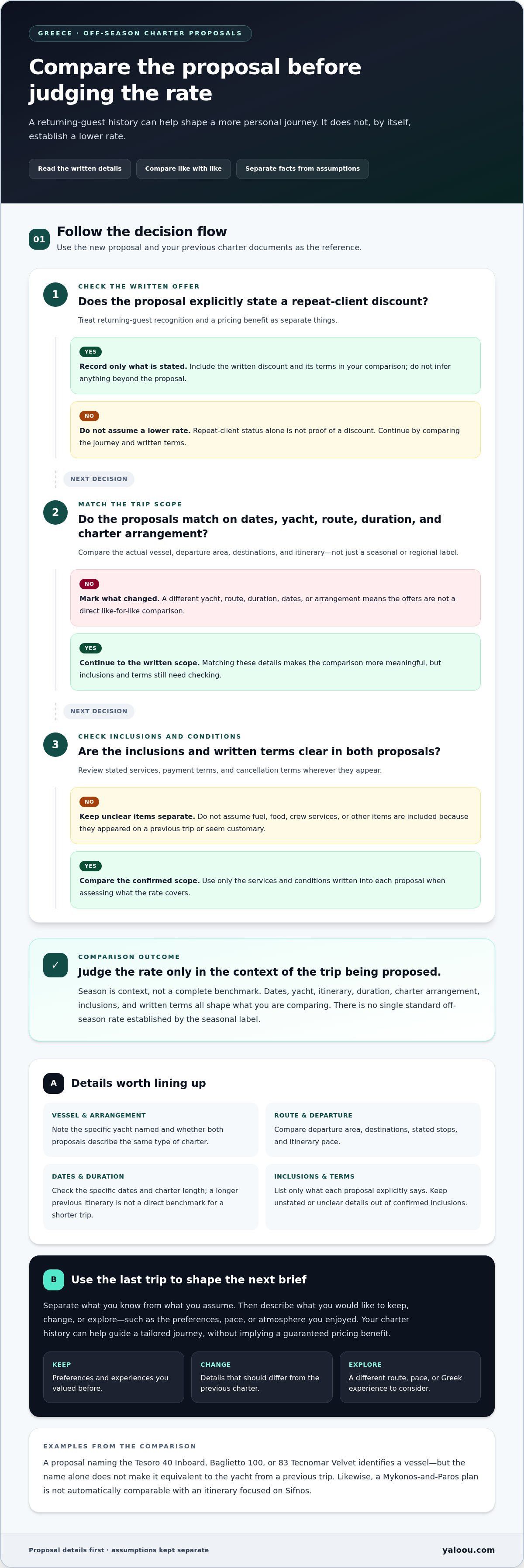
Start with the new proposal and your previous charter documents side by side. A headline rate catches the eye, but it doesn’t show whether the trips cover the same experience. Compare the dates, yacht, route, duration, and charter arrangement first. Then review the written terms that define the scope of each proposal.
For two charter proposals to be meaningfully comparable, match the yacht, route, duration, charter arrangement, inclusions, and written terms.
Compare the yacht and itinerary, not just the headline rate
The yacht and route are separate parts of the experience. A proposal naming the Tesoro 40 Inboard, Baglietto 100, or 83 Tecnomar Velvet identifies a vessel, but the name alone doesn’t make it equivalent to the yacht from your last trip. Compare the specific vessel named in each document, then consider how the proposed route and duration fit your previous journey and current priorities.
Departure area and destinations also matter when they change the shape of the itinerary. A plan involving Mykonos and Paros, for example, isn’t automatically comparable with a trip focused on Sifnos just because both are Greek charters. Look at the proposed stops and pace, not only the destination headline.
Review the proposal’s scope and terms
Use the written proposal and your previous charter documents as your reference. Compare the charter arrangement, dates, duration, route, stated inclusions, and payment or cancellation terms wherever they appear. Don’t assume fuel, food, crew services, or other items are included because they appeared on a previous trip or seem customary. Record what each document explicitly says and leave unstated details out of the comparison.
- Vessel and arrangement: Note the yacht named and whether both proposals describe the same type of charter.
- Route and departure: Compare the stated departure area, destinations, and itinerary rather than relying on a broad regional label.
- Duration: Check the stated charter length and whether the available time supports a similar pace.
- Inclusions and terms: List only the services and conditions written into each proposal. Keep unclear details separate from confirmed inclusions.
This approach makes off-season charter rates for repeat clients in Greece easier to assess without treating a changed itinerary as a like-for-like offer. It also shows what you’d like to keep, change, or clarify in a return brief. If you’re refining the route around the kind of Greek experience you want, explore YAL’OOU’s curated Greek yacht experiences for inspiration.
How to Compare Repeat-Client Charter Offers Without Assuming a Discount
A fair comparison needs more than the amount at the top of a proposal. Put the previous charter documents beside the new offer and line up the matching details. This makes differences easier to spot before you decide whether the new journey suits you. It also keeps expectations about repeat-client treatment grounded in what’s actually written.
A practical side-by-side checklist for two charter proposals
Use the same headings for both trips and fill them in from the relevant proposal or past documents. If a detail is missing, mark it “not stated”; if it differs, note how. Don’t fill gaps with memory or assumptions. Add a separate note about what mattered most last time, such as privacy, an unhurried pace, or a particular destination.
Comparison detailPrevious charterProposed charterVessel
Record the named yacht
Record the named yacht
Destination
List the stated destination
List the stated destination
Route
Summarize the documented itinerary
Summarize the proposed itinerary
Duration
Copy the stated duration
Copy the proposed duration
Inclusions
List only written inclusions
List only written inclusions
Written terms
Note the documented conditions
Note the proposed conditions
Next, separate facts from interpretation. A written inclusion is a confirmed proposal detail. “They know I prefer a slower itinerary” is useful context for a returning guest’s brief, but it isn’t an inclusion or pricing term unless the proposal says so. Keep preferences in their own notes column. That way, they can inform the comparison without being mistaken for promised benefits.
How to judge value when the rate is not the only difference
A lower headline figure doesn’t establish better value if the proposals cover different journeys. A different yacht, route, duration, or charter arrangement may change how well the offer fits your plans. Compare the full written scope first. If key details don’t match or aren’t stated, treat that part of the comparison as incomplete rather than guessing what the difference means.
Then weigh the proposed experience against your priorities. Does the route suit the pace you enjoyed? Does the destination fit what you want from this return trip? Are the inclusions and terms clearly described? These questions help you assess the fit without inventing benefits or reducing the decision to a single figure.
For off-season charter rates for repeat clients in Greece, the practical test is whether the proposal’s stated terms and experience align with your priorities. Returning clients should assess the full offer, not expect an automatic discount. A tailored brief makes your preferences clear; count a pricing benefit only when it appears in the written proposal.
Plan a Greek Off-Season Charter Around Your Previous Trip
Your last charter is a useful starting point for planning the next one. You don’t need to recreate every detail. Identify what made the experience feel right, then decide what you’d like to keep or change. A concise brief turns those memories into practical priorities for a new Greek journey without treating a past booking as a promise of special pricing.
Turn your last charter into a concise planning brief
Think beyond the destination. Note the pace you enjoyed, the moments that felt most personal, and what you’d do differently. Separate essentials, such as privacy or an unhurried itinerary, from flexible choices like which islands to visit. Focus the brief on the experience you want next, not on presumed loyalty benefits.
Use this sequence to move from reflection to a clearer proposal:
- Recall your preferences. Write down the destinations, pace, and experience elements you valued most on your previous trip. Be specific: “more time at each stop” is more useful than “a relaxing trip.”
- Set your priorities. Mark each preference as essential or open to change. This separates the details that define a good return charter from those you’re happy to rethink.
- Choose a destination. Decide whether you want to revisit a familiar place or explore another option. Mykonos, Paros, Antiparos, and Sifnos can help you frame a destination brief without assuming a particular route or date.
- Compare the terms. Once you have a proposal, match its stated itinerary and terms against your priorities. Keep the comparison tied to written details, not assumptions about returning-client treatment.
Choose a destination and experience to compare
Use YAL’OOU’s published Greek destination collection as a starting point, then narrow your choice according to the kind of journey you want. A return visit to a familiar island may suit you if you already know what you enjoy there. Another destination can offer a fresh setting while keeping the same priorities. The choice is personal, and the destination name alone doesn’t define the trip.
As you consider options, think about what shaped your previous experience: how much time you wanted at each stop, the atmosphere you prefer, and how much structure feels comfortable. Treat a published itinerary as inspiration for the journey you want to plan, and compare it with the dates and details in your proposal.
For a broader planning reference, a Greek island charter planning guide can help frame the destination decision. Then explore Greek yacht experiences for itinerary inspiration. As you assess off-season charter rates for repeat clients in Greece, let your preferences shape the brief and use the written proposal to compare the terms.
Explore a Personally Curated Greek Charter with YAL’OOU
A return journey can begin with what you already know you value. YAL’OOU’s promise, “Luxury That Truly Feels Personal,” puts privacy, ease, authentic Greek hospitality, and unhurried journeys at the heart of the experience. Use your past charter to shape a thoughtful brief: what you loved, what you’d like to revisit, and what you hope will feel different this time.
Match the next charter to what matters to you
Let your preferences lead the planning. If a calm pace mattered most, make that clear. If a destination left you wanting to explore more, use it as a starting point for the next itinerary. Mykonos, Paros, Santorini, and Sifnos feature in YAL’OOU’s Greek experience collection. Consider the atmosphere and journey you want rather than assuming the same route will suit every return trip.
The yacht is another part of the overall fit. YAL’OOU’s collection includes the Tesoro 40 Inboard, Baglietto 100, and 83 Tecnomar Velvet. Use those names as a starting point for exploring the options, then consider how the yacht and proposed itinerary align with your priorities. The proposal and your preferences together define the journey.
This is a more useful way to approach off-season charter rates for repeat clients in Greece. Returning guests can bring a clearer sense of what makes a charter feel personal, but the proposal remains the basis for comparing terms. Keep your wishes distinct from any pricing assumption, and use your brief to describe the journey you want to create.
Take the next step toward your Greek charter
Start by exploring the current experience descriptions. They provide a practical way to consider Greek itinerary options and reflect on what might suit your next trip. Note the destinations and experiences that catch your attention, then bring those preferences into your planning brief. Keep the comparison focused on the proposal’s stated itinerary and terms while leaving room for a journey shaped around your tastes.
Explore YAL’OOU’s Greek yacht experiences and find inspiration for your next charter brief. Bring what matters to you, and let the next Greek journey feel truly personal.
Shape a Return Charter Around What Matters Most
Your next Greek charter can build on what you already know you love while leaving space for new discoveries. Let your preferences guide the conversation and the written proposal define the terms. That’s a grounded way to approach off-season charter rates for repeat clients in Greece without tying the value of a return journey to an assumed discount.
YAL’OOU’s promise centers on privacy, ease, and authentic Greek hospitality. Its private yacht itineraries across destinations such as Mykonos, Paros, and Sifnos can inspire a journey shaped around your pace and interests. Decide what matters most, then use those priorities as a clear starting point for your next charter brief.
Ready to plan a return to Greece? Explore YAL’OOU’s Greek yacht experiences and find inspiration for a journey that feels personal from the start.
Frequently Asked Questions
Are off-season charter rates in Greece always lower than peak-season rates?
No. An off-season label alone doesn’t establish whether a proposal is lower than a peak-season offer. The rate relates to the specific yacht, itinerary, duration, charter arrangement, and written terms. For off-season charter rates for repeat clients in Greece, compare proposals built around similar plans rather than relying on a broad seasonal assumption. If the trips differ, note those changes before drawing conclusions.
Does being a repeat yacht charter client guarantee a discount in Greece?
No. Returning as a client doesn’t, by itself, guarantee a discount. Your experience of a previous trip can help you explain your preferred destinations, pace, and experiences, giving the new brief a personal starting point. Treat those preferences separately from pricing. Include a repeat-client benefit in your comparison only if the written proposal states it, and assess the full terms rather than relying on an expectation.
How should I compare a new Greek yacht charter proposal with my last trip?
Put the previous documents beside the new proposal and use the same headings for both: yacht, destination, itinerary, duration, written inclusions, and terms. If the proposed route differs from your last trip, record it as a change rather than treating the offers as identical. Note missing details as “not stated.” This keeps the comparison grounded in the documents and makes meaningful differences easier to spot.
What should I include in a repeat-client yacht charter brief?
Share what you valued about the earlier journey, such as its pace, destinations, or moments that made it feel personal. Then sort your preferences into three simple groups: “keep,” “change,” and “open to ideas.” This gives the planning conversation direction without locking you into a copy of the previous itinerary. Focus on the Greek trip you want next, not on an assumed loyalty benefit.
Can I request the same yacht or route for an off-season charter in Greece?
Yes. You can state that the same yacht or route is your preference. You might name a yacht from YAL’OOU’s collection, such as the Tesoro 40 Inboard, or describe the route you’d like to revisit. It can also help to name an alternative you’d consider, so your brief makes both your first choice and your flexibility clear.
Which Greek destinations can I explore when planning a return yacht charter?
For private yacht itinerary inspiration, explore Mykonos, Paros, Antiparos, Santorini, and Sifnos through the current descriptions. YAL’OOU’s wider Greek destination focus also includes Athens, Aegina, Poros, Spetses, Syros, Tinos, Serifos, Milos, Poliaigos, Kimolos, Ios, Koufonisia, Amorgos, Crete, Corfu, and Zakinthos. Use published itinerary details to shape a shortlist and compare them with the journey you want to plan.
What details should I compare beyond the charter rate?
Compare the yacht, itinerary, duration, charter arrangement, and written scope of the proposal. Review stated terms, such as payment or cancellation conditions, and distinguish listed inclusions from anything you’re assuming. For instance, don’t treat fuel, food, or crew services as included unless the document says so. A clear record of what each proposal covers helps you judge the overall fit, not just the headline figure.
Disclaimer
The YAL’OOU Travel Guide is curated with care to inspire and inform discerning travelers. While every effort is made to ensure the accuracy and relevance of the information provided, all content is offered for general guidance only and may evolve over time.
Details such as local regulations, availability, pricing, and services are subject to change without prior notice. We encourage guests to seek personalized advice and confirm arrangements directly when planning their journeys.
YAL’OOU accepts no liability for any inaccuracies, omissions, or outcomes arising from the use of this information. The Travel Guide may feature recommendations, insights, and selected third-party experiences, presented solely as a source of inspiration and not as formal endorsements.
By accessing this section of our website, you acknowledge and accept this disclaimer as part of your experience with YAL’OOU.