

What if the best way to shape your next Greek yacht charter begins with a few thoughtful notes about the last one? Providing effective feedback to your charter broker post-trip isn’t about finding fault or turning a holiday into a review. It’s a chance to share what made the experience special, what could have worked better, and what you’d like remembered next time.
It can feel awkward to raise a concern, especially when you don’t want criticism to sound personal. After a week at sea, it may also be hard to know which details will help your broker most. Specific examples make the difference: perhaps a quiet anchorage became a highlight, or clearer updates would have made a change of plans easier.
This guide shows you how to describe highlights and shortfalls calmly, with practical details your broker can use. You’ll learn which parts of the trip to mention, how to make your preferences clear, and how constructive feedback can inform a more personal future experience in Greece. The goal is simple: turn a memorable journey into useful insight for the next one.
Key Takeaways
- Share highlights as well as friction points to show what shaped the charter experience.
- Prepare feedback by recalling key moments, grouping them by theme, and choosing examples that explain your preferences.
- When providing effective feedback to your charter broker post-trip, describe what happened and how it affected you rather than making it personal.
- Share difficult feedback calmly and directly, without softening important concerns until they become unclear.
- Summarize the preferences you want carried into a future Greek charter and invite a conversation about how they can inform the planning.
Why Post-Trip Feedback Matters After a Greek Yacht Charter
A yacht charter is shaped by more than the places you visit. Privacy, pace, hospitality, communication, and coordination all affect how the experience feels. Effective feedback turns those impressions into specific observations your broker can understand: what suited you, what felt less seamless, and what you’d prefer in the future.
Constructive post-trip feedback is a clear account of what worked and what didn’t, shared to clarify preferences and address concerns, not to assign blame.
That distinction matters. Describe what happened without guessing at someone’s intentions. “We weren’t told about the change until plans were underway, which made it harder to adjust” is more useful than “The crew didn’t care about our plans.” The first explains the event and its effect, leaving room for a practical conversation.
What useful yacht-charter feedback can accomplish
Concrete observations give your broker a clearer picture of the experience you value. Saying that you appreciated an unhurried start to the day, for example, communicates a preference more clearly than simply calling the charter relaxing. If a particular interaction made you feel welcome, describe what happened. That helps distinguish the service details worth repeating from general praise.
Friction points provide equally useful context. Perhaps updates about a change in plans arrived later than you’d have liked, or a moment that called for privacy felt too busy. Explain what you experienced and how it affected your time on board. Keep assumptions about why someone acted a certain way separate from what you observed. Your feedback gives your broker practical context for a conversation about your preferences and concerns.
Positive feedback can be specific, too. Mentioning that clear communication helped your group settle into the day gives your broker a detail to remember. The broader idea of feedback as information that can guide future actions is explored in Understanding Feedback.
Why the Greek-island context matters
Place shapes the feeling of a charter, but there’s no single Greek-island experience. You might value quiet and privacy around Mykonos, while a visit connected with Paros may stand out for a different reason. These examples don’t imply a set route. They show why feedback about the atmosphere and your personal priorities can be more helpful than a destination name alone. You can explore Greek yacht destinations for inspiration when considering the setting for a future charter.
Think about what made a place feel right for you. Was there enough room in the day to slow down? Did the hospitality feel warm and attentive? Did the experience offer the privacy you wanted? Naming these qualities helps your broker understand what you’d like to carry into another Greek yacht charter, without assuming the same itinerary or details will suit every trip.
Greek charter planning can involve different settings, from Mykonos, Paros and Antiparos to Athens, Aegina, Poros, Spetses, Syros, Tinos, Sifnos, Serifos, Milos, Poliaigos, Kimolos, Santorini, Ios, Koufonisia, Amorgos, Crete, Corfu and Zakinthos. When sharing feedback, distinguish what mattered in the specific setting you visited from the preferences you’d carry to another destination.
That’s the value of providing effective feedback to your charter broker post-trip: it turns memories into useful preferences. Share both the moments you’d gladly experience again and the points that could have felt smoother. Together, they offer a clearer picture of what personal, unhurried travel means to you.
How to Prepare Clear, Constructive Feedback for Your Charter Broker
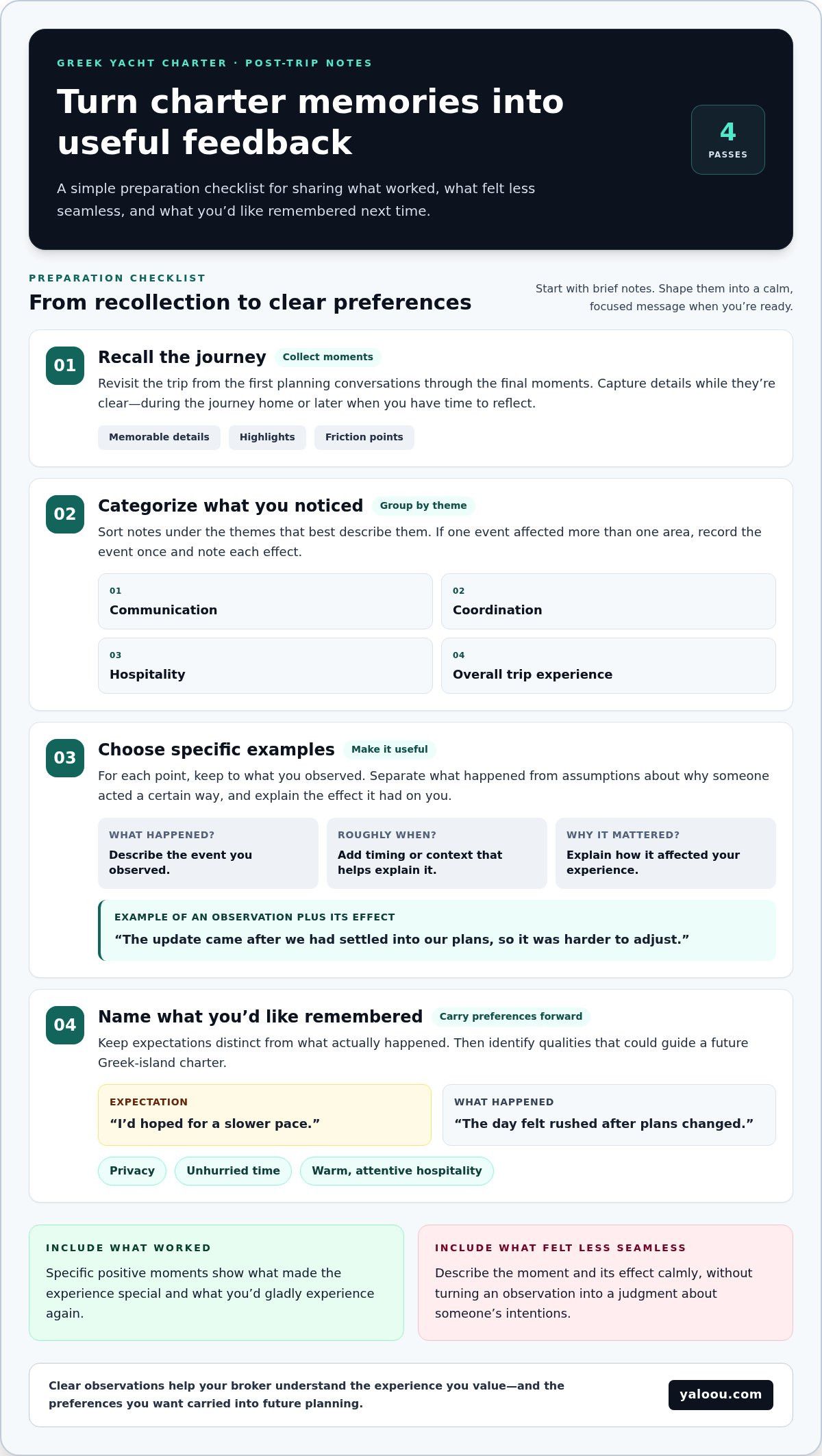
A little preparation helps turn a hazy overall impression into feedback your broker can use. Start while the moments are still clear, whether during the journey home or later when you have time to reflect. Capture brief notes first, then shape them into a calm, focused message. For providing effective feedback to your charter broker post-trip, keep firsthand observations separate from assumptions and other people’s accounts.
Recall the trip, group your observations, select specific examples, and identify the preferences you want remembered.
Gather the details that make feedback specific
For each point, note what happened, roughly when it occurred, and why it mattered to you. “The update came after we had settled into our plans, so it was harder to adjust” gives more context than “communication was poor.” Add positive examples, such as a thoughtful gesture that helped you feel at ease. Stick to what you observed; don’t add technical or operational explanations you can’t verify.
Sort observations into useful feedback themes
Group your notes under communication, coordination, hospitality, and overall trip experience. Keep what you expected distinct from what actually happened: “I’d hoped for a slower pace” is different from “the day felt rushed after plans changed.” Then identify preferences that could guide a future Greek-island charter, such as valuing privacy, unhurried time, or warm, attentive hospitality.
- Recall. Revisit the journey in sequence, from the first planning conversations through the final moments. Jot down memorable details as they come back to you. A few clear words are enough at this stage; you’re collecting material, not drafting the final message.
- Categorize. Place each note under the theme it best describes. If a change affected both communication and the day’s pace, record the event once and note both effects. This makes it easier to spot recurring preferences without turning your feedback into a long list of loosely connected reactions.
- Select examples. Choose a few moments that explain your strongest praise or concern. Include when they happened and how they affected your experience. Be clear about whether you witnessed something yourself, heard about it from another guest, or are sharing an interpretation. That distinction keeps your account fair and reliable.
- Identify preferences. Finish by asking what you’d like to repeat or approach differently next time. You might value more privacy, clearer updates, or a gentler pace. Frame these as preferences, not assumptions about what a future trip must include. They give your broker useful context for a later planning conversation.
Before sending your message, read it once from your broker’s perspective. Can they tell what happened, why it mattered, and what you’d prefer in the future? Remove speculation, but keep important concerns direct. This preparation makes the feedback easier to understand and discuss.
If you’re beginning to picture what might suit you next, exploring curated Greek yacht experiences can help you put those preferences into words.
What to Include in Feedback About Your Charter Experience
A useful review gives your charter broker more than a verdict. It shows how different parts of the trip came together for you: conversations before and during the charter, coordination, hospitality, and whether the pace and atmosphere matched your expectations. Choose details that explain your experience, not every passing thought.
For each concern, connect three points: what you observed, how it affected you, and what might have made the moment clearer or more comfortable. For example: “We weren’t sure when the day’s plans would be discussed, so it was difficult to settle into the morning. A clearer sense of timing would have helped us relax.” This is direct without assuming anyone’s intentions.
Describe what worked well
Make positive feedback specific, too. Instead of saying only that the hospitality was excellent, name the interaction that made you feel welcome. Perhaps a thoughtful conversation helped your group feel at ease, or the pace left room to enjoy time together without rushing. Explain why that mattered to you. Your broker can then understand which qualities felt personal and fitting, and which you’d value again.
Raise concerns without turning them into accusations
Start with the observable detail, then describe its effect. “The change in plans wasn’t clear to us, and we weren’t sure what to expect next” is more constructive than saying someone was careless. If you can, add what would have helped: a concise explanation, a moment to discuss the adjustment, or clearer shared expectations. Measured language keeps the concern clear without turning it into a judgment about character.
Use this checklist to scan the experience. You don’t need to comment on every topic; select the ones that shaped your trip.
- Communication: Were updates understandable and well-timed for your needs? Note a moment when information helped you feel at ease, or when you were unsure what was happening.
- Coordination: Did transitions and shared plans feel clear? Describe where coordination supported a relaxed day or where more clarity would have helped.
- Hospitality: Which interactions felt warm, attentive, or respectful of your privacy? Point to the moment rather than relying on a general rating.
- Expectations: What had you understood before the trip, and how did the experience compare? Keep your original expectation separate from what took place.
- Overall impression: Did the charter feel unhurried and suited to your priorities? Name what contributed to that feeling, or what made the experience less comfortable.
Consider what felt especially personal or well matched to your trip, as well as what you’d want handled differently next time. Providing effective feedback to your charter broker post-trip means offering a balanced picture: meaningful moments worth repeating, concerns stated plainly, and preferences your broker can carry into a future planning conversation.
How to Share Difficult Feedback Without Damaging the Conversation
Raising a concern after a Greek yacht charter can feel uncomfortable, especially when you appreciated much of the trip and don’t want one difficult moment to define it. A calm, direct message keeps the focus on what happened and what you need to communicate. Be considerate, but don’t dilute a serious concern until its impact is hard to understand.
Separate the experience from judgments about a person’s character or intentions. Describe what you saw or heard, explain how it affected you, and say what you’d like clarified. Relevant context, such as what you understood beforehand, can make your point fairer. It shouldn’t obscure an issue that mattered.
A practical structure for raising a concern
Keep the message easy to follow: identify the trip and moment, state the impact in first-person language, then close with a clear question or request. For example: “During our charter, I understood that the day’s plans would be discussed before we settled in. That conversation didn’t happen, and I felt unsure about what to expect. Could you help me understand how the timing was communicated?” Adapt the wording to what you personally experienced.
This structure keeps the tone professional without making your concern vague. A useful message might include:
- Context: Name the relevant part of the charter, without recounting the whole trip.
- Observation: Describe the moment as accurately as you can, using firsthand details.
- Impact: Explain what it meant for your comfort, expectations, or enjoyment.
- Next step: Ask for clarification or state what you’d like discussed.
A conversation may help if a written exchange leaves a misunderstanding unresolved or if people recall the moment differently. Invite a discussion while keeping the central concern in writing, so both sides have a clear point to return to. The aim is to understand the difference in recollections and make your experience clear.
What to do if you disagree about what happened
Return to the concrete details: what you remember, when it took place, and what you understood at the time. If another account differs, acknowledge that directly rather than guessing why. Then make your desired outcome explicit and proportionate, whether you’re seeking an explanation, sharing a lesson for future planning, or asking to discuss an unresolved concern.
Stay open to clarification and be clear about what remains unresolved. Providing effective feedback to your charter broker post-trip creates a clear basis for discussion. If the concern is significant, keep your wording factual and preserve relevant messages or notes so you can refer to them accurately.
As you consider what you’d value in a future journey, explore curated Greek yacht experiences for inspiration and to help put your preferences into focus.
Close the Loop and Carry Your Preferences Into a Future Greek Charter
Once you’ve shared your reflections, distill them into a short set of preferences you’d like your broker to keep in mind. This closing step turns feedback about one trip into a useful starting point for the next planning conversation. You might value a slower pace, a greater sense of privacy, or hospitality that feels warm and attentive without being intrusive.
Separate lasting preferences from details that belonged to a particular journey. A moment that worked well in one setting may not need to be repeated exactly. Focus instead on the quality behind it: what made it feel comfortable, personal, or suited to your group. Clear priorities help your broker understand what matters to you.
Turn trip reflections into future preferences
Try summarizing what you’d most like carried forward in a few simple points. For example: “We valued an unhurried rhythm, thoughtful communication, and time to enjoy a sense of privacy.” Then add any lesson from a concern, such as wanting expectations explained more clearly. This balance gives your broker both a picture of what you appreciate and useful context for what could feel smoother next time.
- Pace: Did you prefer relaxed, unhurried days or a more active rhythm?
- Atmosphere: What helped the trip feel private, welcoming, or connected to its setting?
- Service style: Which gestures or forms of communication felt personal and helpful?
Close your message by asking how these reflections might inform a future planning conversation. You could say, “How can we use these preferences as a starting point when discussing another Greek charter?” This invites a practical exchange grounded in what matters to you.
Explore Greek yacht experiences with your priorities in mind
Use your notes as a compass, not a fixed script. As you consider a future charter, reflect on which elements matter most and how they might shape the atmosphere you’re seeking. YAL’OOU’s emphasis on privacy, ease, authentic Greek hospitality, and unhurried travel supports a personal approach to the experience, where luxury is defined by what feels meaningful rather than excess.
Providing effective feedback to your charter broker post-trip can make your priorities clearer for the next conversation. Keep the preferences that feel lasting, remain open to new possibilities, and let your reflections guide what you explore next. Explore YAL’OOU’s Greek yacht experiences for inspiration for a future journey shaped around what matters to you.
Let Your Next Greek Charter Begin With What Matters to You
Your reflections can become more than a record of one journey. They can help you recognize the atmosphere you want to seek again and the small details that make time at sea feel truly yours. Keep those preferences close as you imagine what comes next. Providing effective feedback to your charter broker post-trip is one way to bring your priorities into that conversation, without expecting every detail to unfold in exactly the same way.
YAL’OOU’s promise, “Luxury That Truly Feels Personal,” is rooted in privacy, ease, authentic Greek hospitality, and unhurried journeys. Let those qualities guide your next inspiration, whether you’re drawn to quiet moments, attentive service, or a more personal sense of escape.
Explore YAL’OOU’s Greek yacht experiences and start picturing a journey shaped around what matters most to you. Your next chapter in Greece can begin with a clearer sense of the experience you want.
Frequently Asked Questions
How soon should I give feedback to my charter broker after a trip?
Send routine feedback when you can describe the experience clearly; there’s no universal deadline for sharing general reflections. If a concern is still unfolding during the charter, raise it promptly through the appropriate onboard channel rather than waiting until you’re home. Formal complaints may follow different timelines, so refer to the terms of your charter agreement if you’re seeking a formal resolution. For ordinary feedback, clarity matters more than rushing to write.
What should I include in post-trip feedback to a yacht charter broker?
Include the parts of the experience that most shaped your trip, with enough context to make your comments understandable. Note when something happened, who in your group it affected, and whether it changed your plans or comfort. Providing effective feedback to your charter broker post-trip can also mean distinguishing a one-time preference from something you’d want considered again. Keep personal details about fellow guests limited to what’s relevant.
How can I give negative feedback without sounding rude?
Use a respectful, straightforward tone and focus on the situation rather than a person’s character. For example: “I found the change difficult to follow, and I wasn’t sure what to expect next. Could you clarify how the update was shared?” This explains your experience without accusing anyone of acting deliberately. You don’t need to apologize for raising a genuine concern; calm, precise wording is both considerate and clear.
Should I include positive feedback as well as complaints?
Yes. Positive feedback can identify a detail you might otherwise forget to mention, such as a thoughtful welcome or a moment when the pace suited your group. Specific praise gives your broker a fuller account than a general rating alone. Keep it honest and relevant, though; you don’t need to add compliments as a cushion before raising a serious concern. Each point can stand on its own.
What if my charter broker disagrees with my feedback?
Ask which part of your account differs from theirs, then return to what you personally remember. A note, message, or other contemporaneous record may help clarify timing or wording, but avoid treating different recollections as proof of bad intent. State what remains unresolved and what you’d like from the exchange, such as an explanation or acknowledgment. If the matter is contractual, refer to your charter agreement for the relevant process.
Can post-trip feedback help personalize a future yacht charter?
It can give your broker a clearer picture of the experience you value. Say whether you tend to prefer privacy, an unhurried pace, or a more socially engaging atmosphere, and distinguish lasting preferences from choices that suited one trip. For example, a charter around Mykonos may leave you with different takeaways than time spent around Paros. Those reflections can help frame a more personal planning conversation.
Disclaimer
The YAL’OOU Travel Guide is curated with care to inspire and inform discerning travelers. While every effort is made to ensure the accuracy and relevance of the information provided, all content is offered for general guidance only and may evolve over time.
Details such as local regulations, availability, pricing, and services are subject to change without prior notice. We encourage guests to seek personalized advice and confirm arrangements directly when planning their journeys.
YAL’OOU accepts no liability for any inaccuracies, omissions, or outcomes arising from the use of this information. The Travel Guide may feature recommendations, insights, and selected third-party experiences, presented solely as a source of inspiration and not as formal endorsements.
By accessing this section of our website, you acknowledge and accept this disclaimer as part of your experience with YAL’OOU.